







Are you sure you want to perform this action?
The coming season will not be dominated by the most eye-catching new styles, but by the most authentic vintage pieces. The 2026 vintage luxury trends point to a more mature, more informed, and above all, more demanding market. A purchase is no longer simply about a recognized brand—it hinges on the quality of craftsmanship, genuine rarity, traceable provenance, and a piece’s ability to stand the test of time without losing its impact.
This shift in perspective changes everything. It favors the heirloom piece over the passing fad, and the object that already carries a story over the novelty. For collectors and lovers of beauty alike, 2026 promises to be a year of curation, not accumulation.
## 2026 Vintage Luxury Trends - The Return of Discernment
The secondary luxury market has long been driven by two parallel forces: aesthetic aspiration and speculation. In 2026, these two dynamics persist, but their priorities have shifted. Immediate desirability still matters, of course, but it is no longer enough to guarantee a piece’s lasting appeal.
The most discerning buyers now favor items with dual legitimacy: an unmistakable house signature and a quality of craftsmanship that speaks for itself. A Hermès bag with impeccable construction, a Louis Vuitton trunk with preserved hardware, a vintage Chanel piece of jewelry with a sculptural presence, or a travel set in weathered leather all find their place in this new economy of taste.
This phenomenon can also be explained by a weariness with standardized luxury. As distribution becomes more widespread and certain lines more repetitive, vintage regains an old privilege: that of distinction. A discontinued piece, a rarely seen series, a vanished format, or a noble patina offer what the new rarely reproduces—singularity.
### Provenance Becomes a Criterion of Desire
For a long time, provenance offered reassurance. Now, it attracts. An authenticated piece, correctly attributed, rigorously dated, and situated within a house’s history evokes a stronger attachment than a simple secondhand item. In a world saturated with fleeting references and generalist platforms, expertise is once again becoming a form of luxury.
This is one of the defining trends of 2026: objects are no longer judged solely by their silhouette or logo, but by the precision of their identity. A beautiful piece with poor documentation loses its appeal. A more understated piece, however, if perfectly authenticated and intelligently selected, gains both symbolic and market value.
## The pieces that will define the 2026 vintage luxury trends
Certain categories are already clearly standing out. They respond to a desire for distinction rather than a quest for spectacle.
Structured bags from major fashion houses continue to occupy a central place, but with a shift in focus. In 2026, interest will focus less on over-exposed models and more on vintage versions, mid-sized formats, more subtle leathers, and colors that have retained a true elegance. The discerning collector often prefers a less flashy and rarer piece to one that is immediately recognizable to everyone.
Trunks, luggage, and travel pieces are experiencing a notable resurgence. They appeal to a decorative sensibility as much as to a collector’s logic. A vintage designer piece of luggage is not merely a travel accessory; it is an object of interior design, a testament to craftsmanship, and sometimes a marker of heritage. This category appeals to a clientele that conceives of luxury beyond the wardrobe.
Vintage small leather goods are also gaining momentum. Wallets, vanity cases, pouches, diaries, and vintage clutches attract buyers eager to acquire a house-branded piece in a more understated style. This trend is not secondary; it reflects a form of sophistication: a preference for well-crafted, sometimes rare objects, even when they are not the most spectacular.
Designer jewelry, particularly pieces from periods that align with a brand’s distinctive aesthetic, should retain a privileged place. Here again, interest centers on the accuracy of the design, visual impact, quality of craftsmanship, and historical consistency. Demand is real, but it is becoming more selective.
### The Rise of Forgotten Styles
One trend deserves special attention: the return of styles that have been sidelined by recent trends. Compact yet structured bags, soft briefcases, slimmer travel bags, toiletry cases, and certain leather office accessories are experiencing a resurgence.
Why now? Because these styles embody a luxury of use, not just a luxury of display. They evoke an era when the object accompanied a more codified, stable, and sometimes more ceremonial lifestyle. For a clientele attuned to the heritage of luxury houses, this aspect matters just as much as aesthetics.
## What Will Really Matter in 2026
Materials will be scrutinized more than ever. In vintage luxury, not all leathers age with the same grace, not all coated fabrics hold up equally well, and not all metal finishes withstand the test of time with the same nobility. In 2026, patina will not be an automatic romantic selling point. It will need to be beautiful, consistent, and sound.
This introduces a clearer distinction between charming wear and detrimental deterioration. A handle softened by time can enhance a piece. A sagging structure or heavy restoration, on the other hand, can diminish its value. The market is thus maturing. It accepts the marks of time, but not sloppiness.
Another decisive criterion: the tension between desire and availability. Some pieces have been so widely discussed that they remain sought-after, yet are less appealing from a collector’s perspective because they are still easily found. Conversely, objects that receive less media attention but are genuinely rare are gaining ground. By 2026, perceived rarity will not suffice; actual rarity will be scrutinized more closely.
### Vintage as an investment exists, but with caveats
It would be an overstatement to present every vintage purchase as a wealth-building decision. The luxury market remains sensitive to aesthetic cycles, condition, available documentation, and the shifting desirability of a brand or model.
On the other hand, certain categories of objects retain remarkable stability: iconic pieces in consistent condition, less common editions, discontinued formats, designer luggage, distinctive jewelry, and models produced during an era when manufacturing standards were particularly high. Here, investment depends less on a rapid market effect than on a more subtle combination of rarity, authenticity, quality, and cultural desirability.
## The 2026 Aesthetic Will Be Less Ostentatious
Vintage luxury in 2026 is moving away from an aesthetic that is too immediately ostentatious. This does not mean the disappearance of visible signatures. Rather, it signifies a rebalancing. Refined collectors and buyers are gravitating toward pieces that speak for themselves through their lines, construction, materials, or historical roots.
This evolution favors more personal purchases. A vintage bag with impeccable tailoring, a trunk with a discreet logo, a signed yet limited-edition piece of jewelry, or a travel accessory from a heritage brand can make a deeper impact than a viral model of the moment. Contemporary sophistication no longer seeks merely to be recognized; it seeks to be understood.
Here we find an almost museum-like logic of taste, without rigidity. The precious object is admired not because it is expensive, but because it bears witness to an era, a workshop, and a standard of craftsmanship that has become increasingly rare. It is precisely this perspective that should define the most meaningful purchases in 2026.
## Making the Right Choices in 2026 Vintage Luxury Trends
Following trends doesn’t mean buying what everyone else is looking at. In luxury vintage, the best decision is often the one that combines emotion, consistency, and knowledge. You must ask yourself whether the piece truly fits into your personal world, whether its condition is consistent with its age, whether its documentation is reliable, and whether its presence will withstand the excitement of the moment.
This is where discerning curation makes all the difference. In a market where supply is abundant but uneven, the savvy buyer seeks not quantity but the right fit. A rigorous selection, backed by indisputable authentication, gives vintage its true status: not a substitute for the new, but a more refined approach to luxury.
At Les Malletiers, this approach naturally resonates with the idea that the finest pieces are not chosen in haste. They are recognized.
In 2026, vintage luxury will not merely be a realm of desire. It will, even more clearly, be a realm of discernment—and that is precisely what makes it so exciting.
Related articles

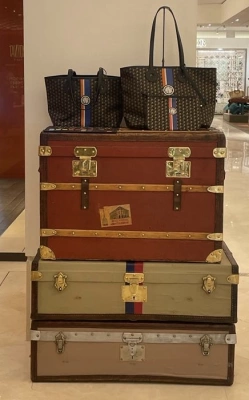
The history of luggage dates back to ancient times, when people used cloth bags or woven baskets to carry their belongings. However, these bags were often bulky and impractical to carry over long distances.
Over the centuries, luggage evolved to become more functional and adapted to travellers' needs. In the Middle Ages, nobles used wooden chests to carry their belongings when travelling. These chests were often heavy and required several people to carry them.
With the advent of rail and sea travel in the 19th century, luggage underwent a new evolution. Wooden trunks became popular, offering better protection for fragile objects. These trunks were often adorned with leather or canvas and were used by wealthy travellers.
In the 20th century, the arrival of commercial aviation led to a further transformation of luggage. Rigid metal or plastic suitcases became common, offering greater shock resistance and storage capacity. Wheels were also added to make transport easier.
Today, luggage is available in a wide variety of shapes, sizes and materials. Many models are available from Les Malletiers....
27 Jul 2023
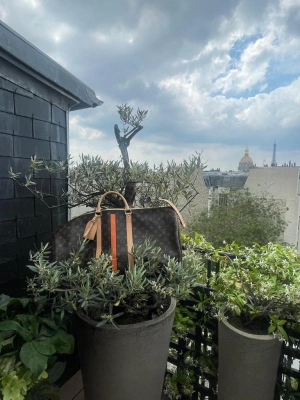
Louis Vuitton's Keepall travel bag, the 1930s... Cruises were fashionable, as were holidays in Deauville and Biarritz.
At that time, Louis Vuitton, renowned for its trunks, had to adapt to these new lifestyles. The result was the Keepall, a bag that "keeps everything". The Keepall is a flexible, zipped bag made from the famous monogrammed coated canvas. Its generous shape allows you to slip in a sports outfit and a few simple clothes for a weekend in the countryside.
An immediate success, the Keepall has never left the Louis Vuitton catalogue. It has been used in the trunk-maker's other collections, and given a new look by artists invited by Marc Jacobs, including Takashi Murakami and others.
Four sizes were chosen (45, 50, 55 and 60 cm), with the first three being the most popular because they could be carried in the cabin.
Seen over and over again on all the people for generations, the Keepall is now a timeless piece, which we keep, cherish and watch lovingly polish... Les Malletiers loves it too!
27 Jul 2023
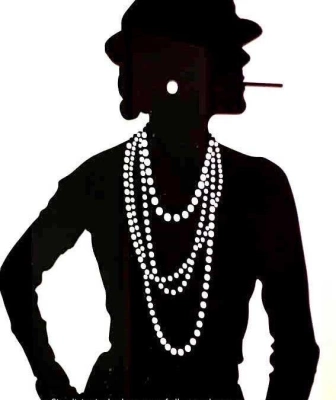
Coco Untold Stories, the early years...
She symbolizes French elegance. Gabrielle Chanel, born in Saumur in 1883, whose real name was Gabrielle Chasnel, was raised in an orphanage. At the age of 12, she was taken in with two of her sisters at Aubazine Abbey in Corrèze.
Her mother died in Brive-la-Gaillarde in 1895. When she was just 12, her father abandoned her a few months later, to the care of the nuns. He never returned. Gabrielle went to Aubazine to learn sewing. She stayed for 6 years. The abbey would remain a powerful source of inspiration for the codes of the House of Chanel...
Coco Chanel's taste for clean lines and her predilection for black, white and beige are perhaps linked to the sobriety of the abbey and its occupants...
Once she left Aubazine, she moved to Moulin. Gabrielle had to earn a living, so she sang in small shows in bars, famous for her rendition of
“Who has seen Coco on the Trocadero? Coco, a nickname that has stuck for posterity...
10 Aug 2023