








Are you sure you want to perform this action?
For Les Malletiers, the online marketplace for pre-owned luxury leather goods, a truly exceptional luxury bag cannot be judged by a single detail. When it comes to authenticating a bag, everything hinges on a holistic assessment—the feel of the leather, the accuracy of the proportions, the quality of the craftsmanship, the consistency of the markings, and, more subtly, the spirit of the brand from which it originates. This is precisely where the difference lies between a simple check and true expertise.
The high-end second-hand market has never attracted so much attention. It provides access to iconic pieces, discontinued lines, and finishes that are no longer available in stores. But this wealth comes with an obvious risk. The more desirable a model is, the more it is copied. And the more advanced the counterfeiting becomes, the more refined the examination must be.
## Why handbag authentication cannot be superficial
A contemporary fake no longer necessarily resembles a crude imitation. Some counterfeiters know how to reproduce a silhouette, a monogram, and sometimes even a serial number. What is missing, however, is the object’s deep-seated coherence. A luxury house does not manufacture a bag as a mere assemblage of external signs. It produces a whole governed by manufacturing codes, a language of materials, and a workshop logic.
This is why simplistic assumptions are often misleading. Claiming that a bag is authentic because it comes with a card, a dust bag, or an invoice has only limited value. These items can be lost, replaced, or counterfeited themselves. Conversely, the absence of original accessories does not necessarily invalidate an antique piece. For a knowledgeable collector, the right question is not: does it have the right papers? Rather, it is: does the object itself speak the exact language of its house?
## The criteria underlying serious bag authentication
The initial assessment is visual, but it must never remain superficial. Overall proportions matter greatly. An authentic bag possesses a specific presence, a deliberate structure. The line of a flap, the angle of a handle, the way the base rests flat—all of this stems from a deliberate design intent. A copy often mimics the appearance without capturing this precision.
### Material and Craftsmanship
Leather is often revealing, provided you know what to look for. Not all supple leathers are created equal, nor are all grain patterns. Some houses cultivate a firmness almost like that of a saddle, others favor a more fluid suppleness, and still others work with very specific glossy finishes. One must observe the texture, the density, the smell, but also the way the material ages. A beautiful vintage leather does not degrade like a mediocre material. It develops a patina, it takes on nuances, it tells the story of time.
Coated fabrics and technical textiles demand the same attention. On a monogrammed piece, the alignment of a pattern, its print depth, its exact color, and its relationship to the seams can reveal inconsistencies. Here again, it is never a single detail that matters, but their harmony.
### Finishes and Construction
A seam is not merely straight or not. It possesses a rhythm, a tension, and a regularity characteristic of quality craftsmanship. The thread—its color, thickness, and angle—deserves careful scrutiny. On certain pieces, a seam that is too perfect can even raise suspicion if it contradicts the house’s historical standard or the model’s supposed era.
The edge, any adhesive, the folded edges, the lining, and the internal structure are just as revealing. True luxury is often found where the untrained eye does not linger. A neglected interior, a poorly proportioned pocket, or inconsistent stiffness are sometimes enough to disrupt the overall harmony.
### Hardware and markings
Metal is a major point of inspection. Its weight, color, fastening system, and wear must correspond to the model and the period. Hardware that is too light, a gold tone that is excessively yellow, an imprecise engraving, or a clasp with a lack of smooth movement call for caution.
Interior markings also require careful scrutiny. A well-placed logo does not guarantee anything in itself. One must assess the typography, letter spacing, depth of the marking, and the exact wording used by the brand at a given date. Serial numbers, date codes, or hallmarks can be valuable clues, but they only make sense when considered as part of a comprehensive analysis. A good code on a bad bag does not make the bag authentic.
## The bag’s era matters as much as the brand
One of the most common pitfalls is examining a vintage piece using contemporary criteria. Yet brands evolve. They switch suppliers, adjust branding details, and modify linings, plaques, or dating methods. A model from the 1980s does not look like a recent production.
This historical dimension is essential for the discerning buyer. An older bag may exhibit legitimate peculiarities related to its period of manufacture. Conversely, a counterfeit sometimes gives itself away by mixing design elements from different eras. The expert eye recognizes these anachronisms. It knows that a detail plausible in isolation can become implausible when linked to a specific year, workshop, or line.
## The Limits of Authentication Based on Photos
It would be unrealistic to claim that all bag authentication can be performed with the same reliability remotely. Photographs are useful, sometimes decisive, but they have their limits. An image can obscure a texture, soften an angle, erase a repair, or alter a color. It shows, but it also interprets.
For this reason, opinions based on a few quick snapshots should be viewed with caution. For certain highly standardized pieces, photos may be sufficient to rule out an obvious counterfeit. For others, particularly rare, vintage, or restored models, a physical examination remains the surest method. Touching the material, examining the edges, inspecting the interior under various lights, and assessing the actual weight—all of this changes the assessment.
## What a Certificate Really Offers
In the world of pre-owned luxury goods, a certificate of authenticity is not merely an accompanying document. When issued by a true specialist, it embodies expertise, methodology, and accountability. Its value lies less in its form than in the authority of the issuer.
This is an essential distinction. The market is flooded with vague attestations, automatic validations, and commercial promises disguised as expertise. Yet a serious certificate must be the result of a rigorous examination, not a decorative prop. For a buyer, it builds trust. For a collector, it also contributes to the future traceability of the item.
At Les Malletiers, every item is presented as authentic and accompanied by a certificate written by Jérôme Lalande, Expert at the Paris Court of Appeal. In a market where assurance depends on the credibility of the examination, this standard profoundly changes the relationship to the purchase.
## Buying an authenticated bag does not mean buying without questions
Authentication protects against counterfeits, but it does not erase all the nuances of a purchase. A bag can be authentic and have been restored. It may have been recolored, had its stitching repaired, or had parts replaced. None of this is necessarily a deal-breaker, especially for an older model intended to be worn. However, these interventions must be understood and appreciated for what they are.
It all depends on your intention. An enthusiast looking for a beautiful, iconic bag for everyday use will not view a restoration the same way a collector seeking absolute integrity does. Similarly, a rare but more fragile model may appeal for its heritage value, while requiring more care than a recent piece. The right decision always stems from a balance between authenticity, condition, rarity, and intended use.
## Best Practices Before Buying
A savvy buyer does not stop at the desirability of a model or the supposed urgency of a deal. They examine the quality of the information provided, the accuracy of the description, the consistency of the photographs, and, above all, the identity of the seller. A reputable professional can clearly answer questions regarding the condition, the era, any restorations, and the basis for its authentication.
One must also accept that an abnormally low price is rarely a favor. In the very high-end market, rarity has its logic. An exceptional object sold without explanation, without a clear provenance, and without a credible guarantee calls for caution, not haste.
Authentication is therefore not an administrative formality placed at the end of the process. It is the very heart of trust. It allows you to purchase not just a name, but the genuine article—an object whose materials, construction, and history remain true to the house that created it. And when a bag is truly authenticated, it regains what no copy can ever fully replicate: presence.
Related articles

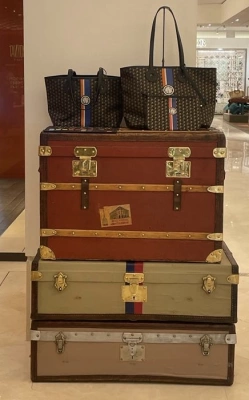
The history of luggage dates back to ancient times, when people used cloth bags or woven baskets to carry their belongings. However, these bags were often bulky and impractical to carry over long distances.
Over the centuries, luggage evolved to become more functional and adapted to travellers' needs. In the Middle Ages, nobles used wooden chests to carry their belongings when travelling. These chests were often heavy and required several people to carry them.
With the advent of rail and sea travel in the 19th century, luggage underwent a new evolution. Wooden trunks became popular, offering better protection for fragile objects. These trunks were often adorned with leather or canvas and were used by wealthy travellers.
In the 20th century, the arrival of commercial aviation led to a further transformation of luggage. Rigid metal or plastic suitcases became common, offering greater shock resistance and storage capacity. Wheels were also added to make transport easier.
Today, luggage is available in a wide variety of shapes, sizes and materials. Many models are available from Les Malletiers....
27 Jul 2023
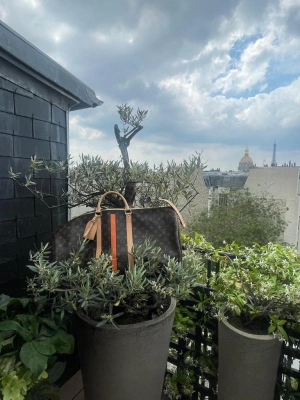
Louis Vuitton's Keepall travel bag, the 1930s... Cruises were fashionable, as were holidays in Deauville and Biarritz.
At that time, Louis Vuitton, renowned for its trunks, had to adapt to these new lifestyles. The result was the Keepall, a bag that "keeps everything". The Keepall is a flexible, zipped bag made from the famous monogrammed coated canvas. Its generous shape allows you to slip in a sports outfit and a few simple clothes for a weekend in the countryside.
An immediate success, the Keepall has never left the Louis Vuitton catalogue. It has been used in the trunk-maker's other collections, and given a new look by artists invited by Marc Jacobs, including Takashi Murakami and others.
Four sizes were chosen (45, 50, 55 and 60 cm), with the first three being the most popular because they could be carried in the cabin.
Seen over and over again on all the people for generations, the Keepall is now a timeless piece, which we keep, cherish and watch lovingly polish... Les Malletiers loves it too!
27 Jul 2023
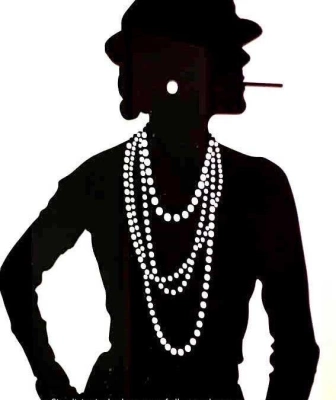
Coco Untold Stories, the early years...
She symbolizes French elegance. Gabrielle Chanel, born in Saumur in 1883, whose real name was Gabrielle Chasnel, was raised in an orphanage. At the age of 12, she was taken in with two of her sisters at Aubazine Abbey in Corrèze.
Her mother died in Brive-la-Gaillarde in 1895. When she was just 12, her father abandoned her a few months later, to the care of the nuns. He never returned. Gabrielle went to Aubazine to learn sewing. She stayed for 6 years. The abbey would remain a powerful source of inspiration for the codes of the House of Chanel...
Coco Chanel's taste for clean lines and her predilection for black, white and beige are perhaps linked to the sobriety of the abbey and its occupants...
Once she left Aubazine, she moved to Moulin. Gabrielle had to earn a living, so she sang in small shows in bars, famous for her rendition of
“Who has seen Coco on the Trocadero? Coco, a nickname that has stuck for posterity...
10 Aug 2023