








Are you sure you want to perform this action?
For Les Malletiers, the online retailer of pre-owned luxury leather goods: Between a Mademoiselle clasp and a double C, the choice is never just a matter of detail. Deciding between a Chanel 2.55 and a vintage Classic is, in reality, choosing between two interpretations of the House of Chanel: one more historic, the other more immediately iconic. For a discerning connoisseur, the question is not merely aesthetic. It concerns the design, the way it’s worn, the period of manufacture, the material, and of course the piece’s heritage value.
## Chanel 2.55 or Vintage Classic: two icons, two distinct styles
At first glance, the two bags share a similar silhouette. Same flap construction, same quilting, same leather-wrapped chain depending on the version, same central place in the Chanel vocabulary. Yet they do not convey exactly the same idea of luxury.
The 2.55 harks back to the original history of the model created in February 1955. Its rectangular “Mademoiselle” clasp, its more understated look, and its less ostentatious presence often appeal to collectors who prioritize heritage authenticity. The Classique, as it later established itself—notably under Karl Lagerfeld’s influence—introduced the rotating CC clasp and affirmed a visual signature that has become universal.
In other words, choosing one or the other comes down to knowing what you expect from a vintage Chanel. A connoisseur’s piece, almost private despite its legendary status, or a signature piece, immediately recognizable, with a more direct visual impact.
## What Really Sets the 2.55 Apart from the Classic
### The Clasp, the Bag’s Primary Language
The most obvious distinguishing feature remains the clasp. On a vintage 2.55, the Mademoiselle lock forms a clean, almost architectural line. It speaks of understated elegance. On a vintage Classique, the double C clasp immediately establishes the most recognizable aspect of Chanel’s iconography.
This difference profoundly alters the perception of the bag when worn. The 2.55 subtly complements a silhouette. The Classique, on the other hand, makes a stronger statement about an outfit. Neither is superior to the other. It all depends on one’s relationship with the house’s visible codes.
### The Chain and the Way It’s Worn
The historic 2.55 features a solid metal chain, without a woven leather strap. This construction gives it a cleaner look, sometimes a bit more like jewelry. The Classique more readily adopts the chain interwoven with leather, which has become one of its defining features.
Whether carried by hand or on the shoulder, the feel differs. The 2.55 may seem slightly more angular, more graphic. The Classic often offers a softer impression in its visual expression, though this varies by era, size, and leather.
### Structure, by Era
In the vintage market, one must be wary of generalizations. A Chanel from the 1980s does not have exactly the same presence as a piece from the 1990s or the early 2000s. Some vintage Classiques have a very pronounced structure, while others have a softer drape. Similarly, some older 2.55s retain remarkably sharp lines, while others reveal a softer patina.
This is where a close examination of the piece becomes essential. You’re not just buying a model name, but a unique combination of era, leather, finishes, and condition.
## Leather Makes All the Difference
In the world of vintage Chanel, leather is often more decisive than the theory behind two models. A vintage Classique in lambskin will convey a completely different feel than a 2.55 in grained calfskin, even when comparing two similar sizes.
Lambskin offers unparalleled visual depth. It delicately captures light and gives the quilting an almost supple texture. On the other hand, it shows wear more easily. For a collector who appreciates the beauty of a noble patina, this isn’t a flaw. For very frequent use, it’s a real consideration.
Caviar leather, being more durable, is better suited to an active daily life. It offers peace of mind, especially on a piece intended to be worn often. But it doesn’t quite deliver the same visual sensuality as vintage lambskin.
The right choice is therefore not an abstract one. Someone looking for a durable day bag will not approach the subject in the same way as a lover of evening pieces or a collector seeking an item representative of a specific period.
## Why Vintage Is More Appealing Than New
In the case of Chanel, vintage appeal isn’t just about price or availability. It’s about the materials, craftsmanship, and character. Many enthusiasts seek pieces whose texture, finish, depth of the leather, or the integrity of the quilting evoke a certain standard of excellence in craftsmanship.
A well-chosen vintage Chanel often possesses a more embodied presence than a contemporary model standardized by global market expectations. It features proportions that are sometimes more desirable, vintage finishes, and above all, that sense that an object has stood the test of time without losing its authority.
This is particularly true for the debate between the vintage Chanel 2.55 and the Classic. The comparison becomes fascinating precisely because the secondary market allows us to observe the nuances in craftsmanship over the decades, far beyond a simplified opposition between two names.
## Which model for which buyer profile?
### The vintage 2.55 for the collector’s eye
The 2.55 often appeals to those who prefer less ostentatious references. It suits a wardrobe where sophistication doesn’t depend on overly visible logos. It also pairs very well with understated, structured silhouettes, tailored suits, beautiful coats, and rich fabrics.
It can also appeal to a first-time Chanel buyer eager to enter the house’s universe through a more refined rather than spectacular gateway.
### The Vintage Classique: The Ultimate Icon
The Classique is designed for those seeking the quintessential Chanel—the one that immediately embodies the house’s legacy. Its double C, leather chain, and timeless appeal make it a remarkable companion for a wardrobe ranging from formal to refined everyday wear.
On the vintage market, a beautiful, well-proportioned Classic, with well-preserved leather and finishes consistent with its era, remains a constant object of desire. However, one must be particular about its condition, as the model’s popularity makes variations in quality particularly noticeable.
## The Question of Value and Desirability
Discussing value in the luxury vintage market requires distinguishing between several levels. There is market value, linked to demand. There is collector’s value, linked to rarity, the era, or specific characteristics. And there is utility value, which depends on the actual pleasure one derives from the piece.
The Classic enjoys very high liquidity on the secondary market thanks to its immediate recognition. The 2.55, on the other hand, may attract a more niche audience, but one that is often highly knowledgeable. This does not mean it is any less interesting—quite the contrary. Certain more understated pieces age better in the eyes of connoisseurs because they escape the most visible trends.
In both cases, provenance, authenticity, consistency of details, and the condition of the corners, lining, padding, and hardware remain decisive factors. In this segment, trust is not a matter of comfort. It determines everything.
## What to Look for Before Buying
Before deciding between a 2.55 and a vintage Classic, you must look beyond the bag’s name. The quality of the leather, the evenness of the patina, the sharpness of the topstitching, any sagging of the flap, the condition of the chain, and the overall balance of the volume reveal more than a simple label.
You must also accept that a very subtle imperfection is sometimes preferable to an overly visible restoration. When it comes to vintage pieces, a slight sign of wear consistent with the item’s age is often better than an intervention that compromises its integrity.
For a major purchase, expertise remains decisive. In a market saturated with reproductions and reworkings, rigorous authentication protects not only the buyer but also the cultural and heritage value of the object. It is precisely this level of rigor that underpins the value of a specialized selection, such as that championed by Les Malletiers.
## So, Chanel 2.55 or Vintage Classic?
If you appreciate understated signatures, historical authenticity, and pieces recognized by connoisseurs, the vintage 2.55 offers a rare sense of authenticity. If you’re seeking the ultimate icon—one that embodies Chanel at a glance and complements nearly any occasion—the vintage Classic is the natural choice.
The right choice, therefore, is not the one dictated by the market, but the one that suits your eye, your use, and your way of experiencing luxury. A great bag is not just a successful purchase. It is a piece whose presence continues to feel obvious long after the transaction.
Related articles

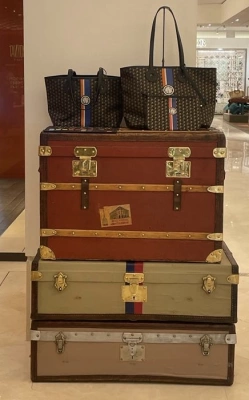
The history of luggage dates back to ancient times, when people used cloth bags or woven baskets to carry their belongings. However, these bags were often bulky and impractical to carry over long distances.
Over the centuries, luggage evolved to become more functional and adapted to travellers' needs. In the Middle Ages, nobles used wooden chests to carry their belongings when travelling. These chests were often heavy and required several people to carry them.
With the advent of rail and sea travel in the 19th century, luggage underwent a new evolution. Wooden trunks became popular, offering better protection for fragile objects. These trunks were often adorned with leather or canvas and were used by wealthy travellers.
In the 20th century, the arrival of commercial aviation led to a further transformation of luggage. Rigid metal or plastic suitcases became common, offering greater shock resistance and storage capacity. Wheels were also added to make transport easier.
Today, luggage is available in a wide variety of shapes, sizes and materials. Many models are available from Les Malletiers....
27 Jul 2023
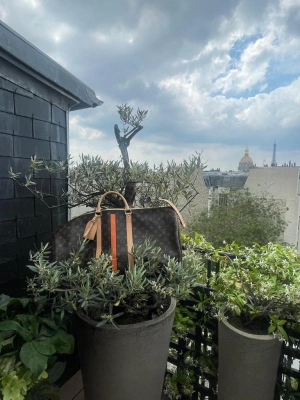
Louis Vuitton's Keepall travel bag, the 1930s... Cruises were fashionable, as were holidays in Deauville and Biarritz.
At that time, Louis Vuitton, renowned for its trunks, had to adapt to these new lifestyles. The result was the Keepall, a bag that "keeps everything". The Keepall is a flexible, zipped bag made from the famous monogrammed coated canvas. Its generous shape allows you to slip in a sports outfit and a few simple clothes for a weekend in the countryside.
An immediate success, the Keepall has never left the Louis Vuitton catalogue. It has been used in the trunk-maker's other collections, and given a new look by artists invited by Marc Jacobs, including Takashi Murakami and others.
Four sizes were chosen (45, 50, 55 and 60 cm), with the first three being the most popular because they could be carried in the cabin.
Seen over and over again on all the people for generations, the Keepall is now a timeless piece, which we keep, cherish and watch lovingly polish... Les Malletiers loves it too!
27 Jul 2023
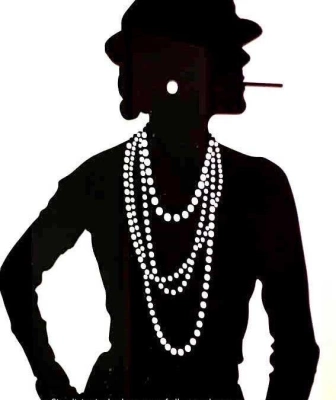
Coco Untold Stories, the early years...
She symbolizes French elegance. Gabrielle Chanel, born in Saumur in 1883, whose real name was Gabrielle Chasnel, was raised in an orphanage. At the age of 12, she was taken in with two of her sisters at Aubazine Abbey in Corrèze.
Her mother died in Brive-la-Gaillarde in 1895. When she was just 12, her father abandoned her a few months later, to the care of the nuns. He never returned. Gabrielle went to Aubazine to learn sewing. She stayed for 6 years. The abbey would remain a powerful source of inspiration for the codes of the House of Chanel...
Coco Chanel's taste for clean lines and her predilection for black, white and beige are perhaps linked to the sobriety of the abbey and its occupants...
Once she left Aubazine, she moved to Moulin. Gabrielle had to earn a living, so she sang in small shows in bars, famous for her rendition of
“Who has seen Coco on the Trocadero? Coco, a nickname that has stuck for posterity...
10 Aug 2023