








Are you sure you want to perform this action?
With Les Malletiers, the luxury pre-owned marketplace: A coveted bag finally appears. The leather is just right, the design is perfect, and the price seems reasonable. Yet, in the world of pre-owned luxury, appearance alone is never the deciding factor. Buying a luxury bag certified as authentic means purchasing a piece whose legitimacy has been rigorously established, not merely a promise made in the context of an enticing ad.
The issue goes far beyond the fear of counterfeits. It touches on the object’s true value, its legacy, its future desirability, and the trust one can place in the seller. In a market where copies have become more sophisticated, the notion of authenticity is no longer merely a matter of psychological comfort. It is the very condition for a fair purchase.
## Why a luxury bag certified as authentic is worth more than one simply “guaranteed”
The vocabulary of the secondary market deserves close scrutiny. Between an item that is “inspected,” “verified,” “compliant,” “authenticated,” or “sold with a certificate,” the nuances are not trivial. They reflect the seller’s level of commitment.
A bag presented as authentic without a clear framework of expertise often relies on a commercial declaration. Conversely, a luxury bag certified as authentic is part of a more rigorous process, based on an examination of materials, construction, markings, finishes, production consistency, and, where possible, its provenance. This distinction has concrete consequences. It affects the item’s resale value if you wish to sell it, its place within a collection, and your peace of mind at the time of purchase.
In the world of heritage fashion houses, authenticity can never be treated as a mere decorative feature. A Kelly, a Timeless, a vintage Speedy, a Lady Dior, or a Goyard bag exist not merely through their silhouette. They exist through a combination of craftsmanship, workshop details, and historical codes that the trained eye can discern.
## What Authenticity Certification Really Entails
Certification is not a mere formality. It derives its value solely from the authority of the issuer and the rigor of the method employed. This is where many savvy buyers distinguish between a generalist platform and a specialized resale house.
Rigorous authentication relies on multiple levels of analysis. The first is physical. The grain of the leather, how it behaves in the light, the suppleness or structural integrity, the quality of the stitching, and the precision of the angles and edges immediately speak to the expert. The second level is technical. Hardware, engravings, zippers, screws, linings, serial numbers, production dates, internal codes, or signatures must correspond to standards specific to each brand and each period.
The third level is historical. A model must be consistent with its era. A typeface, a metal color, a handle assembly, a closure method, or an interior construction can be enough to reveal an anomaly. Contemporary fakes often mimic the general appearance. They more readily fail in terms of overall consistency.
This is why a certificate only makes sense if it is the culmination of an expert appraisal, not a substitute for it. At Les Malletiers, this requirement takes a particularly rare form: each piece is accompanied by a certificate of authenticity drafted by Jérôme Lalande, an expert appointed by the Paris Court of Appeal. For a knowledgeable collector, this certification profoundly changes the nature of the trust placed in the item.
## How to Recognize a Credible Offer on the Secondary Market
An experienced buyer knows that a good deal isn’t always a good purchase. When a bag is offered on the secondary market, several factors must be examined together, not in isolation.
The quality of the photographs is a key indicator. A reputable dealer shows the details that matter: corners, handles, stitching, interior, stamping, hardware, and any signs of wear. Images that are overly flattering or too limited are rarely a good sign. In the pre-owned luxury market, visual transparency is part of the elegance.
The description must also be precise. It is not enough to simply state a brand and model. The estimated year or period, material, color, size, exact condition, included accessories, and any restorations are all important. Vague wording primarily protects the seller, rarely the buyer.
Finally, the price requires discernment. An abnormally low price is not only suspicious in terms of authenticity. It may also indicate a major defect, significant alteration, or partial reconstruction of the item. Conversely, a high price is never proof in itself. For certain iconic models, the market commands a premium for rarity, color, material, or the desirability of the era. Everything therefore depends on the balance between authenticity, condition, and collectible value.
## The condition of an authentic bag: a distinct but inseparable issue
One point deserves to be clearly reiterated: an authentic bag is not necessarily a flawless bag. Authenticity indicates origin. It does not, on its own, indicate the degree of preservation.
In the luxury second-hand market, condition must be assessed with subtlety. A light patina on Box leather, a moderate softening of coated canvas, or a few micro-scratches on gold hardware can be perfectly acceptable—and sometimes even desirable—for collectors of vintage pieces. On the other hand, significant loss of structure, a lingering odor, excessively worn corners, a weakened lining, or visible repairs diminish both the practical value and the heritage value.
It all comes down to your purchasing intent. If you’re looking for a collector’s item, you may be willing to accept signs of age as long as the bag retains its historical integrity. If you’re seeking an everyday companion, you’ll pay closer attention to comfort, the durability of the handles, the proper functioning of the closures, and the overall condition. The right purchase, therefore, isn’t the most perfect bag in absolute terms, but the one whose condition aligns with your intended use.
## Certified Authentic Luxury Bags: A Choice of Taste, but Also of Value
We often speak of desire when it comes to luxury leather goods. We are less inclined to speak of value, as if that word might introduce a logic that is too cold. This is a mistake. In heritage luxury, taste and value are not opposed. They complement each other.
A certified authentic luxury bag retains intellectual and commercial traceability far superior to that of a poorly documented item. This matters if you’re considering a future resale, passing it on, or simply the thoughtful preservation of your wardrobe. A properly authenticated piece inspires confidence in the market. It presents itself better, is better understood, and circulates more easily.
Of course, not all bags follow the same trajectory. Established icons, rare editions, certain sought-after leathers, specific house colors, or particular production periods hold their value more strongly. Others are more about personal pleasure than heritage value. There is nothing trivial about the latter, provided you embrace it. Discernment lies precisely in knowing whether one is buying a fashion item, a functional item, or a collector’s item.
## Why Human Expertise Remains Decisive
Technological tools have improved certain inspection practices, but they cannot replace the expertise of a professional familiar with manufacturing variations, production changes, and the unique characteristics of each brand. Vintage luxury, in particular, defies overly mechanical criteria.
A brand may have modified a lining over a short period, updated a logo, switched clasp suppliers, or adapted a construction method for a specific workshop. The expert does not simply apply a checklist. They interpret consistency. This element of judgment, shaped by experience, is invaluable, especially when dealing with sophisticated fakes and less well-documented vintage models.
This is also why a luxury purchase deserves a sales environment that matches its stature. Trust cannot be decreed. It is built through the quality of the selection, the accuracy of the information, and the level of responsibility taken for each piece.
## Buy Less, Buy Better
The secondhand market has matured. Today’s buyer is no longer simply looking for a lower price than that of a new item. They often seek a rarer, more unique piece—sometimes one that cannot be found in stores—with that extra depth that only a heritage house can offer over time.
In this context, choosing a bag certified as authentic amounts to embracing a more discerning approach to shopping. We prioritize the right object over the merely visible one. We prefer proof over approximation, the culture of the piece over the excitement of an impulse buy.
A beautiful bag is not just one that catches the eye. It is one that you can look at for a long time without anything escaping your notice—neither its material, nor its history, nor its authenticity.
Related articles

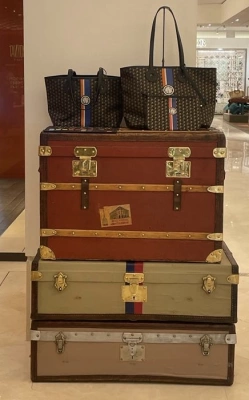
The history of luggage dates back to ancient times, when people used cloth bags or woven baskets to carry their belongings. However, these bags were often bulky and impractical to carry over long distances.
Over the centuries, luggage evolved to become more functional and adapted to travellers' needs. In the Middle Ages, nobles used wooden chests to carry their belongings when travelling. These chests were often heavy and required several people to carry them.
With the advent of rail and sea travel in the 19th century, luggage underwent a new evolution. Wooden trunks became popular, offering better protection for fragile objects. These trunks were often adorned with leather or canvas and were used by wealthy travellers.
In the 20th century, the arrival of commercial aviation led to a further transformation of luggage. Rigid metal or plastic suitcases became common, offering greater shock resistance and storage capacity. Wheels were also added to make transport easier.
Today, luggage is available in a wide variety of shapes, sizes and materials. Many models are available from Les Malletiers....
27 Jul 2023
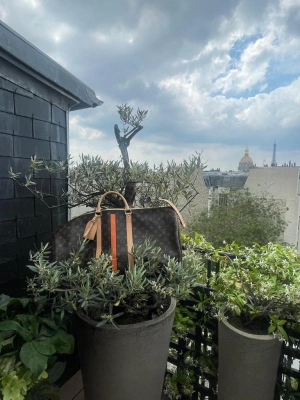
Louis Vuitton's Keepall travel bag, the 1930s... Cruises were fashionable, as were holidays in Deauville and Biarritz.
At that time, Louis Vuitton, renowned for its trunks, had to adapt to these new lifestyles. The result was the Keepall, a bag that "keeps everything". The Keepall is a flexible, zipped bag made from the famous monogrammed coated canvas. Its generous shape allows you to slip in a sports outfit and a few simple clothes for a weekend in the countryside.
An immediate success, the Keepall has never left the Louis Vuitton catalogue. It has been used in the trunk-maker's other collections, and given a new look by artists invited by Marc Jacobs, including Takashi Murakami and others.
Four sizes were chosen (45, 50, 55 and 60 cm), with the first three being the most popular because they could be carried in the cabin.
Seen over and over again on all the people for generations, the Keepall is now a timeless piece, which we keep, cherish and watch lovingly polish... Les Malletiers loves it too!
27 Jul 2023
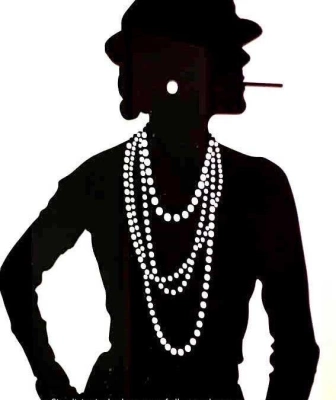
Coco Untold Stories, the early years...
She symbolizes French elegance. Gabrielle Chanel, born in Saumur in 1883, whose real name was Gabrielle Chasnel, was raised in an orphanage. At the age of 12, she was taken in with two of her sisters at Aubazine Abbey in Corrèze.
Her mother died in Brive-la-Gaillarde in 1895. When she was just 12, her father abandoned her a few months later, to the care of the nuns. He never returned. Gabrielle went to Aubazine to learn sewing. She stayed for 6 years. The abbey would remain a powerful source of inspiration for the codes of the House of Chanel...
Coco Chanel's taste for clean lines and her predilection for black, white and beige are perhaps linked to the sobriety of the abbey and its occupants...
Once she left Aubazine, she moved to Moulin. Gabrielle had to earn a living, so she sang in small shows in bars, famous for her rendition of
“Who has seen Coco on the Trocadero? Coco, a nickname that has stuck for posterity...
10 Aug 2023