








Are you sure you want to perform this action?
From Les malletiers, the luxury secondhand leather goods site: Some purchases are made on a whim, while others are made with a genuine sense of passing on a legacy. The question of whether to choose a classic Chanel or a reissue clearly falls into the second category. Because between these two icons from the House of Chanel, the choice isn’t just a matter of aesthetic preference: it involves a relationship to style, history, and, often, the collection.
To the untrained eye, the two bags may seem similar. Both draw on Chanel’s fundamental design language: the quilted pattern, the chain, the flap format, that instantly recognizable allure that has spanned decades without losing its power. Yet the Classic and the Reissue tell two distinct stories. The former embodies the vision that has become a universal symbol. The second offers a more refined interpretation, one that remains truer to the original spirit of the 2.55 created by Gabrielle Chanel in February 1955.
Choosing between the two, therefore, means deciding between a highly recognizable icon and a more subtle piece, often prized by connoisseurs.
## Chanel Classique or Reissue: A Difference in History Above All
The Classic Chanel, often called the Classic Flap, is closely associated with Karl Lagerfeld’s reinterpretation. It was he who established several design elements that the general public now recognizes as Chanel’s definitive signatures, notably the interlocking double C clasp. Over the years, this bag has become one of the most powerful symbols of contemporary fashion.
The Reissue, on the other hand, reflects a different intention. Launched to reinterpret the original 2.55, it seeks to recreate details closer to Mademoiselle Chanel’s original design. Its very name conveys this desire for a reissue. It is not merely a derivative of the Classique, but a tribute to a historic model.
This distinction is essential. The Classic speaks to image, immediate recognition, and visual status. The Reissue speaks more to the house’s heritage, fidelity to the original codes, and a more understated elegance.
## The details that make all the difference
When choosing between the Classic and the Reissue, it is often the finishing touches that make the difference.
The clasp, first and foremost, profoundly changes the bag’s personality. The Classic features the famous double C, more striking in its message and more immediately recognizable. The Reissue adopts the so-called Mademoiselle clasp—rectangular, more discreet, almost austere at first glance. It’s a detail that many collectors appreciate precisely for this restraint.
The chain is another key distinguishing feature. On the Classic, it is interwoven with leather, which reinforces the model’s dressy appeal. On the Reissue, the all-metal “jewelry” chain is more understated, more utilitarian in spirit, with a very distinctive vintage look.
The leather and its construction also influence perception. The Classique comes in a variety of leathers and finishes, often with a more structured and formal look. The Reissue, especially in certain versions made of aged leather, exudes a suppleness and patina that appeal to lovers of pieces that are less sleek and less ostentatious.
Even the way the bag complements an outfit isn’t exactly the same. The Classique frames an outfit more distinctly. The Reissue complements it with a more nonchalant flair.
### The Classique, for a more assertive look
The Chanel Classique has that rare ability to instantly define a silhouette. Worn with a suit, a straight-cut coat, or even very simple denim, it lends a sense of visual authority. Its signature power is considerable.
This is also what makes it so strong in the market: it is universally desired, recognized, and understood. For a first Chanel purchase, many naturally gravitate toward it. It reassures, it embodies, it endures.
### The Reissue, for a more discerning eye
The Reissue often appeals more subtly. It doesn’t seek to be recognized from a distance. It assumes a certain appreciation for detail. Those who choose it generally love fashion for the history it preserves, not just for what it displays.
Its charm lies in this less expected elegance. It may seem more exclusive, but this relative discretion is precisely what makes it appealing. In a collector’s wardrobe, it adds a different kind of depth.
## Lifestyle, use, comfort: the right choice is up to you
There is no universal answer to the question of whether to choose the Classic or the Reissue. The best choice depends first and foremost on how you actually intend to use it.
If you’re looking for a bag for occasions when your outfit must be impeccably put together, almost architecturally precise, the Classic is often the obvious choice. It pairs beautifully with formal settings, important meetings, dinners, and occasions where the bag must play a central role in your look.
If, on the other hand, you prefer pieces that can navigate the day with more flexibility, the Reissue has strong merits. Its slightly more casual vibe allows for great ease, even in less formal wardrobes. It works particularly well for those who appreciate luxury without ostentation.
Wearing comfort is also worth considering. Some people prefer the Classic’s chain for its softer feel, thanks to the interwoven leather. Others prefer the boldness of the metal on the Reissue and its more raw character. This point may seem secondary on paper, but it becomes very real in practice.
## Value, Desirability, and the Secondhand Market
In the secondhand market, the Chanel Classique enjoys exceptionally stable demand. Its reputation, stylistic clarity, and place in the collective imagination make it a lasting benchmark. It appeals to both new buyers and seasoned collectors.
The Reissue operates on a slightly different level. It may spark more selective but often deeply passionate interest. Its audience is sometimes smaller but particularly knowledgeable. For this reason, certain versions, leathers, or sizes resonate remarkably well with enthusiasts of more niche pieces.
One must therefore avoid an overly simplistic view of value. The Classique is often the obvious choice for heritage. The Reissue may be the choice of uniqueness, especially for those who appreciate less ubiquitous models.
In both cases, condition, leather, size, production period, and of course authenticity are decisive factors. In the world of Chanel, even more so than for many other houses, the accuracy of the appraisal determines the trust, desirability, and longevity of the purchase.
## Should you choose the most iconic or the most personal?
This is often where the real decision is made.
Choosing the Classic means embracing an icon in its most obvious form. There is something self-assured, almost ceremonial, about this gesture. You are acquiring a powerful symbol of fashion heritage, a piece whose significance is instantly understood.
Choosing the Reissue is sometimes a way of asserting a more personal taste. Not a better taste, but a less expected one. There is a form of fidelity to the original spirit, as well as a more intimate relationship with the object.
For some collectors, the right approach is actually not to pit the two against each other. The Classic serves as a central reference point, the Reissue as a deeper exploration. One lays the foundation; the other enriches the dialogue.
## How to choose between a classic Chanel and a reissue
If you’re buying your first Chanel and want a piece that’s instantly iconic, the Classic is often the most natural choice. If you’re already familiar with the house’s codes and are looking for a bag that’s more nuanced and historically evocative, the Reissue deserves special attention.
Ask yourself a simple question: do you want your bag to be recognized at first glance, or loved more upon closer inspection? This distinction is not trivial. It often reveals the right answer.
It’s also helpful to look at your actual wardrobe rather than your dream wardrobe. A highly structured, urban, clean wardrobe is a perfect match for the Classic. A more textured, instinctive wardrobe—sometimes with a slightly vintage feel—often pairs better with the Reissue.
At Les Malletiers, this distinction becomes clear when examining the pieces themselves. Two bags with similar names can evoke very different emotions depending on their leather, patina, presence, and era.
Ultimately, a large Chanel bag is never chosen solely based on a photograph or reputation. It is chosen when a certain vision of style, history, and oneself suddenly becomes crystal clear. And when that clarity emerges, it is no longer really a matter of hesitating between two models, but of recognizing the one that was already waiting for you.
Related articles

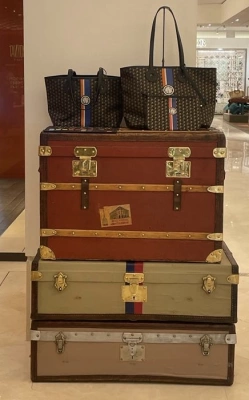
The history of luggage dates back to ancient times, when people used cloth bags or woven baskets to carry their belongings. However, these bags were often bulky and impractical to carry over long distances.
Over the centuries, luggage evolved to become more functional and adapted to travellers' needs. In the Middle Ages, nobles used wooden chests to carry their belongings when travelling. These chests were often heavy and required several people to carry them.
With the advent of rail and sea travel in the 19th century, luggage underwent a new evolution. Wooden trunks became popular, offering better protection for fragile objects. These trunks were often adorned with leather or canvas and were used by wealthy travellers.
In the 20th century, the arrival of commercial aviation led to a further transformation of luggage. Rigid metal or plastic suitcases became common, offering greater shock resistance and storage capacity. Wheels were also added to make transport easier.
Today, luggage is available in a wide variety of shapes, sizes and materials. Many models are available from Les Malletiers....
27 Jul 2023
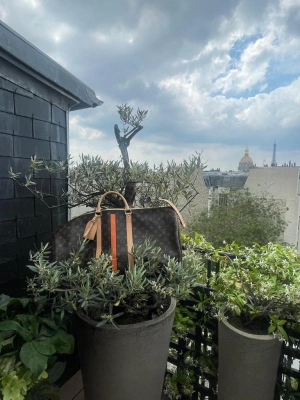
Louis Vuitton's Keepall travel bag, the 1930s... Cruises were fashionable, as were holidays in Deauville and Biarritz.
At that time, Louis Vuitton, renowned for its trunks, had to adapt to these new lifestyles. The result was the Keepall, a bag that "keeps everything". The Keepall is a flexible, zipped bag made from the famous monogrammed coated canvas. Its generous shape allows you to slip in a sports outfit and a few simple clothes for a weekend in the countryside.
An immediate success, the Keepall has never left the Louis Vuitton catalogue. It has been used in the trunk-maker's other collections, and given a new look by artists invited by Marc Jacobs, including Takashi Murakami and others.
Four sizes were chosen (45, 50, 55 and 60 cm), with the first three being the most popular because they could be carried in the cabin.
Seen over and over again on all the people for generations, the Keepall is now a timeless piece, which we keep, cherish and watch lovingly polish... Les Malletiers loves it too!
27 Jul 2023
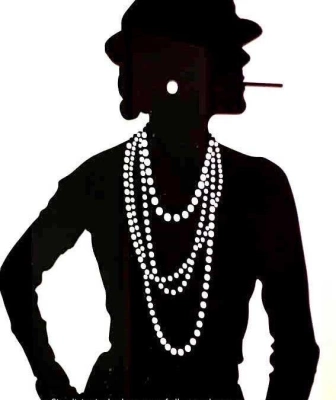
Coco Untold Stories, the early years...
She symbolizes French elegance. Gabrielle Chanel, born in Saumur in 1883, whose real name was Gabrielle Chasnel, was raised in an orphanage. At the age of 12, she was taken in with two of her sisters at Aubazine Abbey in Corrèze.
Her mother died in Brive-la-Gaillarde in 1895. When she was just 12, her father abandoned her a few months later, to the care of the nuns. He never returned. Gabrielle went to Aubazine to learn sewing. She stayed for 6 years. The abbey would remain a powerful source of inspiration for the codes of the House of Chanel...
Coco Chanel's taste for clean lines and her predilection for black, white and beige are perhaps linked to the sobriety of the abbey and its occupants...
Once she left Aubazine, she moved to Moulin. Gabrielle had to earn a living, so she sang in small shows in bars, famous for her rendition of
“Who has seen Coco on the Trocadero? Coco, a nickname that has stuck for posterity...
10 Aug 2023