








Are you sure you want to perform this action?
A collector's bag isn't chosen like just any accessory. It reflects a certain aesthetic, a fashion sensibility, and often involves a significant investment. A good guide to buying a collector's bag, therefore, isn't about simply pointing out a few desirable models, but about learning to recognize what gives a piece its lasting value—beyond market hype, fleeting trends, and empty promises.
Some bags stand out immediately. A silhouette that has become iconic, leather that ages gracefully, craftsmanship that withstands the test of time without losing its shape. Others appeal primarily because they are rare or currently in high demand. The difference between these two categories is crucial. The discerning collector doesn’t just buy a name. They buy a harmony between the brand, the era, the quality of craftsmanship, the condition, and genuine market demand.
## What Truly Makes a Collector’s Bag
The term “collector’s item” is widely used, sometimes to the point of losing its meaning. In reality, a bag becomes a collector’s item when it combines several factors at once. It may be an iconic model from a house, a limited edition, a discontinued model that is now hard to find, or a piece representative of a defining moment in the history of luxury.
At Hermès, Chanel, Louis Vuitton, Dior, Goyard, or Moynat, certain lines do not owe their status to mere scarcity. They embody a vision of craftsmanship. The proportions, construction, choice of materials, and quality of finishes all contribute to their enduring aesthetic appeal. A collector’s bag isn’t just hard to come by. It continues to look just right, year after year.
This nuance matters. A piece in high demand today may lose its appeal tomorrow if its appeal is based primarily on a trend. Conversely, a model with less media exposure may prove far more desirable to a discerning collector because it bears a strong signature, features remarkable craftsmanship, or has a specific history.
## Collector's Bag Buying Guide - Start with the House
Before even examining a specific piece, you must consider the house that designed it. Not all luxury brands carry the same heritage weight on the secondary market. Some models enjoy consistent demand, while others appeal to a more niche but highly loyal clientele.
Buying a Kelly, a Birkin, a Timeless, a Lady Dior, or a Louis Vuitton soft trunk involves a different logic than acquiring a more understated model from Prada or Gucci. The former often involves an established icon with strong market recognition. The latter can open up more subtle opportunities, particularly when quality is high and supply is limited. It’s not a matter of “good” purchases on one side and “bad” ones on the other. Above all, there are different buyer profiles.
If you’re looking for a heritage piece, prioritize models whose formal identity has already stood the test of time. If you’re buying with the eye of a pure collector, the appeal may also lie in a rare variation, a unique color, a special order, or an older production rarely seen on the market.
### The Icon Isn’t Always the Best Choice
The most famous model isn’t automatically the most relevant. Its entry price can be very high, and its relative availability may be wider than one might imagine on certain platforms. Conversely, a less-discussed bag that’s hard to find in pristine condition can offer a much more compelling appeal.
It all depends on your intention. Do you want an absolute benchmark of luxury, immediately recognizable, or a more sophisticated piece that speaks more to connoisseurs than to the general public?
## Authenticity Is Never a Minor Detail
In the luxury pre-owned market, the decisive factor remains authenticity. It is the foundation of all value. Without it, rarity means nothing, the market value becomes fictitious, and the joy of ownership is immediately undermined.
An experienced buyer is not satisfied with mere reassurances. They expect clear, well-documented, and compelling expertise. Construction details, material consistency, markings, hardware, stitching, typography, manufacturing codes, and natural wear must all come together to form a credible whole. This assessment requires specific knowledge, especially regarding the most frequently counterfeited brands.
This is precisely where rigorous selection makes all the difference. At Les Malletiers, every piece is presented as authentic and accompanied by a certificate of authenticity drafted by Jérôme Lalande, an expert appointed by the Paris Court of Appeal. For a buyer of rare pieces, this level of assurance is not merely a comfort factor. It is a prerequisite for trust.
## Condition Changes Everything
Two bags that appear identical on paper can vary considerably in value depending on their condition. Dried-out leather, repaired corners, heavily pitted hardware, or a sagging structure profoundly alter a piece’s desirability, even if the model remains sought-after.
You must learn to look beyond the labels “very good condition” or “good condition.” The overall condition matters just as much as localized flaws. A collector’s item can withstand patina—sometimes it even calls for it. On the other hand, severe deterioration, clumsy restoration, or alterations that don’t align with the original spirit can affect both its current appeal and its future potential.
### Noble patina or detrimental wear
The line is fine. A supple yet sound monogram canvas, slightly marked box leather, or an elegantly darkened handle can retain all their charm. On the other hand, visibly re-sewn seams, uneven varnish, a replaced lining, or metal parts changed without traceability call for greater caution.
The best approach is to ask for an honest assessment of the actual condition, not a flattering sales pitch. The more valuable the piece, the more essential this precision becomes.
## Rarity, limited edition, discontinuation—three distinct concepts
Not all rare bags are rare for the same reasons. Some were produced in limited quantities. Others have been discontinued and are becoming difficult to find in good condition. Still others are rare because they appealed only to a narrow circle at the time of their release, before being rediscovered later.
This distinction affects value. A highly publicized limited edition may see its price rise quickly and then stabilize. A discontinued model with a strong design may gain desirability more slowly, but more steadily. As for atypical pieces from less-studied eras, they often attract the most discerning collectors.
A serious guide to buying collector’s bags must therefore encourage a long-term perspective. True rarity is not merely quantitative. It is also cultural.
## Should you buy to wear, keep, or pass on?
The answer changes how you buy. If you plan to wear the bag often, the condition should be excellent but not necessarily perfect, and the choice of material becomes key. Some leathers withstand wear better, while certain designs age more gracefully.
If you’re buying to keep, you can aim for a rarer piece—less versatile, but more meaningful. The presence of original accessories, a dust bag, a box, or even an old invoice may then carry more weight. If you’re thinking about passing it on, it’s best to prioritize a recognizable, timeless model from a house whose history remains firmly rooted in the heritage of luxury.
This isn’t a hierarchy. It’s a matter of alignment. A very good purchase is, first and foremost, the right purchase for its owner.
## Collector’s Bag Buying Guide – The Most Costly Mistakes
The most common mistake is buying too quickly under the influence of an apparent opportunity. A price below market value is never enough to qualify as a good deal. It may mask doubts about authenticity, poor condition, extensive repairs, or a model with low actual demand.
The other mistake is relying solely on the market value. The potential resale value is a legitimate concern for many buyers, but it does not replace taste or knowledge. A sought-after bag in an undesirable configuration will not perform as well as the same model in a more prized leather, size, or color.
Finally, be wary of overly abstract purchases. A collector’s item is judged on its pedigree, certainly, but also on its presence. Its balance, feel, density, and construction often tell a story beyond its mere technical specifications.
## Buy with discernment, not haste
The best purchase isn’t always the most spectacular. It’s the one that combines undeniable authenticity, excellent condition, a reasonable price, and lasting emotional appeal. In a market where supply seems abundant but truly beautiful pieces are actually few and far between, discernment remains the true luxury.
If a specific model has been on your mind for a long time, it is sometimes better to wait for the perfect piece rather than settle for a less-than-ideal version. And if you are looking for a rare or discontinued model that is hard to find, an expert’s eye can save you precious time. A collector’s bag deserves better than an impulse purchase. It deserves to be chosen as one would choose a heritage piece—with passion, yes, but also with method.
Related articles

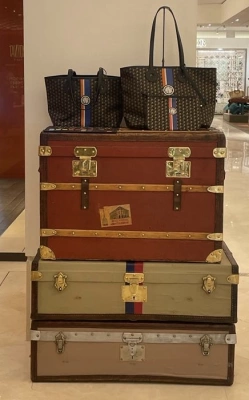
The history of luggage dates back to ancient times, when people used cloth bags or woven baskets to carry their belongings. However, these bags were often bulky and impractical to carry over long distances.
Over the centuries, luggage evolved to become more functional and adapted to travellers' needs. In the Middle Ages, nobles used wooden chests to carry their belongings when travelling. These chests were often heavy and required several people to carry them.
With the advent of rail and sea travel in the 19th century, luggage underwent a new evolution. Wooden trunks became popular, offering better protection for fragile objects. These trunks were often adorned with leather or canvas and were used by wealthy travellers.
In the 20th century, the arrival of commercial aviation led to a further transformation of luggage. Rigid metal or plastic suitcases became common, offering greater shock resistance and storage capacity. Wheels were also added to make transport easier.
Today, luggage is available in a wide variety of shapes, sizes and materials. Many models are available from Les Malletiers....
27 Jul 2023
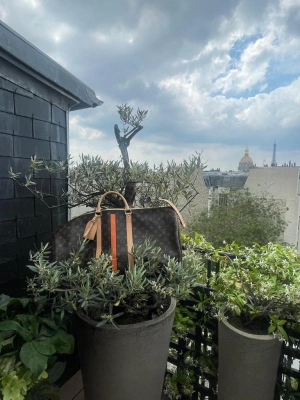
Louis Vuitton's Keepall travel bag, the 1930s... Cruises were fashionable, as were holidays in Deauville and Biarritz.
At that time, Louis Vuitton, renowned for its trunks, had to adapt to these new lifestyles. The result was the Keepall, a bag that "keeps everything". The Keepall is a flexible, zipped bag made from the famous monogrammed coated canvas. Its generous shape allows you to slip in a sports outfit and a few simple clothes for a weekend in the countryside.
An immediate success, the Keepall has never left the Louis Vuitton catalogue. It has been used in the trunk-maker's other collections, and given a new look by artists invited by Marc Jacobs, including Takashi Murakami and others.
Four sizes were chosen (45, 50, 55 and 60 cm), with the first three being the most popular because they could be carried in the cabin.
Seen over and over again on all the people for generations, the Keepall is now a timeless piece, which we keep, cherish and watch lovingly polish... Les Malletiers loves it too!
27 Jul 2023
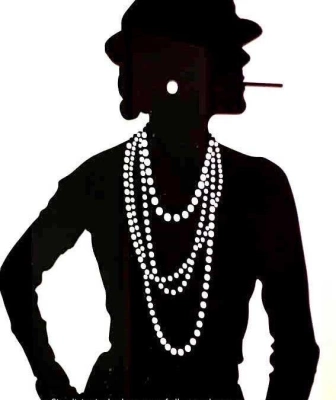
Coco Untold Stories, the early years...
She symbolizes French elegance. Gabrielle Chanel, born in Saumur in 1883, whose real name was Gabrielle Chasnel, was raised in an orphanage. At the age of 12, she was taken in with two of her sisters at Aubazine Abbey in Corrèze.
Her mother died in Brive-la-Gaillarde in 1895. When she was just 12, her father abandoned her a few months later, to the care of the nuns. He never returned. Gabrielle went to Aubazine to learn sewing. She stayed for 6 years. The abbey would remain a powerful source of inspiration for the codes of the House of Chanel...
Coco Chanel's taste for clean lines and her predilection for black, white and beige are perhaps linked to the sobriety of the abbey and its occupants...
Once she left Aubazine, she moved to Moulin. Gabrielle had to earn a living, so she sang in small shows in bars, famous for her rendition of
“Who has seen Coco on the Trocadero? Coco, a nickname that has stuck for posterity...
10 Aug 2023