








Are you sure you want to perform this action?
A vintage Hermès bag should never be judged based on a single detail. What determines its value, desirability, and sometimes its rarity lies in a specific combination of factors—the silhouette, the leather, the craftsmanship, the markings, the era, and the overall consistency of the construction. A guide to appraising vintage Hermès bags must therefore go beyond quick, instinctive judgments. In the high-end secondhand market, the trained eye does not merely seek to confirm authenticity. It reads an object, its material history, and its place within the house’s heritage.
## Why appraising a vintage Hermès bag requires a rigorous method
Hermès occupies a unique place in the world of luxury. The house has built its reputation on manufacturing standards whose codes have evolved discreetly over the decades, without ever succumbing to passing fads. This is precisely what makes authentication so delicate. An unusual detail is not necessarily suspicious on a vintage piece. On the contrary, it may be consistent with a specific period, workshop, special order, or manufacturing logic that no longer exists today.
The most common mistake is to apply the criteria of a contemporary bag to an antique Kelly or Bolide. The proportions of the letters, the shade of the branding, the suppleness of the leather, the appearance of the lining, or the shape of the handles can vary depending on the year. Serious authentication therefore relies on comparison, an understanding of the object, and knowledge of the brand’s historical variations.
## Guide to Authenticating Vintage Hermès Bags: Key Points to Observe
The examination begins with the overall impression. A vintage Hermès bag, even one that has been heavily used, generally retains structural integrity. The silhouette remains true. The lines are balanced. The stitching complements the shape rather than constraining it. When several elements appear out of place at the same time—poorly positioned handles, unstable proportions, rough hardware, leather lacking depth—caution is warranted.
The leather deserves special attention. Depending on the era and model, Hermès has used hides with very specific grains, sheens, and textures. An older Box bag does not have the same presence as a Courchevel calfskin, a Fjord, or an Ardennes. Over time, some leathers develop a subtle patina, others become more matte, and still others soften. A convincing patina is not merely a matter of signs of use. It must appear natural and gradual, consistent with the areas of handling and the bag’s presumed age.
Saddle stitching is another essential indicator. At Hermès, it exhibits a lively regularity, never mechanical in the industrial sense. On an older piece, the stitching may show nuances related to use, but it must retain this characteristic artisanal precision. Stitching that is too stiff, too uniform, or, conversely, poorly executed at the corners, warrants closer examination.
## Markings, Stamps, and Dating Codes
Markings often fascinate buyers, sometimes to their detriment. Yes, they are decisive. No, they are never sufficient on their own. The Hermès Paris Made in France marking must be evaluated for its typography, clarity, placement, and consistency with the model. Depending on the era, the depth, spacing, and finish may vary. A stamp that is too deep or abnormally clear on a bag presented as vintage may raise concerns.
The date stamp, when present, helps pinpoint the production date. Here again, one must know how to interpret it. Systems have changed over the years, featuring single letters, circled letters, or square letters depending on the period. Certain restorations, interior wear, or specific model features can make this marking harder to read. The absence of perfect legibility does not automatically invalidate a piece, especially on a vintage bag that has seen use.
Artisan’s hallmarks, additional markings, and certain internal signs can also inform the analysis. But their presence only makes sense when viewed as part of a whole. A sophisticated forgery can reproduce a date code. It is more difficult for it to reproduce the complete logic of a vintage Hermès bag.
### What the hardware really reveals
The hardware of an antique Hermès bag speaks volumes, provided it is not reduced to its mere color. Whether it is gold-plated or palladium-plated is not the only question. One must observe the visual weight, the quality of the engravings, the shape of the lock, the cut of the plates, the screws, the rivets, and how the metal has aged over time.
On an authentic, vintage piece, the wear on the metal generally follows a credible pattern. It appears where the hand interacts with it, where the clasp operates, and where friction occurs naturally. Hardware that is artificially aged or looks strangely new compared to the leather may indicate tampering, restoration, or a problematic assembly. This isn’t always a deal-breaker, but it does affect the object’s heritage value.
## The Importance of the Model and the Period
Appraising an antique Hermès bag also requires a thorough understanding of the model. A Kelly Sellier does not age like a Kelly Retourne. An antique Bolide does not have the same structural characteristics as a Constance or a Trim. Some sizes were more widely produced, others are rarer. Certain combinations of leather, color, and hardware are common, while others are exceptionally sought-after.
The period matters just as much. Bags produced several decades ago sometimes feature details that no longer exist today, whether in the interior, the pockets, the dimensions, or certain construction details. This is where expertise takes on a cultural dimension. It is no longer just a matter of verification. It is a matter of situating the piece within the material history of Hermès.
An antique bag may thus be worth more than a newer model not because it is old, but because it reflects a standard of craftsmanship, a type of leather, proportions, or a presence that has become rare. Conversely, age alone guarantees neither desirability nor value. Condition, the model’s recognizability, and overall balance remain decisive.
## Condition, Restorations, and Impact on Value
In the collectibles market, the concept of condition requires nuance. An older Hermès bag in beautiful original condition may be more sought-after than one that has been overly restored. A well-executed restoration can preserve functionality and elegance. Excessive restoration, however, can diminish the piece’s historical character.
It is therefore important to distinguish between maintenance work—which is compatible with an object’s normal life—and modifications that alter its appearance. Heavy recoloring, replacement of visible parts, clumsy stitching repairs, non-compliant replacement of hardware, or overly aggressive restructuring can affect value.
It all depends on the model, its rarity, and the extent of the intervention. For a very rare bag, expert restoration may remain acceptable. For a more common model, however, it may make it less desirable.
### Provenance and Documentation
Provenance is not merely a nice-to-have. In some cases, it builds confidence and refines the valuation. An old invoice, certificate, sales history, or even simple documentary consistency are useful elements. They never replace a physical appraisal, but they can support an attribution and reassure a future buyer.
In a world where counterfeiting has become increasingly sophisticated, documentation alone does not provide complete protection. A convincing dossier must always be compared with the reality of the object.
## Why Independent Expertise Remains Indispensable
A guide to appraising vintage Hermès bags can refine one’s eye, but it can never replace an expert. The older, rarer, or more atypical the piece, the more rigorously the evaluation must be conducted. Some apparent anomalies are actually consistent with production from that era. Other highly appealing details mask profound inconsistencies. This is precisely the value of a professional assessment, grounded in hands-on experience with authentic pieces.
At a specialized firm like Les Malletiers, expertise truly comes into its own when it draws on knowledge of major heritage houses, repeated observation of materials, and rigorous documentation standards. For the buyer, this changes everything. They are not just purchasing a bag. They are choosing an object already placed within its context of manufacture, preservation, and collecting.
## What a savvy buyer should keep in mind
When faced with a vintage Hermès, one must resist jumping to conclusions too quickly. A visible date code, a lock, a dust bag, or a beautiful patina are not enough. What matters is consistency. Consistency of the leather with the era. Consistency of the markings with the model. Consistency of the construction with the house’s craftsmanship. Finally, consistency between the bag’s actual condition and the story that accompanies it.
An eye for these details develops over time, but one rule remains very reliable: when a piece inspires both desire and hesitation, it is expertise that must decide, never enthusiasm alone. In the vintage luxury market, true elegance also lies in buying with discernment.
Related articles

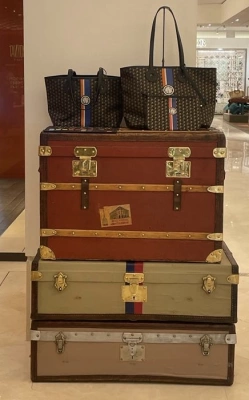
The history of luggage dates back to ancient times, when people used cloth bags or woven baskets to carry their belongings. However, these bags were often bulky and impractical to carry over long distances.
Over the centuries, luggage evolved to become more functional and adapted to travellers' needs. In the Middle Ages, nobles used wooden chests to carry their belongings when travelling. These chests were often heavy and required several people to carry them.
With the advent of rail and sea travel in the 19th century, luggage underwent a new evolution. Wooden trunks became popular, offering better protection for fragile objects. These trunks were often adorned with leather or canvas and were used by wealthy travellers.
In the 20th century, the arrival of commercial aviation led to a further transformation of luggage. Rigid metal or plastic suitcases became common, offering greater shock resistance and storage capacity. Wheels were also added to make transport easier.
Today, luggage is available in a wide variety of shapes, sizes and materials. Many models are available from Les Malletiers....
27 Jul 2023
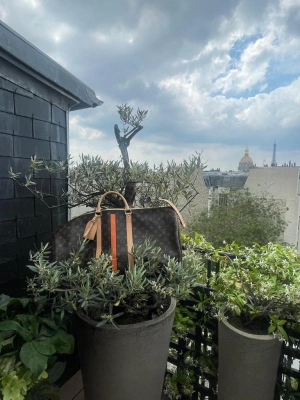
Louis Vuitton's Keepall travel bag, the 1930s... Cruises were fashionable, as were holidays in Deauville and Biarritz.
At that time, Louis Vuitton, renowned for its trunks, had to adapt to these new lifestyles. The result was the Keepall, a bag that "keeps everything". The Keepall is a flexible, zipped bag made from the famous monogrammed coated canvas. Its generous shape allows you to slip in a sports outfit and a few simple clothes for a weekend in the countryside.
An immediate success, the Keepall has never left the Louis Vuitton catalogue. It has been used in the trunk-maker's other collections, and given a new look by artists invited by Marc Jacobs, including Takashi Murakami and others.
Four sizes were chosen (45, 50, 55 and 60 cm), with the first three being the most popular because they could be carried in the cabin.
Seen over and over again on all the people for generations, the Keepall is now a timeless piece, which we keep, cherish and watch lovingly polish... Les Malletiers loves it too!
27 Jul 2023

Coco Untold Stories, the early years...
She symbolizes French elegance. Gabrielle Chanel, born in Saumur in 1883, whose real name was Gabrielle Chasnel, was raised in an orphanage. At the age of 12, she was taken in with two of her sisters at Aubazine Abbey in Corrèze.
Her mother died in Brive-la-Gaillarde in 1895. When she was just 12, her father abandoned her a few months later, to the care of the nuns. He never returned. Gabrielle went to Aubazine to learn sewing. She stayed for 6 years. The abbey would remain a powerful source of inspiration for the codes of the House of Chanel...
Coco Chanel's taste for clean lines and her predilection for black, white and beige are perhaps linked to the sobriety of the abbey and its occupants...
Once she left Aubazine, she moved to Moulin. Gabrielle had to earn a living, so she sang in small shows in bars, famous for her rendition of
“Who has seen Coco on the Trocadero? Coco, a nickname that has stuck for posterity...
10 Aug 2023