








Are you sure you want to perform this action?
A Louis Vuitton trunk weathered by time, a Hermès vanity case with just the right patina, a Dior trolley from a line that no longer exists—in the world of luxury travel, certain pieces go far beyond their practical purpose. This guide to luxury luggage is for those who seek not just a beautiful object, but a piece of history, craftsmanship, and timeless style.
Luxury luggage occupies a unique place in a collection. It is less visible than an iconic handbag, often more demanding to choose, but it tells a different story: the art of travel, a culture of detail, elegance in motion. A beautiful travel piece is never purely utilitarian. It carries the memory of a house, an era, and sometimes a use that no longer exists.
## Why Collect Luxury Luggage
Collecting luxury luggage is not simply about expanding a wardrobe. It is about entering a realm where heritage, craftsmanship, and true rarity intersect. The great houses have never treated travel as a secondary accessory. For some, it is even the point of origin. Trunks, hard-sided suitcases, toiletries bags, garment bags, or travel bags often constitute the most faithful expression of their identity.
This historical dimension changes our perspective. An antique trunk is not interesting simply because it is old, but because it embodies a craftsmanship, a silhouette, and a way of life that has since passed. Conversely, certain more recent pieces appeal through their understated sophistication and limited availability. The discerning collector knows that desirability does not depend solely on age.
One must also consider the timelessness of taste. Luxury luggage is, in part, immune to the rapid cycles of fashion. Beautiful craftsmanship, fine materials, and perfect proportions stand the test of time better than objects designed for immediate impact. This does not automatically make them investments, but it explains their enduring appeal.
## Luxury Luggage Collection Guide: Brands to Watch
Not all prestigious brands occupy the same place in the world of travel. Some have built their legends there, while others have brought a more contemporary or niche perspective.
Louis Vuitton remains a benchmark. Trunks, suitcases, beauty cases, and Keepall, Alzer, or Pégase bags make up an extremely codified realm, rich in archives and variations. Value depends on many factors: era, model, condition of the hardware, presence of markings, interior configuration, and how common the piece is.
Hermès attracts a different kind of attention. The house is less spontaneously associated with trunks than certain historic trunk makers, but its travel pieces, weekend bags, vanity cases, and certain travel accessories embody a standard of leather and craftsmanship that appeals to collectors of materials and finishes.
Moynat and Goyard occupy a niche market. Their appeal lies in the culture of trunk-making, the tradition of personalized travel, and a rarity that, on the secondary market, can become particularly sought-after. These pieces, however, require a more expert eye, as supply is less abundant and comparables are harder to find.
Dior, Chanel, Prada, or Gucci are of particular interest when a travel line strongly embodies the aesthetic of an era. Here, the collector seeks less a lineage of luggage-making and more a consistency of style, remarkable craftsmanship, or a series that is now impossible to find.
## What Determines a Piece’s Value
The first criterion is authenticity. In luxury luggage, this is never limited to a logo or a serial number. It is evident in the construction, the hardware, the quality of the trims, the logic of the stitching, the consistency of the branding, and the relationship between the object and the customs of its era. The older or rarer the piece, the more nuanced this assessment must be.
Next comes condition. This is where judgment must remain nuanced. A natural patina can enhance the beauty of an antique piece, whereas excessive restoration can diminish its appeal. Conversely, on contemporary luggage, warping, worn corners, replaced wheels, or damaged linings carry greater weight. It all depends on the category, age, and purpose of the piece—pure collection, occasional use, or dual-purpose.
Rarity matters, of course, but it is not enough. A rare piece without real market demand may remain marginal. What matters is the intersection of rarity, clarity, and desirability. An iconic model in a rare version will often be more interesting than an obscure object—admittedly rarely seen, but difficult to situate within a house’s history.
Finally, provenance sometimes adds a particular depth. An original monogram, a special order, a custom interior configuration, or a precise match with the house’s archives can tip a piece over into the realm of a true collector’s item.
## Antique, vintage, or contemporary: you must choose your approach
Many buyers approach luxury luggage with an aesthetic preference but without a method. Yet a coherent collection rests on a clear perspective.
Antiques appeal through their presence. A trunk from the late 19th or early 20th century offers unparalleled historical depth. But it requires space, a certain commitment to preservation, and a tolerance for the marks of time. It is not always a spontaneous purchase.
Vintage, in the sense of the 1970s to 2000s, often offers a simpler balance. The pieces remain recognizable, easier to integrate into contemporary life, while retaining a true uniqueness. This is often where the most discerning collections begin.
Finally, contemporary pieces should not be overlooked. Certain limited editions, discontinued lines, or low-circulation creations already constitute the archives of tomorrow. The risk lies in buying too close to the novelty effect. The value of a collection piece then rests on the accuracy of one’s eye, not on the enthusiasm of the moment.
## How to assess condition without making a mistake
In a guide to collecting luxury luggage, the question of condition deserves more than a simple “good” or “bad.” One must learn to distinguish between noble wear and problematic deterioration.
On a trunk, the protected corners, original hardware, canvas or outer lining, handle, closures, and interior must all be examined together. Beautiful, even wear may be acceptable, and sometimes even desirable. On the other hand, structural damage, persistent odors, old moisture, or poorly executed restorations should raise a red flag.
With soft luggage, the inspection focuses more on overall condition, load-bearing seams, the quality of the zippers, the state of the handles and shoulder straps, as well as areas of friction. An item can look very appealing in photos but be disappointing in person if its structure has lost its integrity.
The ideal is not always to find a perfect piece. The ideal is to pay the right price for a condition that is clearly understood.
## Buying to Use or to Keep
This is one of the real questions, and it changes everything. A collector who wants to travel with their luggage will not apply the same criteria as someone building a heritage collection.
For actual use, functionality takes precedence. Sturdy handles, smooth-closing mechanisms, a clean interior, and compatibility with modern travel constraints—all of these become essential. An exceptional but fragile piece will not serve the same purpose.
For preserving a collection, one can tolerate more delicacy if rarity and historical integrity are present. Certain trunks, vanity cases, or travel accessories now hold more legitimacy as objects of decoration, heirlooms, or historical artifacts than as travel companions.
There is no hierarchy between these two approaches. There are simply different trade-offs.
## The Decisive Role of Expertise
The secondary luxury market has increased the supply. It has also created more gray areas. In luxury luggage even more so than in other categories, independent expertise makes the difference between an informed purchase and a risky gamble.
Rigorous authentication does more than just provide reassurance. It protects the item’s value, clarifies its place in the brand’s history, and enables purchases made with a level of discernment consistent with the high-end market. At Les Malletiers, this rigor is part of a precise vision of second-hand luxury: an object is only fully valuable if it is correctly identified, described, and contextualized.
This standard is particularly important for rare, atypical, or antique pieces, where visual cues alone are insufficient. The discerning collector does not seek a mere promise. They expect an expert assessment.
## Building a Collection That Makes Sense
The finest collections are not always the largest. They have a cohesive theme. Some choose a single brand. Others focus on a specific type of item—vanity cases, cabin trunks, coated canvas travel bags, leather travel accessories. Still others collect pieces from a particular era or style.
This consistency strengthens the collection as a whole and refines decision-making. It prevents opportunistic purchases, which are often appealing in the moment but less convincing over time. In luxury luggage, taste develops quickly once you consistently examine the details, proportions, and construction.
Starting modestly is not a flaw. A single, beautifully chosen piece is better than a scattered collection. Over time, the eye becomes more discerning, the criteria more precise, and the collection gains intellectual depth as well as aesthetic richness.
True luxury isn’t just about what you own. It’s about understanding the significance, craftsmanship, and history behind it—and wanting to pass it on just as much as you want to admire it.
Related articles

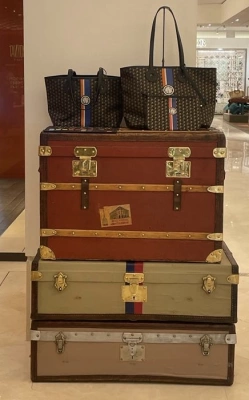
The history of luggage dates back to ancient times, when people used cloth bags or woven baskets to carry their belongings. However, these bags were often bulky and impractical to carry over long distances.
Over the centuries, luggage evolved to become more functional and adapted to travellers' needs. In the Middle Ages, nobles used wooden chests to carry their belongings when travelling. These chests were often heavy and required several people to carry them.
With the advent of rail and sea travel in the 19th century, luggage underwent a new evolution. Wooden trunks became popular, offering better protection for fragile objects. These trunks were often adorned with leather or canvas and were used by wealthy travellers.
In the 20th century, the arrival of commercial aviation led to a further transformation of luggage. Rigid metal or plastic suitcases became common, offering greater shock resistance and storage capacity. Wheels were also added to make transport easier.
Today, luggage is available in a wide variety of shapes, sizes and materials. Many models are available from Les Malletiers....
27 Jul 2023
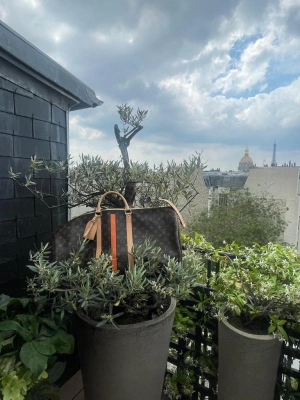
Louis Vuitton's Keepall travel bag, the 1930s... Cruises were fashionable, as were holidays in Deauville and Biarritz.
At that time, Louis Vuitton, renowned for its trunks, had to adapt to these new lifestyles. The result was the Keepall, a bag that "keeps everything". The Keepall is a flexible, zipped bag made from the famous monogrammed coated canvas. Its generous shape allows you to slip in a sports outfit and a few simple clothes for a weekend in the countryside.
An immediate success, the Keepall has never left the Louis Vuitton catalogue. It has been used in the trunk-maker's other collections, and given a new look by artists invited by Marc Jacobs, including Takashi Murakami and others.
Four sizes were chosen (45, 50, 55 and 60 cm), with the first three being the most popular because they could be carried in the cabin.
Seen over and over again on all the people for generations, the Keepall is now a timeless piece, which we keep, cherish and watch lovingly polish... Les Malletiers loves it too!
27 Jul 2023
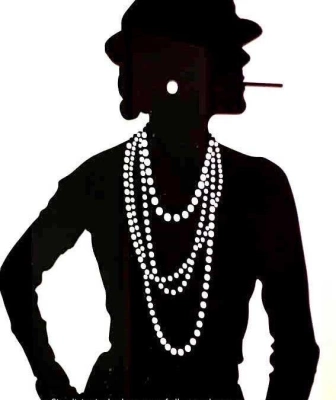
Coco Untold Stories, the early years...
She symbolizes French elegance. Gabrielle Chanel, born in Saumur in 1883, whose real name was Gabrielle Chasnel, was raised in an orphanage. At the age of 12, she was taken in with two of her sisters at Aubazine Abbey in Corrèze.
Her mother died in Brive-la-Gaillarde in 1895. When she was just 12, her father abandoned her a few months later, to the care of the nuns. He never returned. Gabrielle went to Aubazine to learn sewing. She stayed for 6 years. The abbey would remain a powerful source of inspiration for the codes of the House of Chanel...
Coco Chanel's taste for clean lines and her predilection for black, white and beige are perhaps linked to the sobriety of the abbey and its occupants...
Once she left Aubazine, she moved to Moulin. Gabrielle had to earn a living, so she sang in small shows in bars, famous for her rendition of
“Who has seen Coco on the Trocadero? Coco, a nickname that has stuck for posterity...
10 Aug 2023