








Are you sure you want to perform this action?
For the secondhand site Les Malletiers, some choices have less to do with fashion than with style. Deciding between a Hermès Kelly and a Birkin isn’t simply a matter of choosing between two iconic bags. It’s a choice between two attitudes, two approaches to luxury, two ways of engaging with an object whose presence far exceeds its function.
At Hermès, a bag is never a mere accessory. It is a construction of leather, balance, and craftsmanship. The Kelly and the Birkin share this workshop-level precision, this almost architectural attention to detail, but they don’t tell the same story when held in the hand, carried on the arm, or used in daily life. To choose wisely, one must look beyond mere fame.
## Hermès Kelly or Birkin: two icons, two temperaments
The Kelly captivates with its sleek lines, its haughty bearing, and its instantly recognizable structure. Its flap, single handle, signature clasp, and trapezoidal silhouette come together to form a whole of rare distinction. Even when worn in a more contemporary style, it retains a certain ceremonial air. It frames the silhouette, demands a certain outfit, almost a discipline.
The Birkin, on the other hand, appears more direct, more spacious, more lively. Its double handles, its more open volume, and its less rigid construction in certain versions give it a different presence. It shares the same noble craftsmanship, but its style is more spontaneous. Where the Kelly suggests restraint, the Birkin embraces the idea of a lived-in, mobile, almost everyday luxury.
It therefore depends less on which is the most famous than on understanding which one suits you. Some collectors swear by the Kelly’s impeccable verticality. Others always return to the Birkin for its ease and its ability to accompany an active life without losing its aesthetic power.
## Style Before Price
The debate is often reduced to market value. This is a misjudgment. Before assessing resale potential or rarity, one must consider stylistic coherence.
The Kelly naturally complements a structured wardrobe. It harmonizes with clean lines, a well-tailored coat, a understated wardrobe, and bold fabrics. It can, of course, be worn casually, and it is often in this context that it takes on a unique modernity, yet it always retains a touch of formality. This is what gives it its charm and, at times, its limitation.
The Birkin offers greater flexibility. It complements both precise tailoring and a more relaxed, urban, and instinctive wardrobe. Its shape, especially in certain sizes, makes it particularly appealing to those who want a statement bag without sacrificing practicality. It handles a busy daily routine, long days, and frequent travel better.
In other words, the Kelly is often chosen for its silhouette. The Birkin, for its versatility. This distinction isn’t absolute, but it remains relevant when looking for your first large Hermès bag.
### The Kelly: A More Composed Elegance
The Kelly sometimes requires a bit more attention. It doesn’t open as readily, its structure calls for a certain delicacy in handling, and its shape makes it less forgiving when loaded. In return, it offers unparalleled poise. It stands the test of time without losing its visual authority.
### The Birkin: A More Organic Form of Luxury
The Birkin is often perceived as more functional, without being utilitarian in the mundane sense of the word. It retains an exceptional aura, but its relationship to the body is more natural. You pick it up, open it, and fill it with greater ease. For many, it is precisely this ease of use that makes it irresistible.
## Hermès Kelly or Birkin: Choosing Based on Actual Use
An exceptional bag is only truly successful if it fits seamlessly into one’s life. The question of how it will be used therefore deserves to be asked frankly.
If you’re looking for a bag to enhance special occasions, dinners, and select appearances, the Kelly has a clear advantage. Its presence is almost like a piece of jewelry. Even in supple leathers or more compact sizes, it retains that formal intensity that enhances a silhouette without overwhelming it.
If you want a more versatile companion, capable of handling the office, short trips, and days when you carry more than just the bare essentials, the Birkin is often the better choice. It fits into everyday life with a confidence that needs no explanation.
You also have to consider the feel. Some people love the precision of the Kelly, the ritual of its closure, the way it’s carried in the hand or on the shoulder depending on the model. Others prefer the immediacy of the Birkin, its instinctive grip, its generous interior. These seemingly minor details often determine long-term satisfaction.
## Sizes, leathers, and hardware make all the difference
Comparing a Kelly and a Birkin without considering their configurations would be reductive. A 25 Kelly in stiff leather has neither the same spirit nor the same purpose as a softer, larger Kelly. Similarly, a 25 Birkin does not convey the same message as a 35 Birkin. Size alters the balance, formality, and even the perception of rarity.
Leather plays an equally decisive role. Structured leather accentuates the Kelly’s sharp lines and reinforces its sculptural character. Softer leather softens the lines, introducing a different, sometimes more contemporary sensuality. On a Birkin, the material can either emphasize its poise or give it a more lively, more personal drape over time.
Finally, the hardware subtly shifts how the bag is perceived. Palladium, gold, special finishes—every detail counts in the aesthetic equation. Discerning enthusiasts know that the same model changes radically depending on its execution. That is why the right question is not simply Kelly or Birkin, but which Kelly and which Birkin.
## Value, desirability, and the secondary market
In the secondary market, both models occupy a unique position. Their desirability is sustained, their availability controlled, and certain combinations of sizes, colors, leathers, or finishes become particularly sought after. But we must avoid simplistic generalizations.
A Kelly can surpass a Birkin in appeal depending on its configuration. A Birkin can be more liquid on the market depending on its size and color. Value does not depend solely on the model’s name. It is based on a set of specific criteria: condition, year, leather, color, presence of accessories, rarity of the combination, and above all, fully established authenticity.
For a savvy buyer, the concept of value must never be separated from that of trust. In the Hermès universe, where counterfeiting is sophisticated and standards are high, provenance and expertise are central. This is all the more true when seeking a collector’s item or a hard-to-find model.
The secondary market also has a real merit: it provides access to models no longer sold in stores, to discontinued colors, and to configurations that have become rare. For some enthusiasts, true luxury begins there—in the possibility of finding not just any Hermès bag, but the right Hermès bag.
## Which one to choose for a first purchase?
For a first foray into the world of large Hermès bags, the choice must remain personal, but a few guidelines can help.
If you love objects with a strong formal presence, if you’re looking for an iconic silhouette, if you prioritize structured elegance over practicality, the Kelly often stands out as the obvious choice. It has that rare power to make every outfit more precise, more distinctive.
If you want a bag that’s roomier, more versatile, and easier to integrate into a busy daily routine, the Birkin often feels like a more natural choice. It offers a less formal relationship, while retaining that intense allure unique to Hermès’s iconic creations.
Some buyers start with the Birkin and then move on to the Kelly, as one refines one’s taste. Others do the opposite, immediately drawn to the Kelly’s almost absolute purity. There is no universal hierarchy. There is an affinity, and it is often recognized immediately when one encounters the right piece.
## Choosing with a Collector’s Eye
A collector doesn’t simply ask which model is the most visible or in highest demand. They observe the harmony between the piece, its era, its design, and their own perspective. A stunning Kelly Sellier in a deep hue serves a different purpose than a supple Birkin in leather with a remarkable grain. Both can be essential, but not for the same reasons.
This is also where expert guidance truly comes into its own. At Les Malletiers, this attention to detail is inseparable from a commitment to authenticity and provenance. Because acquiring a Kelly or a Birkin is not simply about checking off a box on a heritage list. It is about recognizing the right piece—one whose condition, craftsmanship, and history truly deserve attention.
Ultimately, choosing between a Hermès Kelly and a Birkin comes down to choosing the form of luxury you wish to bring into your life. One sets a standard, the other establishes a style. When the choice is right, it doesn’t follow trends—it stays with you for a long time.
Related articles

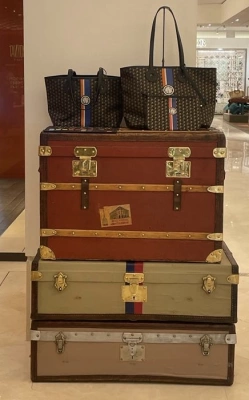
The history of luggage dates back to ancient times, when people used cloth bags or woven baskets to carry their belongings. However, these bags were often bulky and impractical to carry over long distances.
Over the centuries, luggage evolved to become more functional and adapted to travellers' needs. In the Middle Ages, nobles used wooden chests to carry their belongings when travelling. These chests were often heavy and required several people to carry them.
With the advent of rail and sea travel in the 19th century, luggage underwent a new evolution. Wooden trunks became popular, offering better protection for fragile objects. These trunks were often adorned with leather or canvas and were used by wealthy travellers.
In the 20th century, the arrival of commercial aviation led to a further transformation of luggage. Rigid metal or plastic suitcases became common, offering greater shock resistance and storage capacity. Wheels were also added to make transport easier.
Today, luggage is available in a wide variety of shapes, sizes and materials. Many models are available from Les Malletiers....
27 Jul 2023
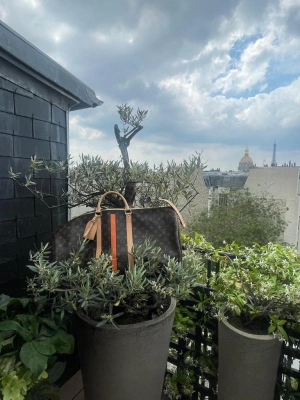
Louis Vuitton's Keepall travel bag, the 1930s... Cruises were fashionable, as were holidays in Deauville and Biarritz.
At that time, Louis Vuitton, renowned for its trunks, had to adapt to these new lifestyles. The result was the Keepall, a bag that "keeps everything". The Keepall is a flexible, zipped bag made from the famous monogrammed coated canvas. Its generous shape allows you to slip in a sports outfit and a few simple clothes for a weekend in the countryside.
An immediate success, the Keepall has never left the Louis Vuitton catalogue. It has been used in the trunk-maker's other collections, and given a new look by artists invited by Marc Jacobs, including Takashi Murakami and others.
Four sizes were chosen (45, 50, 55 and 60 cm), with the first three being the most popular because they could be carried in the cabin.
Seen over and over again on all the people for generations, the Keepall is now a timeless piece, which we keep, cherish and watch lovingly polish... Les Malletiers loves it too!
27 Jul 2023
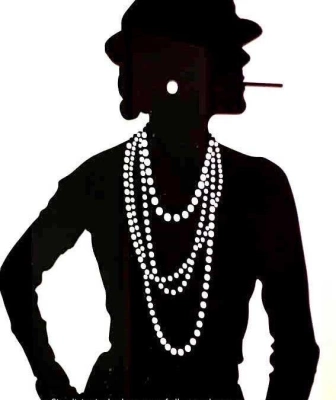
Coco Untold Stories, the early years...
She symbolizes French elegance. Gabrielle Chanel, born in Saumur in 1883, whose real name was Gabrielle Chasnel, was raised in an orphanage. At the age of 12, she was taken in with two of her sisters at Aubazine Abbey in Corrèze.
Her mother died in Brive-la-Gaillarde in 1895. When she was just 12, her father abandoned her a few months later, to the care of the nuns. He never returned. Gabrielle went to Aubazine to learn sewing. She stayed for 6 years. The abbey would remain a powerful source of inspiration for the codes of the House of Chanel...
Coco Chanel's taste for clean lines and her predilection for black, white and beige are perhaps linked to the sobriety of the abbey and its occupants...
Once she left Aubazine, she moved to Moulin. Gabrielle had to earn a living, so she sang in small shows in bars, famous for her rendition of
“Who has seen Coco on the Trocadero? Coco, a nickname that has stuck for posterity...
10 Aug 2023