








Are you sure you want to perform this action?
According to Les Malletiers, the website specializing in pre-owned luxury leather goods: A Van Cleef & Arpels bracelet, a Chanel Haute Fantaisie brooch, a Bulgari ring from the 1980s, or a Hermès necklace never enter the market as mere secondhand jewelry. When considering how to appraise a designer piece of jewelry, one does not merely evaluate the weight of the gold, a gemstone, or its condition. One assesses a brand, a creative era, a level of desirability, and, often, a form of rarity that defies standard valuation scales.
The subject therefore warrants a more nuanced approach than a calculation by the gram. A designer piece of jewelry can be worth far more than the sum of its materials, but it can also disappoint if the designer attribution is incorrect, if its condition significantly diminishes its appeal, or if the market no longer values certain models. This is precisely where expertise makes the difference.
## How to appraise a signed piece of jewelry without reducing it to its materials
The first mistake is to approach it as if it were unsigned jewelry. Of course, the precious metal matters. The karat weight of the gold, the platinum, and the quality of the diamonds or colored gemstones provide a tangible foundation. But in the world of luxury houses, this foundation is merely a starting point.
What creates the difference in value is the signature in the full sense of the word. This refers not only to the engraved name, but also to the design, the workshop, the date of manufacture, the model’s place in the house’s history, and current collector demand. A ring signed by a major Parisian house, even a relatively understated one, can far exceed the value of an anonymous model that is heavier or more richly set.
A fair valuation therefore arises from a combination of intrinsic value and heritage value. It is this dual perspective that explains why two pieces of 18-karat gold jewelry, of comparable weight, can have such significant differences in value.
## The criteria that determine true value
### The House and the Strength of the Signature
Not all signatures carry the same prestige. Cartier, Van Cleef & Arpels, Bulgari, Chaumet, Tiffany & Co., Chanel, or Hermès do not generate the same demand depending on the era, the collection, and the market. Some houses maintain a very stable market value, while others experience more pronounced spikes in interest for specific collections.
It is also important to distinguish between high jewelry, boutique jewelry, and sometimes designer costume jewelry. A Chanel brooch made of gold-plated metal and glass paste is obviously not valued the same as a diamond-set ring, but it can nonetheless command a significant price if it belongs to a sought-after period and features an iconic design.
### The Era of Creation
The era often carries as much weight as the designer’s signature itself. A piece of jewelry from the 1920s, 1950s, 1970s, or 1990s will not be viewed the same way by the market. Some decades are sought after for the purity of their design, others for their exuberance or their connection to a particular artistic direction.
An older piece, especially if well-preserved, may command a premium for its rarity. Conversely, some more recent pieces are valued higher when they belong to iconic lines that remain in high demand. There are no hard and fast rules. Age alone does not guarantee a higher value.
### Condition
A signed piece of jewelry must retain its integrity. Excessive polishing, a replaced clasp, shortened links, weakened settings, deep scratches, or missing original elements can significantly lower the appraisal value.
In the case of signed costume jewelry, condition is even more critical. Faded plating, replaced rhinestones, or missing parts significantly reduce its appeal to collectors. For designer brands, value also depends on the piece’s fidelity to its original design.
### Hallmarks, numbers, and markings
A visible signature is not enough. Examining hallmarks, serial numbers, workshop marks, metal fineness, and sometimes clasp mechanisms is essential. These elements allow the jewelry to be authenticated, dated, and linked to a specific production.
A blurred, inconsistent, or unusual marking is not necessarily a deal-breaker, but it calls for genuine caution. Conversely, a set of perfectly consistent markings builds confidence and thus value.
### Gemstones and Craftsmanship
For fine jewelry, gemstones remain central. Cut, color, clarity, uniformity, possible provenance, and the quality of the setting all influence the valuation. However, in a designer piece, the overall quality of craftsmanship matters just as much. The drape of a bracelet, the balance of a clip, the flexibility of a link necklace, or the sophistication of a clasp immediately reveal the level of craftsmanship.
A prestigious house is not valued solely for its name. It is valued for a distinctive style that the trained eye recognizes very quickly.
## How to Estimate a Designer Jewelry Piece Based on the Market
A serious estimate cannot be purely theoretical. It must take into account the actual market, that is, observed sales of comparable pieces. This involves comparing the same brand, the same period, the same type of jewelry, similar materials, and, if possible, a similar condition.
This is where many rough estimates go wrong. Sometimes a common Cartier ring is compared to a collector’s model, or a widely available signed costume necklace to a rare piece produced in limited quantities. The result is skewed from the start.
It is also important to distinguish between the listed price, the hammer price, and the achievable resale price. An item may be offered at a high price without selling. Conversely, a quick sale between professionals does not always reflect its full value to a final buyer. Valuing is not about choosing the most flattering figure. It is about placing the jewelry within a credible range, depending on its sales channel.
## Documents That Build Trust
The original case, the invoice, an old certificate, a mention in a catalog, an archival photograph, or clear traceability do not always create value, but they do reinforce it. In the pre-owned luxury segment, documented provenance reassures buyers and helps them envision the item’s future.
For some houses, having a complete set is particularly valued. For others, the piece itself is sufficient if it is perfectly authentic and desirable. Here again, it all depends on the type of jewelry and the profile of the target buyer.
## The Limits of a Remote Appraisal
Photographs allow for an initial assessment, never a definitive one. They show the general design, some of the markings, and sometimes the overall condition. They often hide actual wear, past repairs, the quality of the setting, or certain manufacturing inconsistencies.
A signed piece of jewelry should ideally be examined in person. The weight, the fluidity, the clarity of the engraving, the way light plays on the stones, and the quality of the joints provide essential information. In this field, sensory experience still counts.
This is why a serious preliminary estimate can be useful, but it must remain cautious until a physical examination has confirmed the decisive factors.
## What an expert looks for before setting a price range
The expert does not merely seek to verify a name. They assess the overall coherence. Does the style match the brand in question? Are the markings consistent with the period? Are the materials and craftsmanship up to the expected standard? Has the piece been altered? Is there sustained market interest in this model today?
This comprehensive analysis allows one to distinguish between a piece that is merely signed and one that is genuinely sought-after. This distinction is essential. Not all designer jewelry is rare, and not all rare jewelry commands the same level of desire. The valuation is determined precisely by this gap.
In a world where counterfeits, re-set pieces, and hasty attributions cloud the picture, relying on rigorous expertise remains the surest path. At Les Malletiers, this standard stems from a simple conviction: when it comes to heritage luxury, value arises from the convergence of authenticity, quality, and history.
Before selling, insuring, or passing down a signed piece of jewelry, the right approach is therefore not to ask how much the gold is worth, but what the object truly tells us. That is often where its true value begins.
Related articles

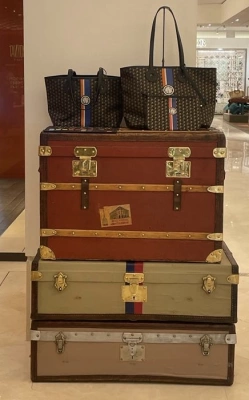
The history of luggage dates back to ancient times, when people used cloth bags or woven baskets to carry their belongings. However, these bags were often bulky and impractical to carry over long distances.
Over the centuries, luggage evolved to become more functional and adapted to travellers' needs. In the Middle Ages, nobles used wooden chests to carry their belongings when travelling. These chests were often heavy and required several people to carry them.
With the advent of rail and sea travel in the 19th century, luggage underwent a new evolution. Wooden trunks became popular, offering better protection for fragile objects. These trunks were often adorned with leather or canvas and were used by wealthy travellers.
In the 20th century, the arrival of commercial aviation led to a further transformation of luggage. Rigid metal or plastic suitcases became common, offering greater shock resistance and storage capacity. Wheels were also added to make transport easier.
Today, luggage is available in a wide variety of shapes, sizes and materials. Many models are available from Les Malletiers....
27 Jul 2023

Louis Vuitton's Keepall travel bag, the 1930s... Cruises were fashionable, as were holidays in Deauville and Biarritz.
At that time, Louis Vuitton, renowned for its trunks, had to adapt to these new lifestyles. The result was the Keepall, a bag that "keeps everything". The Keepall is a flexible, zipped bag made from the famous monogrammed coated canvas. Its generous shape allows you to slip in a sports outfit and a few simple clothes for a weekend in the countryside.
An immediate success, the Keepall has never left the Louis Vuitton catalogue. It has been used in the trunk-maker's other collections, and given a new look by artists invited by Marc Jacobs, including Takashi Murakami and others.
Four sizes were chosen (45, 50, 55 and 60 cm), with the first three being the most popular because they could be carried in the cabin.
Seen over and over again on all the people for generations, the Keepall is now a timeless piece, which we keep, cherish and watch lovingly polish... Les Malletiers loves it too!
27 Jul 2023
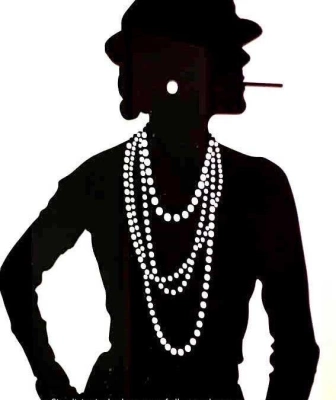
Coco Untold Stories, the early years...
She symbolizes French elegance. Gabrielle Chanel, born in Saumur in 1883, whose real name was Gabrielle Chasnel, was raised in an orphanage. At the age of 12, she was taken in with two of her sisters at Aubazine Abbey in Corrèze.
Her mother died in Brive-la-Gaillarde in 1895. When she was just 12, her father abandoned her a few months later, to the care of the nuns. He never returned. Gabrielle went to Aubazine to learn sewing. She stayed for 6 years. The abbey would remain a powerful source of inspiration for the codes of the House of Chanel...
Coco Chanel's taste for clean lines and her predilection for black, white and beige are perhaps linked to the sobriety of the abbey and its occupants...
Once she left Aubazine, she moved to Moulin. Gabrielle had to earn a living, so she sang in small shows in bars, famous for her rendition of
“Who has seen Coco on the Trocadero? Coco, a nickname that has stuck for posterity...
10 Aug 2023