








Are you sure you want to perform this action?
For Les malletiers, the online retailer of pre-owned luxury leather goods: A cannage Lady Dior, a sleek Saddle, a more understated Diorissimo—every Dior bag bears the hallmarks of its era. Knowing how to date a Dior bag is more than just a matter of curiosity. The date influences how the model is interpreted, its historical context, its desirability, and often its value on the secondhand market.
At Dior, however, this exercise requires a measured approach. The house has evolved its markings, linings, plaques, codes, and certain manufacturing details over the decades, without always following a perfectly linear logic for the general public. Dating a piece therefore involves observing a set of clues, never just one.
## How to date a Dior bag without making a mistake
The first rule is simple: you cannot date a Dior bag based on a single element. An interior plaque, a logo, or a date code can guide the analysis, but they are not sufficient on their own. Luxury houses go through transitional periods, variations across lines, and productions intended for different markets, not to mention repairs or replacements that may have occurred during the bag’s lifetime.
Accurate dating relies on cross-referencing several categories of clues: the bag’s construction, the typography of the branding, the materials used, the metal hardware, the label or production code, and, of course, the bag’s place in the house’s stylistic history.
### Start by precisely identifying the model
Even before looking for a code, you must name the object. A Lady Dior, a Saddle, a Gaucho, a Diorissimo, a Book Tote, or a Bobby do not belong to the same periods or follow the same manufacturing logic. Some lines have undergone several relaunches, sometimes with minimal modifications visible only to the trained eye.
The Lady Dior is a good example. First introduced in the mid-1990s, it has spanned the decades without losing its identity. Yet the shape of the handles, the drape of the leather, certain sizes, the interior plaque, the DIOR charms, and the overall structure have evolved. Two bags that appear very similar may thus be separated by a decade.
### Observe the silhouette and proportions
Dating also involves the design. Dior bags strongly reflect the house’s aesthetic eras. The more compact and structured lines of certain years do not tell the same story as the soft volumes or oversized formats that appeared later.
A Saddle from the height of the Galliano era does not read like a contemporary reissue. The curve, the shoulder strap, the metal hardware, and even the bag’s overall vibe change subtly. For a collector, these nuances are crucial.
## Physical clues that help date a Dior bag
Once the model has been identified, examining the physical details becomes key. This is often where greater precision is achieved.
### The interior marking
The interior inscription is one of the first things to examine. Depending on the period, the Dior signature appears in different forms. The typography, the mention of the place of manufacture, and the material of the marking vary.
On many pieces, there is a stamp or a plaque bearing “Christian Dior” or “Christian Dior Paris.” The clarity of the letters, the spacing, the alignment, and the quality of execution must be consistent with the presumed period. Typography that is too heavy, rough gilding, or an inconsistent layout can indicate a problem with authenticity, but also an incorrect chronological attribution.
It is also important to remember that a house like Dior underwent gradual changes. A change in branding does not always appear overnight across the entire production line. There are therefore gray areas, particularly on bags from transitional periods.
### The date code or production code
For anyone looking to date a Dior bag, the question of the code immediately arises. On contemporary models and on many pieces from recent decades, Dior uses production codes placed inside the bag, often on a leather label or in a discreet location.
These codes can provide valuable clues about the month, year, and manufacturing workshop. However, one must understand their exact logic, which has varied over time. A common mistake is to read a code without comparing it to the rest of the bag. Yet a credible code on a piece whose materials or construction do not match remains insufficient.
Another point to note: the absence of a visible code does not automatically imply that a bag is old or inauthentic. Depending on the model, year, wear, or certain subsequent alterations, a code may be erased, difficult to access, or hard to spot.
### Materials and Lining
The choice of leather, canvas, and lining—and how they age—are very revealing. The cannage on a Lady Dior, for example, does not always have the same appearance depending on the year. Certain leathers exhibit a grain, texture, and sheen characteristic of a specific period.
The lining deserves special attention. Its texture, color, any pattern, and the quality of the cut can help date the bag. Here again, the analysis must never be mechanical. A lining replaced during restoration alters the assessment and can mislead a hurried eye.
### Hardware and Finishes
Metal elements often provide very precise clues. The letter charms on a Lady Dior, the shape of the rings, the type of zipper, the engraving on the clasps, or the shade of the metal can sometimes significantly narrow down a chronological range.
One must examine the quality of the plating, the depth of the engravings, the consistency among the various metal parts, and their patina. A bag presumed to be vintage with hardware that looks too new or is of a later style naturally raises questions. Conversely, a harmonious patina can reinforce a piece’s age.
## Dating a Dior Bag by Major Periods
Without attempting to confine Dior to a rigid timeline, certain periods offer useful reference points.
The 1990s marked a defining moment for several of the house’s icons, notably the Lady Dior. This era features highly structured designs, an almost architectural elegance, and details that differ significantly from more recent productions.
The 2000s, marked by intense creativity, saw the emergence or rise of bolder lines, of which the Saddle is the most obvious example. Bags from this era may feature highly recognizable signatures—sometimes more showy—which make them particularly sought-after today.
The 2010s and 2020s introduced a more contemporary take on the classics, with reissues, revised sizes, variations in shoulder straps, and finishes adapted to modern uses. On these pieces, production codes are often easier to identify, but this does not eliminate the need for a comprehensive analysis.
## What Complicates Dating
Here lies the real issue: dating a Dior bag is not always a straightforward exercise. Several factors muddy the waters.
First, certain lines have been reissued almost identically. A relaunched model may incorporate the aesthetic codes of an older version while integrating contemporary details. Without detailed knowledge, confusion is common.
Second, bags that have circulated across multiple markets do not always bear exactly the same marking conventions. Finally, restoration can transform an object. A replaced zipper pull, a swapped-out plaque, a recoloring, or a reupholstered interior alter the chronological reading. The bag may remain authentic, but it is no longer entirely in its original condition.
This is also why serious dating is never purely documentary. It relies on a discerning eye. One must compare, place the object within a production lineage, and identify what is consistent and what is not.
## The Most Common Mistakes
The first is confusing the model date with the production date. A bag designed in the 1990s may have been produced much later as part of a reissue. Saying it is a 1990s design does not mean it was manufactured during that period.
The second mistake is placing excessive trust in simplified charts circulating online. They can provide initial guidance, but rarely more than that. Dior is not a brand that can be seriously analyzed using a single grid.
The third mistake is to ignore the relationship between dating and authenticity. A bag that cannot be placed within a plausible timeline warrants a thorough examination. Historical inconsistency is often one of the first warning signs.
## When to Consult an Expert
As soon as the item involves real heritage or financial stakes, expert assessment becomes crucial. This is particularly true for iconic models, limited editions, runway bags, exotic versions, or pieces from the Galliano era—which are highly coveted and therefore highly vulnerable to sophisticated counterfeits.
An expert does more than just scan a code. They compare the piece against reference standards, workshop practices, materials, production periods, and a visual memory of the market. It is this depth of analysis that allows for accurate dating—or, at times, the recognition that a chronological range is more honest than an overly precise date.
In the world of luxury second-hand goods, this rigor changes everything. It protects the buyer, enlightens the collector, and does justice to the object itself. At Les Malletiers, this standard is a natural part of an approach where authenticity and historical consistency take precedence over any approximation.
A well-dated Dior bag is not merely a year written on a tag. It finds its place in the house’s history, in a moment of style, in a certain sense of taste. And it is often at this precise point that the true pleasure of collecting begins.
Related articles

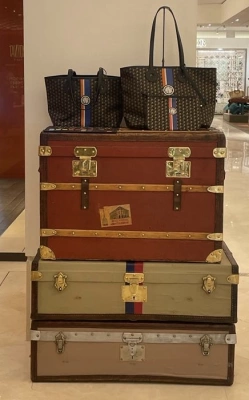
The history of luggage dates back to ancient times, when people used cloth bags or woven baskets to carry their belongings. However, these bags were often bulky and impractical to carry over long distances.
Over the centuries, luggage evolved to become more functional and adapted to travellers' needs. In the Middle Ages, nobles used wooden chests to carry their belongings when travelling. These chests were often heavy and required several people to carry them.
With the advent of rail and sea travel in the 19th century, luggage underwent a new evolution. Wooden trunks became popular, offering better protection for fragile objects. These trunks were often adorned with leather or canvas and were used by wealthy travellers.
In the 20th century, the arrival of commercial aviation led to a further transformation of luggage. Rigid metal or plastic suitcases became common, offering greater shock resistance and storage capacity. Wheels were also added to make transport easier.
Today, luggage is available in a wide variety of shapes, sizes and materials. Many models are available from Les Malletiers....
27 Jul 2023

Louis Vuitton's Keepall travel bag, the 1930s... Cruises were fashionable, as were holidays in Deauville and Biarritz.
At that time, Louis Vuitton, renowned for its trunks, had to adapt to these new lifestyles. The result was the Keepall, a bag that "keeps everything". The Keepall is a flexible, zipped bag made from the famous monogrammed coated canvas. Its generous shape allows you to slip in a sports outfit and a few simple clothes for a weekend in the countryside.
An immediate success, the Keepall has never left the Louis Vuitton catalogue. It has been used in the trunk-maker's other collections, and given a new look by artists invited by Marc Jacobs, including Takashi Murakami and others.
Four sizes were chosen (45, 50, 55 and 60 cm), with the first three being the most popular because they could be carried in the cabin.
Seen over and over again on all the people for generations, the Keepall is now a timeless piece, which we keep, cherish and watch lovingly polish... Les Malletiers loves it too!
27 Jul 2023
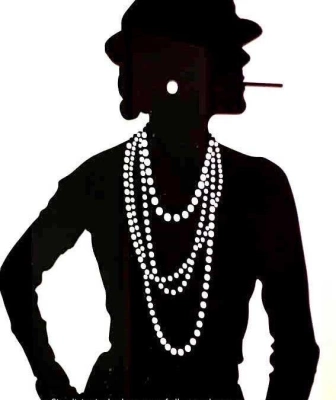
Coco Untold Stories, the early years...
She symbolizes French elegance. Gabrielle Chanel, born in Saumur in 1883, whose real name was Gabrielle Chasnel, was raised in an orphanage. At the age of 12, she was taken in with two of her sisters at Aubazine Abbey in Corrèze.
Her mother died in Brive-la-Gaillarde in 1895. When she was just 12, her father abandoned her a few months later, to the care of the nuns. He never returned. Gabrielle went to Aubazine to learn sewing. She stayed for 6 years. The abbey would remain a powerful source of inspiration for the codes of the House of Chanel...
Coco Chanel's taste for clean lines and her predilection for black, white and beige are perhaps linked to the sobriety of the abbey and its occupants...
Once she left Aubazine, she moved to Moulin. Gabrielle had to earn a living, so she sang in small shows in bars, famous for her rendition of
“Who has seen Coco on the Trocadero? Coco, a nickname that has stuck for posterity...
10 Aug 2023