








Are you sure you want to perform this action?
For Les malletiers, the online marketplace for pre-owned luxury leather goods: A Chanel clasp almost never fails to catch the trained eye. In the pre-owned market, it’s often the first thing that speaks volumes: the balance of proportions, the sharpness of the double C, the quality of the metal, and the precision of the rotation. If you’re wondering how to reliably identify a Chanel clasp, you need to look far beyond the logo’s simple design.
The clasp is a litmus test. It embodies both the brand’s aesthetic vocabulary and technical details that are difficult to replicate accurately. This doesn’t mean that a clasp alone is enough to authenticate a bag. However, it often allows you to quickly rule out an inconsistent piece—or, conversely, to confirm an impression of quality.
## Why the Chanel clasp deserves special attention
At Chanel, hardware is never just an accessory. On a Classic Flap, a 2.55 Reissue, or certain more exclusive clutches, the clasp plays a full role in the model’s identity. It is not merely a functional element, but a sign of style, era, and sometimes even collection.
This importance explains why counterfeits focus on it. Many copy the general design, but few capture all the right details. A poorly made clasp may feature a double C that’s too thick, uneven symmetry, a loose rotation, or a visibly thin plating. Conversely, some recent copies are more convincing at first glance. This is where expert analysis comes in: an isolated detail matters less than the overall consistency.
## How to identify a Chanel clasp by model
Before examining the quality of craftsmanship, you must identify the expected clasp type. Chanel has produced several iconic designs, and the most common mistake is comparing a bag to a model other than its own.
### The Classic Flap’s CC Turnlock Clasp
This is the most famous one. Two interlocking Cs, with a central rotating mechanism, mounted on a plate or integrated into the flap depending on the generation. On an authentic piece, the proportions are generally very well-balanced. The upright C passes over the left C at the top and beneath it at the bottom. The visual appearance is clean and uncluttered.
The movement should inspire confidence. The rotation is neither abnormally stiff nor loose. There may be variations depending on the bag’s age and wear, but the mechanism generally retains a solid feel. A clasp that is too loose or whose axis seems unstable warrants caution.
### The Mademoiselle Lock on the 2.55 Reissue
Here, there is no visible double C. The rectangular clasp, known as the Mademoiselle, follows a more understated, architectural design. It is of major importance for authentication, precisely because it is less showy. Counterfeits often neglect the exact lines, the volume of the metal, and the fit of the rotating mechanism.
On a beautiful 2.55, the clasp appears integrated into the bag’s design, never tacked on as an afterthought. The straightness of the edges, the depth of the finish, and the relationship between the metal and the leather are essential. A finish that is too shiny or too thick may betray a rough interpretation of the model.
### Clasps on Clutch Bags, Evening Bags, and Special Editions
This is the most delicate area. Chanel has introduced numerous decorative variations: jeweled clasps, logoed buttons, concealed magnetic snaps, and jeweled closures on evening pieces. In these cases, it is risky to rely on a universal rule. One must know the reference, the era, and the spirit of the collection.
An unusual clasp is not suspicious by default. At Chanel, the exception is part of the house’s language. But it must remain credible in terms of craftsmanship, materials, and stylistic context.
## The details that distinguish an authentic Chanel clasp
First impressions matter, but they must be verified point by point. An authentic Chanel clasp is rarely recognizable by a single spectacular detail. Rather, it stands out through a combination of precise details.
### The proportions of the double C
The logo design is often misinterpreted on counterfeits. The curves may be too round, too flat, too thick, or visibly unbalanced. On an authentic piece, the letters intertwine clearly. Nothing looks forced.
The spacing between the elements also deserves attention. A double C that is too tight or too open immediately alters the clasp’s appearance. At Chanel, this geometry has an almost instinctive balance: the eye is never jarring.
### The Quality of the Metal and Finish
A genuine Chanel clasp has a beautiful visual density. Whether it is made of gold, silver, ruthenium-plated, or aged metal depending on the era, the finish must appear masterfully executed. This does not mean uniform. Some older series display a natural patina, others a more pronounced sheen. But the overall effect remains elegant.
Be wary of overly flashy surfaces, poor reflections, or coarse irregularities. The plating should not give an immediate impression of fragility. On vintage pieces, wear may be present, of course, but it generally follows a pattern of elegant use, not premature and inconsistent deterioration.
### Engravings and Markings
Some clasps or associated interior plates bear Chanel markings or manufacturing details. Their presence, typography, and clarity should be examined carefully. An authentic engraving is generally precise, legible, and well-placed.
However, one must remain nuanced. Depending on the model and period, not all clasps feature the same inscriptions. The absence of a marking in a given location is therefore not always a negative sign. Conversely, a marking that is too heavy-handed, poorly centered, or clumsily executed should raise a red flag.
### Assembly and alignment
The clasp does not stand alone. It must be in perfect harmony with the flap, the padding, the closure plate, and, on certain models, the interior pocket. A slight misalignment may exist on a well-worn piece, but the overall assembly must remain coherent.
When the clasp appears crooked, off-center, or out of sync with the bag’s lines, suspicion is warranted. Chanel masters the architecture of its objects. Even a soft or vintage piece retains this sense of order.
## What counterfeits fail to reproduce
The best copies can imitate a logo. They are far less successful at reproducing the relationship between the metal, the mechanism, and the structure. It is often in the movement that they fall short. The clasp turns too freely, offers uneven resistance, sounds hollow, or becomes misaligned over time.
Another common issue: a poor understanding of historical periods. We sometimes see a clasp inspired by a recent Classic Flap mounted on a bag meant to evoke an older design, or a metal finish that clashes with the chain, eyelets, and other hardware. This type of inconsistency matters just as much as the clasp itself.
The copy also falls short in the details. The angles between the clasp and the leather, the precision of the screws, the fit of the back plate, the relief of the logo—these are all subtle details that a trained eye quickly spots. Authenticity is revealed in continuity, not in the overall effect.
## How to identify a Chanel clasp without falling for false criteria
There is a common temptation: to look for a simple, almost mechanical rule. For example, believing that a specific weight of the clasp, a single screw shape, or a single shade of gold is enough to make a definitive judgment. In reality, Chanel has evolved its designs over the decades, across workshops, seasons, and reissues.
One must therefore avoid absolute certainties. A more matte clasp may be perfectly authentic for a given period. Visible wear may be consistent with a high-quality vintage piece. Conversely, a flawless clasp is not necessarily reassuring if the rest of the bag lacks consistency.
The correct method involves cross-referencing clues: model, presumed era, overall construction, leather, chain, interior markings, hologram if present, and of course the clasp. In the world of Chanel, authenticity depends on a holistic assessment.
## The Value of an Expert Appraisal When Doubt Remains
For a collector’s purchase or a significant investment, examining the clasp should be a reflex, not a final verdict. A reputable seller should be able to document the piece, stand by their analysis, and present a well-reasoned assessment of its characteristics.
This is particularly true for vintage models, rare series, or bags that have been repaired. A replaced clasp does not necessarily imply a counterfeit, but it alters the interpretation of the object and its value. One must then distinguish the authentic restored piece from an incoherent assembly.
At a specialized house like Les Malletiers, this nuance is essential. A beautiful secondhand object is not judged by a single visual sign, but by the accuracy of its material history.
## What a Clasp Reveals to the Collector
Learning to observe a Chanel clasp means refining one’s perspective on the house itself. It reveals a discipline of design, a culture of hardware, and a very French sense of style where detail is never merely decorative or random. For the discerning connoisseur, this learning goes beyond mere caution regarding fakes.
It allows for better selection, better comparison, and sometimes the recognition of a piece’s uniqueness even before examining its interior. A genuine clasp has a certain calmness about it. It does not try to convince. It asserts itself with obviousness.
If you’re hesitating over a Chanel bag, take a few seconds to look at its clasp as an expert would look at a signature: not as a promise, but as the tangible mark of craftsmanship.
Related articles

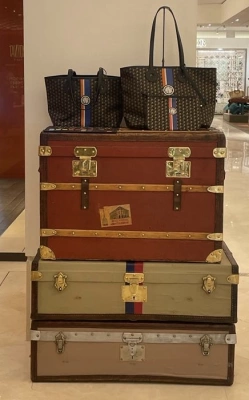
The history of luggage dates back to ancient times, when people used cloth bags or woven baskets to carry their belongings. However, these bags were often bulky and impractical to carry over long distances.
Over the centuries, luggage evolved to become more functional and adapted to travellers' needs. In the Middle Ages, nobles used wooden chests to carry their belongings when travelling. These chests were often heavy and required several people to carry them.
With the advent of rail and sea travel in the 19th century, luggage underwent a new evolution. Wooden trunks became popular, offering better protection for fragile objects. These trunks were often adorned with leather or canvas and were used by wealthy travellers.
In the 20th century, the arrival of commercial aviation led to a further transformation of luggage. Rigid metal or plastic suitcases became common, offering greater shock resistance and storage capacity. Wheels were also added to make transport easier.
Today, luggage is available in a wide variety of shapes, sizes and materials. Many models are available from Les Malletiers....
27 Jul 2023
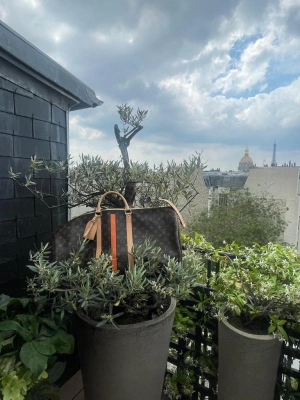
Louis Vuitton's Keepall travel bag, the 1930s... Cruises were fashionable, as were holidays in Deauville and Biarritz.
At that time, Louis Vuitton, renowned for its trunks, had to adapt to these new lifestyles. The result was the Keepall, a bag that "keeps everything". The Keepall is a flexible, zipped bag made from the famous monogrammed coated canvas. Its generous shape allows you to slip in a sports outfit and a few simple clothes for a weekend in the countryside.
An immediate success, the Keepall has never left the Louis Vuitton catalogue. It has been used in the trunk-maker's other collections, and given a new look by artists invited by Marc Jacobs, including Takashi Murakami and others.
Four sizes were chosen (45, 50, 55 and 60 cm), with the first three being the most popular because they could be carried in the cabin.
Seen over and over again on all the people for generations, the Keepall is now a timeless piece, which we keep, cherish and watch lovingly polish... Les Malletiers loves it too!
27 Jul 2023
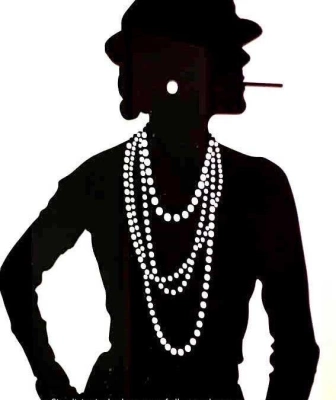
Coco Untold Stories, the early years...
She symbolizes French elegance. Gabrielle Chanel, born in Saumur in 1883, whose real name was Gabrielle Chasnel, was raised in an orphanage. At the age of 12, she was taken in with two of her sisters at Aubazine Abbey in Corrèze.
Her mother died in Brive-la-Gaillarde in 1895. When she was just 12, her father abandoned her a few months later, to the care of the nuns. He never returned. Gabrielle went to Aubazine to learn sewing. She stayed for 6 years. The abbey would remain a powerful source of inspiration for the codes of the House of Chanel...
Coco Chanel's taste for clean lines and her predilection for black, white and beige are perhaps linked to the sobriety of the abbey and its occupants...
Once she left Aubazine, she moved to Moulin. Gabrielle had to earn a living, so she sang in small shows in bars, famous for her rendition of
“Who has seen Coco on the Trocadero? Coco, a nickname that has stuck for posterity...
10 Aug 2023