








Are you sure you want to perform this action?
A Speedy from the ’90s, a Keepall weathered by travel, a monogrammed trunk that still embodies the very idea of setting out—**pre-owned Louis Vuitton** is more than just an alternative to new. It is often a more refined, more deliberate choice, and sometimes even a more discerning one. But you still need to know how to distinguish a beautiful piece from one that is simply old, a heritage item from an impulse buy, and an authentic rarity from a market saturated with promises.
## Why secondhand Louis Vuitton is so appealing
Louis Vuitton occupies a unique place in the history of French luxury. Few houses have managed to consistently bring together function, travel, craftsmanship, and contemporary desirability. It is precisely for this reason that the pre-owned market is so vibrant.
Buying a second-hand Louis Vuitton piece isn’t just about looking for a price different from the one in the store. It also means gaining access to discontinued styles, finishes no longer offered, more balanced proportions, or pieces whose patina lends a depth that new items do not yet possess. Vintage Monogram canvas, natural leather that has aged gracefully, hardware slightly softened by time—these are all signs that can enhance a piece’s character rather than diminish it.
But this appeal has its downside. The higher the demand, the higher the standards must be. Not all vintage pieces deserve a collector’s interest, and not all offers are created equal.
## How to Choose a Pre-Owned Louis Vuitton with Discernment
The first criterion is less the model itself than the actual condition of the piece. An iconic piece retains its appeal, of course, but the condition determines the quality of the purchase. With Louis Vuitton, certain elements warrant special attention: the canvas, the corners, the handles, the stitching, the metal hardware, and—when the model features them—the natural leather parts.
The coated canvas should hold its shape well, without structural cracks or excessive sagging. The corners often reveal a bag’s true condition faster than its front face. As for calfskin, it warrants a nuanced assessment. A uniform honey-colored patina can be highly desirable. On the other hand, pronounced water stains, irregular darkening, or deep drying out detract from the bag’s overall elegance.
The second criterion is how you intend to use it. An Alma or a Speedy does not meet the same expectations as a Neverfull, an Accessory Clutch, or a Keepall. For an everyday purchase, practicality, weight, and ease of opening matter just as much as style. For a collector’s item, rarity, the accuracy of proportions, and the presence of original elements take precedence. There is no such thing as a “good” purchase per se—there is only a purchase that aligns with your perspective and how you experience the object.
### The models that stand the test of time
Certain Louis Vuitton models have stood the test of time with remarkable consistency. The Speedy remains a classic thanks to its instantly recognizable silhouette and its balance of capacity and elegance. The Keepall remains a benchmark for those who appreciate the heritage of travel. The Noé, with its supple silhouette, possesses a very distinctive presence on the secondary market, especially in its well-preserved vintage versions.
Other pieces appeal due to their more limited availability on the market. This is the case with certain small leather goods, costume jewelry that has become hard to find, or luggage and trunks that are more a part of heritage than mere accessories. These items require a more trained eye, but often offer a rarer sense of satisfaction.
### Older isn’t always better than newer
One might think that an older piece is necessarily more interesting. This isn’t always true. Some recent designs offer formats better suited to contemporary uses, more thoughtfully designed interiors, or refined finishes found in limited editions. Conversely, certain older models appeal because of their materials, construction, or craftsmanship details.
It all depends, therefore, on what you’re looking for. If you’re drawn to patina and history, vintage is the natural choice. If you prioritize structure, functionality, or near-new condition, a more recent piece may be preferable. The secondhand Louis Vuitton market is vast enough to accommodate both approaches, provided you don’t confuse them.
## Authenticity: The Decisive Factor in Secondhand Louis Vuitton
In this segment, trust isn’t a matter of convenience—it’s a necessity. Louis Vuitton is one of the most counterfeited brands in the world. A successful purchase therefore begins with a flawless verification process.
Authenticity is never determined by a single detail. It relies on a cluster of indicators: the quality of the canvas, the consistency of the markings, the uniformity of the stitching, the typography, the overall construction, the hardware, the date code where applicable, and the overall alignment between the model, the era, and its characteristics. It is precisely this level of expert analysis that distinguishes a reputable house from a mere intermediary platform.
A certificate of authenticity issued by a recognized expert profoundly changes the nature of the purchase. It is no longer merely a commercial statement, but a documented commitment. For both the discerning enthusiast and the collector, this guarantee provides decisive peace of mind, particularly for high-value items or models rarely seen on the market.
## What Determines a Piece’s True Value
Price alone says little. The value of a pre-owned Louis Vuitton is determined by a combination of factors: the model’s desirability, rarity, condition, the presence of original accessories, the appeal of the design, and market supply and demand.
A widely available model in average condition may be affordable without being particularly appealing. Conversely, a more understated piece, perfectly preserved, complete with its shoulder strap, padlock, keys, or original box, may command a significantly higher price. The savvy collector doesn’t just pay for a name—they recognize the integrity of the entire piece.
Timing is also a key factor. Some items experience spikes in interest tied to trends, then stabilize. Others appreciate more slowly but with greater consistency, particularly items related to the world of travel or models that have long been discontinued. If your purchase is driven by personal taste, this fluctuation matters little. If you’re also thinking in terms of long-term value, it’s worth observing calmly.
## Where to buy without compromising your standards
Today’s secondary market offers a wealth of channels, but not all provide the same level of curation or the same degree of accountability. The gap is considerable between generalist marketplaces, specialized dealers, and houses with a strong culture of expertise.
A truly serious selection does not present items as anonymous stock.
It describes them with precision, acknowledges their actual condition, documents important details, and situates the object within a history of manufacture, use, and desire. This is where a specialist’s approach becomes evident.
For buyers who value rarity, condition, and authenticity, a curatorial specialist often offers a more authentic experience. At Les Malletiers, this commitment takes the form of a selection focused on prestigious houses, accompanied by a certificate of authenticity written by Jérôme Lalande, an expert at the Paris Court of Appeal. In a world where assurance determines value, this rigor is no small matter.
## Buying well also means knowing how to wait
The desire to find something quickly often leads to unnecessary compromises. Yet the right pre-owned Louis Vuitton piece isn’t necessarily the one you see most often. It’s the one whose condition, size, era, and presence precisely match what you were looking for—sometimes without having even articulated it exactly.
Waiting for a better patina, a more compelling color, an older version, or simply a cleaner example is often the most elegant decision. This patience is part of the culture of the rare object. It avoids merely adequate purchases and allows for acquisitions that truly matter.
To achieve this, it is helpful to examine pieces methodically, compare proportions, familiarize yourself with manufacturing details, and never pit emotion against expertise. In the world of secondhand luxury, the finest choice is often the one where the two come together.
A well-chosen pre-owned Louis Vuitton piece offers more than just a logo or status. It introduces into a wardrobe, a collection, or an interior an object that has already stood the test of time and can continue to do so with style. It is perhaps the most demanding form of luxury—one that prioritizes authenticity over immediate impact.
Related articles

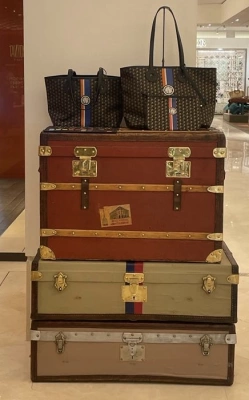
The history of luggage dates back to ancient times, when people used cloth bags or woven baskets to carry their belongings. However, these bags were often bulky and impractical to carry over long distances.
Over the centuries, luggage evolved to become more functional and adapted to travellers' needs. In the Middle Ages, nobles used wooden chests to carry their belongings when travelling. These chests were often heavy and required several people to carry them.
With the advent of rail and sea travel in the 19th century, luggage underwent a new evolution. Wooden trunks became popular, offering better protection for fragile objects. These trunks were often adorned with leather or canvas and were used by wealthy travellers.
In the 20th century, the arrival of commercial aviation led to a further transformation of luggage. Rigid metal or plastic suitcases became common, offering greater shock resistance and storage capacity. Wheels were also added to make transport easier.
Today, luggage is available in a wide variety of shapes, sizes and materials. Many models are available from Les Malletiers....
27 Jul 2023
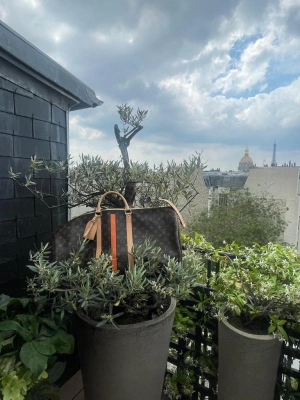
Louis Vuitton's Keepall travel bag, the 1930s... Cruises were fashionable, as were holidays in Deauville and Biarritz.
At that time, Louis Vuitton, renowned for its trunks, had to adapt to these new lifestyles. The result was the Keepall, a bag that "keeps everything". The Keepall is a flexible, zipped bag made from the famous monogrammed coated canvas. Its generous shape allows you to slip in a sports outfit and a few simple clothes for a weekend in the countryside.
An immediate success, the Keepall has never left the Louis Vuitton catalogue. It has been used in the trunk-maker's other collections, and given a new look by artists invited by Marc Jacobs, including Takashi Murakami and others.
Four sizes were chosen (45, 50, 55 and 60 cm), with the first three being the most popular because they could be carried in the cabin.
Seen over and over again on all the people for generations, the Keepall is now a timeless piece, which we keep, cherish and watch lovingly polish... Les Malletiers loves it too!
27 Jul 2023
Coco Untold Stories, the early years...
She symbolizes French elegance. Gabrielle Chanel, born in Saumur in 1883, whose real name was Gabrielle Chasnel, was raised in an orphanage. At the age of 12, she was taken in with two of her sisters at Aubazine Abbey in Corrèze.
Her mother died in Brive-la-Gaillarde in 1895. When she was just 12, her father abandoned her a few months later, to the care of the nuns. He never returned. Gabrielle went to Aubazine to learn sewing. She stayed for 6 years. The abbey would remain a powerful source of inspiration for the codes of the House of Chanel...
Coco Chanel's taste for clean lines and her predilection for black, white and beige are perhaps linked to the sobriety of the abbey and its occupants...
Once she left Aubazine, she moved to Moulin. Gabrielle had to earn a living, so she sang in small shows in bars, famous for her rendition of
“Who has seen Coco on the Trocadero? Coco, a nickname that has stuck for posterity...
10 Aug 2023