








Are you sure you want to perform this action?
Discover secondhand jewelry with Les Malletiers. A clasp that clicks crisply, a setting with just the right weight, a patina that can’t be faked—luxury vintage jewelry is often recognizable even before it’s identified. For discerning connoisseurs, this intuitive sense matters just as much as the designer’s signature. It speaks to the quality of craftsmanship, the era, and sometimes even the specific workshop where it was made. And it reminds us that when it comes to secondhand jewelry, value lies not only in the name of the house, but in the convergence of desire, provenance, and the integrity of the object.
Choosing an antique or vintage piece from a prestigious house is far from an impulse buy. It is a more deliberate, and also more intimate, act. We seek a presence, a silhouette, a legacy. Unlike a new piece, the jewelry has already stood the test of time. It sometimes embodies the codes of a decade, sometimes a freedom of design that has become rare, and sometimes a level of craftsmanship that certain contemporary productions no longer match at this price point.
## Why luxury vintage jewelry attracts collectors
The appeal lies first and foremost in rarity. Many pieces by Chanel, Dior, Hermès, Gucci, or Prada are no longer produced. Some collections existed for only a few seasons. Others marked a specific period in a house’s style and are now sought after for that very reason. Buying vintage, therefore, means accessing a broader aesthetic vocabulary than that of current collections.
Then there is the question of character. A beautifully crafted vintage piece of jewelry does not need a spectacular effect to make its presence felt. An architectural cuff, a pair of sculptural clip-ons, or a perfectly balanced necklace are enough. Here, luxury does not lie in what is visible at first glance, but in precision.
Finally, we must address the concept of legacy. A piece of heritage jewelry, when authentic, well-preserved, and desirable, fits into a heritage framework that is far more compelling than a mere fashion purchase. This does not mean that every piece automatically increases in value. However, certain brands, certain conditions of preservation, and certain references maintain remarkable stability in the market.
## What Really Determines the Value of a Piece of Vintage Luxury Jewelry
The first criterion is authenticity, without question. In the world of secondhand luxury, it is not a marketing pitch but the very condition of value. A signed piece of jewelry without proper traceability, expert examination, manufacturing consistency, or a credible certificate enters a zone of uncertainty that connoisseurs avoid.
The designer’s signature, then, matters, but it is not enough. Not all pieces from a major house are created equal. Some lines have become iconic, others more anecdotal. Certain creative periods are particularly sought after for their stylistic strength. One must therefore examine the jewelry in its context—estimated date, collection, formal language, materials used, clasp system, and quality of finish.
Condition plays a decisive role. A light patina consistent with the piece’s age is acceptable, and sometimes even desirable. On the other hand, extensive restoration, missing parts, deformations, or excessive wear affect desirability. It all depends on the nature of the piece. On a very rare piece of jewelry, a flaw may be tolerated. On a more common piece, it carries greater weight.
Provenance adds another dimension. A piece of jewelry accompanied by clear documentation, an original case, or a rigorously prepared certificate of authenticity inspires a different level of confidence. For a discerning clientele, this confidence is not incidental. It shapes the pleasure of acquiring the piece as much as its future resale value.
## How to assess a piece beyond its logo
An experienced buyer is never satisfied with just a logo. They first examine the construction. The hinges, the soldering, the consistency of the settings, the density of the metal, the quality of a plating, or the precision of a motif all provide valuable insights. The great houses have standards. Even when a piece features an exuberant design, its craftsmanship must remain meticulous.
One must also understand the house’s spirit. Chanel does not express jewelry like Hermès, and Dior does not approach ornamentation like Gucci. Some houses favor bold ornamentation, others a more structured restraint. An authentic piece resonates within this universe. When a piece of jewelry seems to contradict the brand’s historical codes too sharply, caution is warranted.
The question of materials deserves nuance. In luxury vintage, not all pieces fall under the category of fine jewelry. Designer costume jewelry, when remarkable for its design, rarity, and condition, can inspire as much desire as a piece made of precious metals. We should therefore not systematically pit material value against collectible value. They follow similar but distinct logics.
## Buying to wear, collect, or pass on
The intention behind the purchase changes how one chooses. If the jewelry is meant to be worn often, comfort, durability, and versatility matter greatly. A spectacular brooch may captivate in a display case but rarely see the light of day. Conversely, a well-proportioned necklace, bracelet, or earrings fit more naturally into an everyday wardrobe, even a very demanding one.
If buying with a view to collecting, coherence often takes precedence over wearability. One will seek out a specific period, a designer house, a motif, or sometimes a set. Documentary rarity can become as important as pure aesthetics. This type of acquisition requires greater patience and a disciplined eye.
For the purpose of passing down, it is best to prioritize timeless designs and recognizable signatures. Pieces that are too dependent on a passing trend certainly retain their appeal, but they speak less universally. A beautiful vintage piece of jewelry must be able to pass from one generation to the next without losing its relevance.
## Common Mistakes in Luxury Vintage Jewelry
The first is buying too quickly under the influence of scarcity. Vintage, by its very nature, creates a sense of urgency, since a piece is unique or nearly impossible to find. But rarity does not excuse a hasty decision. It is better to pass on an attractive piece than to settle for one with insufficient provenance.
The second mistake is overvaluing the brand name at the expense of the object’s intrinsic quality. A big name is appealing, but a minor piece from a prestigious house may be less interesting than a stronger model that is better preserved and more representative of the brand’s codes.
The third mistake concerns condition. Many novice buyers believe that vintage jewelry must necessarily show significant signs of wear. This is incorrect. Some antique pieces have been worn very little and retain a remarkable presence. Age is not an automatic justification for flaws.
Finally, don’t confuse a high price with solid value. The secondhand luxury market is subject to trends, frenzies, and corrections. The best purchase isn’t always the most expensive one, but the one where quality, authenticity, and desirability align.
## Where to Find Trustworthy Vintage Luxury Jewelry
The purchasing channel significantly influences the level of risk. Open platforms offer choice but require a highly trained eye. Specialized dealers offer something else—curation, inspection, editorial consistency, and accountability. In a segment as sensitive as that of second-hand luxury jewelry, this difference is considerable.
A serious specialist does not merely present an object. They situate it within a brand’s history, describe its characteristics with precision, honestly report its condition, and guarantee its authenticity through a verifiable expert appraisal. It is in this spirit that Les Malletiers curates its selection, accompanied by a certificate of authenticity drafted by Jérôme Lalande, Expert at the Paris Court of Appeal. For the discerning connoisseur, this level of rigor makes all the difference.
This standard also applies to resale. A piece of jewelry that was well-sourced, properly documented, and preserved in good condition circulates more smoothly on the secondary market. Vintage luxury is not a guaranteed investment, but the quality of the selection minimizes unpleasant surprises.
## Recognizing the Right Piece
The right piece isn’t always the most showy. It’s often the one that stands up to a second look, then a third. The one whose proportions remain precise, whose presence doesn’t fade after the initial impact. In vintage luxury jewelry, this enduring quality is a precious sign.
One must accept that the choice also depends on oneself. Some seek the instantly recognizable icon. Others prefer a more discreet creation, discernible only to connoisseurs. Neither choice is superior to the other. It all depends on the relationship one wishes to have with the object—a style statement, personal pleasure, or a collector’s acquisition.
A well-chosen antique or vintage piece of jewelry does more than simply adorn. It adds depth to a silhouette, memory to a gesture, and meaning to an acquisition. This is undoubtedly what makes it so unique—it does not replace the new; it offers something else, something richer, more selective, and often more enduring.
Related articles

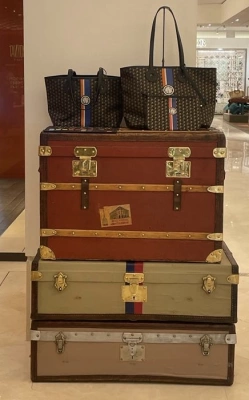
The history of luggage dates back to ancient times, when people used cloth bags or woven baskets to carry their belongings. However, these bags were often bulky and impractical to carry over long distances.
Over the centuries, luggage evolved to become more functional and adapted to travellers' needs. In the Middle Ages, nobles used wooden chests to carry their belongings when travelling. These chests were often heavy and required several people to carry them.
With the advent of rail and sea travel in the 19th century, luggage underwent a new evolution. Wooden trunks became popular, offering better protection for fragile objects. These trunks were often adorned with leather or canvas and were used by wealthy travellers.
In the 20th century, the arrival of commercial aviation led to a further transformation of luggage. Rigid metal or plastic suitcases became common, offering greater shock resistance and storage capacity. Wheels were also added to make transport easier.
Today, luggage is available in a wide variety of shapes, sizes and materials. Many models are available from Les Malletiers....
27 Jul 2023
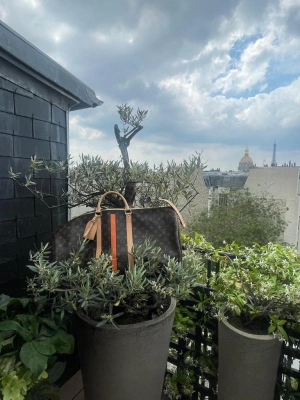
Louis Vuitton's Keepall travel bag, the 1930s... Cruises were fashionable, as were holidays in Deauville and Biarritz.
At that time, Louis Vuitton, renowned for its trunks, had to adapt to these new lifestyles. The result was the Keepall, a bag that "keeps everything". The Keepall is a flexible, zipped bag made from the famous monogrammed coated canvas. Its generous shape allows you to slip in a sports outfit and a few simple clothes for a weekend in the countryside.
An immediate success, the Keepall has never left the Louis Vuitton catalogue. It has been used in the trunk-maker's other collections, and given a new look by artists invited by Marc Jacobs, including Takashi Murakami and others.
Four sizes were chosen (45, 50, 55 and 60 cm), with the first three being the most popular because they could be carried in the cabin.
Seen over and over again on all the people for generations, the Keepall is now a timeless piece, which we keep, cherish and watch lovingly polish... Les Malletiers loves it too!
27 Jul 2023
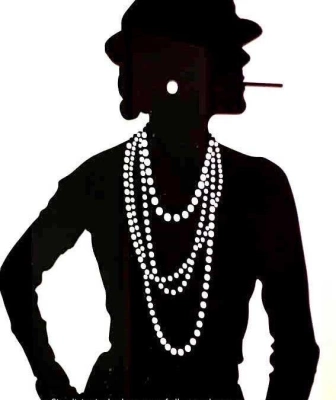
Coco Untold Stories, the early years...
She symbolizes French elegance. Gabrielle Chanel, born in Saumur in 1883, whose real name was Gabrielle Chasnel, was raised in an orphanage. At the age of 12, she was taken in with two of her sisters at Aubazine Abbey in Corrèze.
Her mother died in Brive-la-Gaillarde in 1895. When she was just 12, her father abandoned her a few months later, to the care of the nuns. He never returned. Gabrielle went to Aubazine to learn sewing. She stayed for 6 years. The abbey would remain a powerful source of inspiration for the codes of the House of Chanel...
Coco Chanel's taste for clean lines and her predilection for black, white and beige are perhaps linked to the sobriety of the abbey and its occupants...
Once she left Aubazine, she moved to Moulin. Gabrielle had to earn a living, so she sang in small shows in bars, famous for her rendition of
“Who has seen Coco on the Trocadero? Coco, a nickname that has stuck for posterity...
10 Aug 2023