








Are you sure you want to perform this action?
All it takes is opening an old trunk, lifting a weathered brass clasp, and feeling the texture of full-grain leather to realize that a vintage luxury piece of luggage is far more than just a travel accessory. It is an object of history, craftsmanship, and memory. Unlike a contemporary piece designed for the rapid turnover of collections, it carries a presence—that of a house, an era, a purpose, and sometimes even a certain art of living.
In the world of secondhand luxury, luggage holds a special place. It appeals to the refined traveler, of course, but also to the collector, the design enthusiast, and those with an eye for classic lines and the perfect patina. A Louis Vuitton trunk, a Dior vanity case, a Goyard trolley, a Hermès travel kit, or a Moynat suitcase do not all fulfill the same desire. Some are bought to be used. Others to be preserved, passed down, or displayed. The right choice therefore depends less on a trend than on an intention.
## Why vintage luxury luggage is so fascinating
The first appeal is obvious—the quality of craftsmanship. The great travel houses have developed techniques that stand the test of time because they were designed to last. Coated canvas, saddle leather, reinforced corners, metal trim, padded handles, compartmentalized interiors—nothing was left to chance. This material excellence gives vintage pieces a unique advantage over some of today’s offerings, which are sometimes more about show than substance.
But the fascination isn’t just about craftsmanship. An antique piece of luggage possesses cultural depth. It tells the story of the golden age of ocean crossings, night trains, legendary hotels, and meticulously planned departures. Even when reintroduced into a very contemporary setting, it retains this depth. This explains why a vintage cabin trunk or soft-sided suitcase can harmonize just as well with a sophisticated interior as it does with practical use.
Finally, there is rarity. In certain categories, it is decisive. Vintage sizes are no longer produced, finishes have changed, certain fabrics have disappeared, and some interiors were made to order. This creates a market where nuance matters greatly. Two pieces from the same brand, visually similar, can have very different values depending on their era, condition, configuration, or appeal to collectors.
## How to Buy Luxury Vintage Luggage Without Making a Mistake
The first criterion is not the brand. It is authenticity. On the secondary market, luggage is a vulnerable category, especially when it comes to highly sought-after brands. A rigorous inspection is therefore essential. It must focus on the piece’s overall consistency—materials, markings, construction, hardware, typography, lining, natural wear, and manufacturing details. A thorough authentication never relies on a single isolated sign.
Condition comes next, with significant precision—an antique piece of luggage doesn’t have to be perfect to be desirable. A uniform patina, slightly worn corners, supple leather, and canvas softened by time can enhance the piece’s charm. On the other hand, certain alterations must be evaluated with caution—a sagging structure, a weakened handle, a musty odor, a lining that is too deteriorated, clumsy restorations, or elements replaced inconsistently.
It is also important to distinguish between a piece’s condition for everyday use and its condition as a collector’s item. A vintage suitcase intended for travel will not meet the same standards as a collector’s trunk or a travel kit meant to remain in a closet. A collector may sometimes accept inherent fragility if the piece is rare and unusual. A buyer who wishes to use it daily will prioritize a sturdy construction, a reliable closure, and a size suitable for modern use.
### The Importance of Provenance and Expertise
In this world, trust makes all the difference. A piece that is well-documented, accurately described, and examined by an expert inspires greater confidence in the purchase. This is particularly true for the most coveted houses, where market value depends heavily on authenticity and condition.
At Les Malletiers, every item comes with a certificate of authenticity written by Jérôme Lalande, an expert appointed by the Paris Court of Appeal. For a discerning buyer, this rigor is not a mere administrative formality. It forms the very foundation of an informed purchase, especially when dealing with a rare, heritage piece, or one intended to be passed down.
## Which pieces to look for based on your profile
Not all lovers of vintage luxury luggage are looking for the same thing, and that’s a good thing. The market offers several entry points.
The trunk remains the absolute archetype. It attracts collectors, lovers of decorative arts, and interiors where the piece can be showcased. Its appeal lies as much in its visual impact as in its historical significance. It does, however, require space, a certain understanding of collecting conventions, and a willingness to accept that its use may sometimes be more decorative than practical.
The hard- or semi-hard-shell suitcase often strikes the best balance. It retains the elegance of vintage luggage while being easier to integrate into contemporary life. Carry-on models, vanity cases, and certain travel bags offer a beautiful blend of character, functionality, and collectibility.
The trolley or more recent luggage from major luxury houses follows a different logic. It appeals to enthusiasts of iconic objects who wish to travel with a piece marked by a house’s heritage without sacrificing modern designs. Here, vintage is less about history and more about style. Value then depends on the line, the material, the period, and market availability.
### The Houses That Really Matter
Louis Vuitton remains a defining benchmark, both for the history of travel and for the depth of its secondary market. Its trunks, suitcases, and travel bags have stood the test of time with exceptional timeless appeal. Goyard appeals through a more understated rarity, often sought after by connoisseurs who appreciate restraint. Moynat attracts enthusiasts of the trunk-making tradition and a more understated Parisian elegance.
Hermès occupies a more unique niche—that of leather, refined travel, and beautifully crafted pieces that are sometimes less visible but highly desirable. Dior, Chanel, Gucci, and Prada offer more fashion-forward luggage and travel accessories, often more immediately recognizable, with a strong stylistic dimension. The choice therefore depends on your relationship with luxury—whether it’s rooted in heritage, aesthetics, practicality, or collecting.
## What Truly Determines a Piece’s Value
The brand alone is not enough. A piece gains value when it combines several qualities—impeccable authenticity, good condition, rarity of the model, the brand’s desirability, consistency of original details, and visual appeal.
A common trunk that has been heavily restored will not hold the same appeal as a less spectacular piece that remains intact in its original configuration.
The period also matters. Certain decades are more sought after for the quality of the materials, the beauty of the proportions, or the distinctive identity of the craftsmanship. One must also examine the details that connoisseurs notice immediately—period linings, locks, markings, corners, handles, interior straps, vintage labels, and any monograms present. A monogram may diminish a piece’s universal appeal for some buyers, but it can also enhance its historical charm for others. Here again, it all depends on how the object is viewed.
It is worth noting that a heritage purchase is not always a speculative investment. Some pieces appreciate in value. Others stabilize. Still others are purchased simply because they are irreplaceable in a collection or in a person’s life. This distinction deserves to be acknowledged. In vintage luxury, taste often takes precedence over performance.
## How to Incorporate Vintage Luxury Luggage Today
One of the most common mistakes is treating these pieces as objects too precious to be touched. When chosen wisely, vintage luggage can still serve a purpose. A vanity case can become a weekend companion. A carry-on suitcase can accompany short trips. A trunk can define a home office, a walk-in closet, or a living room with a quiet authority that no mass-produced piece of furniture truly possesses.
You simply need to respect the nature of the object. You don’t use a collector’s piece of luggage like a modern, functional suitcase. You avoid unnecessary strain, excessive weight, moisture, and rough handling. Vintage luxury doesn’t demand to be kept under a glass dome, but rather intelligent use.
For those seeking a specific piece, patience is often the best ally. A rare model should not be replaced by another simply because it is available. It is better to wait for the right maker, the right line, the right period, and the right condition. In this world, the right purchase brings lasting satisfaction, whereas a hasty purchase is immediately apparent.
The most beautiful luggage isn’t necessarily the flashiest or the most expensive. It’s the one whose presence stands out naturally, as if time had already done some of the selecting for you. When authenticity, craftsmanship, and style come together, you’re no longer just buying a travel item—you’re choosing a form of permanence.
Related articles

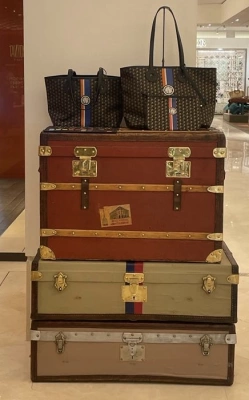
The history of luggage dates back to ancient times, when people used cloth bags or woven baskets to carry their belongings. However, these bags were often bulky and impractical to carry over long distances.
Over the centuries, luggage evolved to become more functional and adapted to travellers' needs. In the Middle Ages, nobles used wooden chests to carry their belongings when travelling. These chests were often heavy and required several people to carry them.
With the advent of rail and sea travel in the 19th century, luggage underwent a new evolution. Wooden trunks became popular, offering better protection for fragile objects. These trunks were often adorned with leather or canvas and were used by wealthy travellers.
In the 20th century, the arrival of commercial aviation led to a further transformation of luggage. Rigid metal or plastic suitcases became common, offering greater shock resistance and storage capacity. Wheels were also added to make transport easier.
Today, luggage is available in a wide variety of shapes, sizes and materials. Many models are available from Les Malletiers....
27 Jul 2023
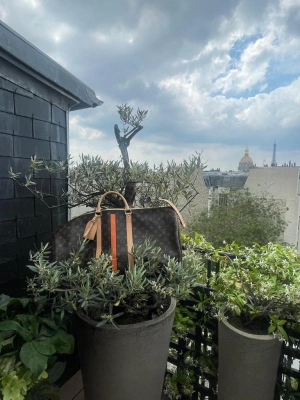
Louis Vuitton's Keepall travel bag, the 1930s... Cruises were fashionable, as were holidays in Deauville and Biarritz.
At that time, Louis Vuitton, renowned for its trunks, had to adapt to these new lifestyles. The result was the Keepall, a bag that "keeps everything". The Keepall is a flexible, zipped bag made from the famous monogrammed coated canvas. Its generous shape allows you to slip in a sports outfit and a few simple clothes for a weekend in the countryside.
An immediate success, the Keepall has never left the Louis Vuitton catalogue. It has been used in the trunk-maker's other collections, and given a new look by artists invited by Marc Jacobs, including Takashi Murakami and others.
Four sizes were chosen (45, 50, 55 and 60 cm), with the first three being the most popular because they could be carried in the cabin.
Seen over and over again on all the people for generations, the Keepall is now a timeless piece, which we keep, cherish and watch lovingly polish... Les Malletiers loves it too!
27 Jul 2023
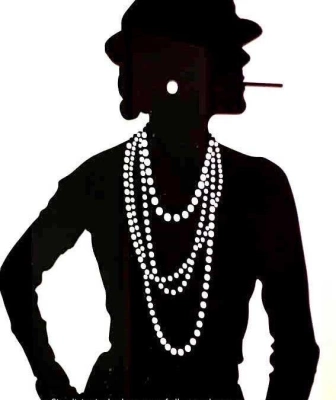
Coco Untold Stories, the early years...
She symbolizes French elegance. Gabrielle Chanel, born in Saumur in 1883, whose real name was Gabrielle Chasnel, was raised in an orphanage. At the age of 12, she was taken in with two of her sisters at Aubazine Abbey in Corrèze.
Her mother died in Brive-la-Gaillarde in 1895. When she was just 12, her father abandoned her a few months later, to the care of the nuns. He never returned. Gabrielle went to Aubazine to learn sewing. She stayed for 6 years. The abbey would remain a powerful source of inspiration for the codes of the House of Chanel...
Coco Chanel's taste for clean lines and her predilection for black, white and beige are perhaps linked to the sobriety of the abbey and its occupants...
Once she left Aubazine, she moved to Moulin. Gabrielle had to earn a living, so she sang in small shows in bars, famous for her rendition of
“Who has seen Coco on the Trocadero? Coco, a nickname that has stuck for posterity...
10 Aug 2023