








Are you sure you want to perform this action?
According to Les Malletiers, the secondhand marketplace, choosing a vintage Moynat bag isn’t like making a typical secondhand purchase. It’s a serendipitous encounter. With this discreet house, which has long remained outside the media spotlight, the vintage Moynat market primarily attracts enthusiasts who already appreciate fine leather goods, clean lines, and genuine rarity.
## Why Vintage Moynat Is Gaining Increasing Interest
Moynat belongs to that select circle of French houses whose prestige rests less on visibility than on the enduring nature of their craftsmanship. Founded in the 19th century, the house has distinguished itself in the world of travel, trunks, and refined leather goods, with a construction philosophy that immediately resonates with connoisseurs. This heritage matters. It explains the timeless design, the intelligent use of space, and the very distinct feeling of an object built to last.
In the pre-owned market, this historical discretion creates a unique phenomenon. On one hand, Moynat remains less abundant than other Parisian brands, which fuels desire. On the other hand, the house remains largely under the radar of the general public, which can make certain acquisitions more appealing than in saturated segments. This is not to promise an easy bargain—fine pieces are recognizable and command a price—but to remind us that a less overexposed market leaves more room for discernment than for fleeting trends.
For many buyers, choosing Moynat means favoring a more understated form of luxury. One seeks less an immediately recognizable status symbol than a clear sense of style, remarkable craftsmanship, and a history of craftsmanship. This is precisely what makes vintage pieces so compelling from this house.
## What Determines the Value of a Vintage Moynat Piece
The value of a Moynat bag or small leather good never depends on a single factor. It results from a balance between the model, condition, materials, era, color, and market desirability. In some cases, a very elegant model produced in larger quantities will be worth less than a more exclusive piece featuring exceptional leather or a construction that has become rare.
Condition remains decisive, but it warrants a nuanced assessment. In collectible leather goods, a uniform patina can enhance a piece’s charm, whereas heavy restoration or visible repairs can, on the contrary, diminish its appeal. One must distinguish between noble wear—gently polished corners, supple leather, a lively interior—and structural defects such as significant warping, weakened stitching, cracked varnish, or replaced hardware.
The material also plays a major role. Beautiful bull calf leather, well-preserved box calf, deeply grained leather, or an iconic canvas—depending on the era—do not all have the same presence. At Moynat, the balance between suppleness and structure matters greatly. A piece retains its desirability when it maintains its shape while developing a beautiful feel.
## How to recognize a good vintage Moynat
First, focus on the silhouette. With major leather goods houses, the precision of a line is often the first clue. An authentic Moynat bag features a masterful shape, without unnecessary stiffness. The proportions appear natural, the curves are clean, the gussets are consistent, and the closure flows with the design rather than interrupting it.
Next comes the quality of craftsmanship. The stitching must be even, the edges clean, and the assembly precise. The lining, markings, clasps, and metal hardware must all tell the same stylistic and technical story. When a detail appears newer, cruder, or simply out of place with the whole, caution is warranted.
One must also accept that a convincing vintage piece is not necessarily perfect. An older piece may show signs of age and remain highly desirable, provided its integrity is preserved. This is often where the difference lies between a fine acquisition and a purchase that is merely appealing in photos.
### Points to Watch for Before Purchasing
The luxury second-hand market demands particular attention to authenticity. For Moynat, this vigilance is all the more important given that the market mixes recent pieces, older models, incomplete descriptions, and sometimes imprecise attributions. A seller must be able to clearly document the item being offered, its material, its actual condition, and, ideally, its era.
Photographs must show the exterior, interior, angles, handles, markings, and hardware. A vague listing, lighting that obscures details, or insufficient images should be viewed as red flags. Doubt is not a minor detail in this segment; it determines the quality of a purchase.
In this world, independent expertise remains the most reassuring benchmark. At Les Malletiers, each piece is presented as authentic and accompanied by a certificate of authenticity issued by Jérôme Lalande, Expert at the Paris Court of Appeal. For a discerning buyer, this rigor profoundly transforms the experience: it places desire within a framework of trust.
## Which models to look for based on your profile
Not all buyers expect the same thing from a vintage Moynat. Some seek an everyday bag that fits naturally into a contemporary wardrobe. Others are looking for a collector’s piece—rarer, more distinctive, sometimes less practical but more striking. The right choice therefore depends less on an abstract hierarchy than on intended use and personal taste.
If you’re looking for a piece that’s easy to carry, it’s best to opt for a structured yet understated shape, in a deep shade or an elegant neutral. These models effortlessly transcend seasons and allow you to enter the brand’s world through a well-balanced purchase. If you’re seeking a more collector-oriented piece, the more exclusive editions, certain designs rooted in the heritage of travel, or less common colors can offer greater uniqueness.
There is also a trade-off between visibility and privacy. Some Moynat pieces immediately speak to discerning connoisseurs, while others remain almost secret. It is often this second category that appeals to collectors most attached to understated elegance.
## Price, Rarity, and Market Dynamics
The market for vintage Moynat does not entirely follow the usual patterns of the luxury resale market. The brand enjoys a strong image, but its more limited distribution creates a unique tension between availability and desire. As a result, not everything is available all the time, and the most beautiful pieces circulate less frequently.
This scarcity can support prices, especially when the condition is excellent and the model is sought-after. But it can also have the opposite effect on pieces that are less well identified, poorly presented, or insufficiently contextualized. In other words, the seller’s knowledge greatly influences the perception of value. A rare object is not automatically expensive if no one really knows how to interpret it. Conversely, a piece that is correctly attributed, documented, and appraised immediately takes on a whole new dimension.
For the buyer, this means focusing on the quality of the object rather than simply comparing prices. A bag that is slightly more expensive but flawless in terms of authenticity, condition, and overall integrity will often be a better choice than a cheaper piece shrouded in uncertainty.
### Should you buy to wear or to collect?
Both approaches are valid, but they lead to different choices. A purchase intended for regular use must consider the leather’s durability, the practicality of the design, comfort, and ease of care. A collector’s item, on the other hand, can afford to be more delicate, feature unique design elements, or possess documentary rarity.
The best scenario is sometimes somewhere in between: an object remarkable enough to maintain a real presence, yet functional enough to continue being used. This is often where vintage finds its truest form, because it remains faithful to its purpose as a precious yet lived-in object.
## Why the story behind it matters as much as the piece itself
In the world of secondhand luxury, the object alone is not enough. The way it is selected, described, and authenticated is an integral part of its value. An antique Moynat bag deserves more than a quick listing and a few rough photos. It requires the eye of a specialist, capable of assessing the model’s authenticity, its actual condition, any restorations, and the piece’s place in the house’s history.
This is also what distinguishes a generalist platform from true curation. When a professional knows the houses, they do not merely resell. They curate a collection, set aside the ordinary, highlight both the qualities and the limitations, and enable the buyer to choose with discernment.
The Moynat Vintage Secondhand collection appeals to those who prefer accuracy over hype. If you’re looking for a piece, take the time to examine its construction, its condition, its actual presence, and the quality of the expertise that accompanies it. This is how a purchase becomes more than a transaction: a lasting entry into the world of a great house.
Related articles

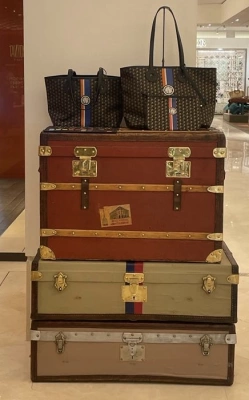
The history of luggage dates back to ancient times, when people used cloth bags or woven baskets to carry their belongings. However, these bags were often bulky and impractical to carry over long distances.
Over the centuries, luggage evolved to become more functional and adapted to travellers' needs. In the Middle Ages, nobles used wooden chests to carry their belongings when travelling. These chests were often heavy and required several people to carry them.
With the advent of rail and sea travel in the 19th century, luggage underwent a new evolution. Wooden trunks became popular, offering better protection for fragile objects. These trunks were often adorned with leather or canvas and were used by wealthy travellers.
In the 20th century, the arrival of commercial aviation led to a further transformation of luggage. Rigid metal or plastic suitcases became common, offering greater shock resistance and storage capacity. Wheels were also added to make transport easier.
Today, luggage is available in a wide variety of shapes, sizes and materials. Many models are available from Les Malletiers....
27 Jul 2023
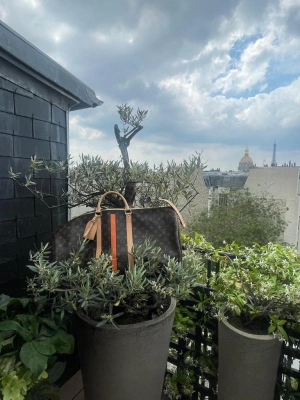
Louis Vuitton's Keepall travel bag, the 1930s... Cruises were fashionable, as were holidays in Deauville and Biarritz.
At that time, Louis Vuitton, renowned for its trunks, had to adapt to these new lifestyles. The result was the Keepall, a bag that "keeps everything". The Keepall is a flexible, zipped bag made from the famous monogrammed coated canvas. Its generous shape allows you to slip in a sports outfit and a few simple clothes for a weekend in the countryside.
An immediate success, the Keepall has never left the Louis Vuitton catalogue. It has been used in the trunk-maker's other collections, and given a new look by artists invited by Marc Jacobs, including Takashi Murakami and others.
Four sizes were chosen (45, 50, 55 and 60 cm), with the first three being the most popular because they could be carried in the cabin.
Seen over and over again on all the people for generations, the Keepall is now a timeless piece, which we keep, cherish and watch lovingly polish... Les Malletiers loves it too!
27 Jul 2023
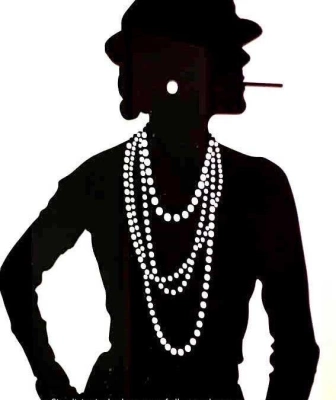
Coco Untold Stories, the early years...
She symbolizes French elegance. Gabrielle Chanel, born in Saumur in 1883, whose real name was Gabrielle Chasnel, was raised in an orphanage. At the age of 12, she was taken in with two of her sisters at Aubazine Abbey in Corrèze.
Her mother died in Brive-la-Gaillarde in 1895. When she was just 12, her father abandoned her a few months later, to the care of the nuns. He never returned. Gabrielle went to Aubazine to learn sewing. She stayed for 6 years. The abbey would remain a powerful source of inspiration for the codes of the House of Chanel...
Coco Chanel's taste for clean lines and her predilection for black, white and beige are perhaps linked to the sobriety of the abbey and its occupants...
Once she left Aubazine, she moved to Moulin. Gabrielle had to earn a living, so she sang in small shows in bars, famous for her rendition of
“Who has seen Coco on the Trocadero? Coco, a nickname that has stuck for posterity...
10 Aug 2023