








Are you sure you want to perform this action?
Some bags almost never appear on the market. A model discontinued too soon, leather that’s become impossible to find, a special edition reserved for a select few clients, a seasonal color the brand never brought back. This is precisely where the search for a collector’s bag on demand comes into its own: not as a mere hunt for an object, but as a connoisseur’s pursuit, grounded in rarity, authenticity, and the right choice.
In the world of secondhand luxury, not everything holds the same value, even when the brand name is prestigious. A collector’s bag is not defined solely by its market value or how hard it is to obtain. It also stands out for its place in a brand’s history, the quality of its craftsmanship, the uniqueness of its materials, and sometimes a detail nearly invisible to the general public. Searching for such a piece on demand therefore requires more than just active monitoring. It requires an understanding of the market, knowledge of the models, and a constant focus on provenance.
## Why choose a custom collector’s bag search
Buying a rare bag that’s available immediately may seem simpler. However, this convenience often comes with a downside. When a piece appears unfiltered on highly open platforms, the buyer must alone assess the reasonableness of the price, the actual condition, the authenticity, the long-term desirability, and any fidelity to the original characteristics. Yet, with the most sought-after models, a mistake comes at a high cost.
On-demand search allows us to reverse this logic. Instead of settling for what the market offers, it starts with your specific intent. You may be looking for a vintage Kelly Sellier with a sleeker silhouette than recent models, a Chanel Timeless in a specific configuration, a Louis Vuitton collaboration that has become iconic, or a vintage Dior Saddle with particular finishes. In every case, the search becomes selective, targeted, and well-reasoned.
This approach is particularly suited to those who aren’t just buying a brand name, but a specific piece. A discerning collector knows that between two seemingly identical bags, the differences can be significant. The year, the hardware, the patina, the structure, the presence of accessories, the quality of the leather, and even the appropriateness of any restoration work profoundly alter the object’s appeal.
## What a custom search should actually cover
A serious custom search for a collector’s bag isn’t just about sending a few alerts and then waiting. It begins with a precise definition of the need. This is often the most underestimated step. Many clients arrive with a correct intuition, but one that is still incomplete. They know they want a specific model, but haven’t yet decided between different versions, sizes, or production periods.
### Defining the right piece, not just the right model
In heritage luxury, the right question isn’t always “which bag do you want?”, but “which version of this bag is worth seeking out?”. A Birkin in Box leather does not convey the same presence as a Birkin in Togo leather. A Chanel from the 1990s does not tell the same story as a more recent piece. A collector’s model may be desirable for its silhouette, for a technique that is no longer used, for a limited edition, or for a color that has become iconic.
Defining the criteria helps avoid two pitfalls. The first is overpaying for an average piece due to a lack of reference points. The second is dismissing a truly beautiful example because it doesn’t match an overly vague idea. The more refined the search, the more effective it becomes.
### Assessing rarity with discernment
The word “rare” is used liberally, often incorrectly. A piece is not rare simply because it is unavailable at a given moment. It may be hard to find, poorly described, held in private collections, or available in a condition unsuitable for a discerning purchase. True rarity depends on a combination of factors: the number of copies produced, the number surviving in good condition, market demand, the appeal of the configuration, and the quality of provenance.
One must also accept that a very rare piece is not always the wisest choice. Some rarities are difficult to resell; others have been restored to the point of losing some of their appeal. Conversely, a better-known model but in an exceptionally fine condition may represent a stronger, more elegant, and more enduring choice.
## Authenticity: Non-Negotiable
In the secondary market, the pursuit of rarity inevitably attracts sophisticated counterfeits, altered pieces, and inaccurate descriptions. The more coveted the model, the greater the vigilance required. This is particularly true for brands whose iconic pieces are widely copied, but also for certain limited editions where authentic pieces are scarce.
The authenticity of a collector’s bag is never limited to a general impression. It requires an analysis of the materials, markings, proportions, assembly techniques, consistency between the period and the finishes, as well as the model’s history. A thorough appraisal also examines what may have been altered: the handle, clasp, lining, color, stitching, and accessories. An authentic piece that has been overly altered does not hold the same heritage value as one that has remained true to its original condition.
This is where a specialist intermediary makes all the difference. When a bag is sought for a specific client, the challenge is not simply to find an authentic piece, but to find the right authentic piece.
## The criteria that distinguish a purchase from an acquisition
A collector’s bag deserves to be approached as an heirloom, or at least as an object whose presence will stand the test of time. This requires a more nuanced assessment than simply falling in love at first sight.
### Condition is not a binary issue
Between “excellent condition” and “good condition,” the actual differences are immense. A light patina can enhance vintage leather. A slightly softened structure may be acceptable on some models, but much less so on others. Conversely, overly visible restoration can diminish the aesthetic and heritage value of a piece that might otherwise be appealing in photographs.
Condition must therefore be judged in light of the model, its age, and its nature. A collector’s bag does not need to be new to be remarkable. It must be consistent, sound, and desirable.
### Provenance and Associated Items
Pouch, padlock, bell, original invoice, dust bag, box, certificate, runway archive, or original sales documentation: not all of these items carry the same weight, but they can matter. For some pieces, they enhance the value. For others, they primarily serve to document the item’s history.
In any case, they contribute to the quality of the acquisition.
### Price Accuracy
The price of a collector’s item is not determined solely by public market value. It depends on a combination of condition, desirability, actual rarity, and quality of craftsmanship. A well-priced piece can sell quickly. Another, priced too high, may remain unsold for a long time despite a prestigious name. Research on demand allows us to place the price within a clearer context, far from fleeting market frenzies.
## For whom is this approach most relevant
It is primarily aimed at collectors seeking a specific reference and unwilling to make hasty compromises. It is also suitable for the discerning enthusiast who wishes to enter the world of collector’s bags with a piece that is coherent, durable, and reliable. Finally, it perfectly meets the needs of international clients for whom direct access to certain qualified resale networks is not always straightforward, especially when they desire a rigorous selection and controlled shipping.
In Paris, where exquisite pieces from private wardrobes still circulate, this approach holds particular significance. Yet it is by no means strictly local. True luxury today is not merely about having access to the market. It is about being guided with discernment through a market that has become too vast, too fast-paced, and at times too uncertain.
When conducted with high standards, on-demand sourcing achieves more than just a successful purchase. It provides access to a piece that fits naturally into a collection, a personal style, or a family legacy. It is in this spirit that Les Malletiers approaches this work: not as a simple matchmaking service, but as the quest for the right object—rigorously authenticated and chosen to last.
A great collector’s bag isn’t always found quickly. But when you finally find the right one, the wait ceases to be a delay and becomes part of its value.
Related articles

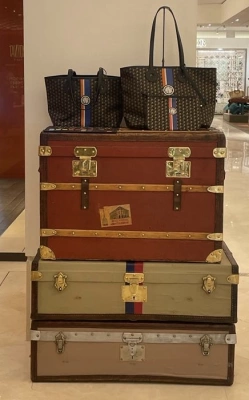
The history of luggage dates back to ancient times, when people used cloth bags or woven baskets to carry their belongings. However, these bags were often bulky and impractical to carry over long distances.
Over the centuries, luggage evolved to become more functional and adapted to travellers' needs. In the Middle Ages, nobles used wooden chests to carry their belongings when travelling. These chests were often heavy and required several people to carry them.
With the advent of rail and sea travel in the 19th century, luggage underwent a new evolution. Wooden trunks became popular, offering better protection for fragile objects. These trunks were often adorned with leather or canvas and were used by wealthy travellers.
In the 20th century, the arrival of commercial aviation led to a further transformation of luggage. Rigid metal or plastic suitcases became common, offering greater shock resistance and storage capacity. Wheels were also added to make transport easier.
Today, luggage is available in a wide variety of shapes, sizes and materials. Many models are available from Les Malletiers....
27 Jul 2023
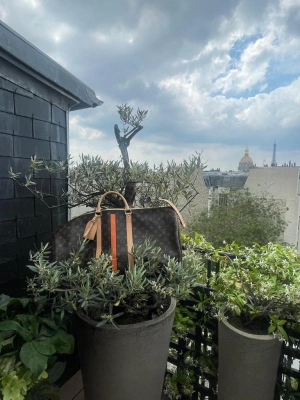
Louis Vuitton's Keepall travel bag, the 1930s... Cruises were fashionable, as were holidays in Deauville and Biarritz.
At that time, Louis Vuitton, renowned for its trunks, had to adapt to these new lifestyles. The result was the Keepall, a bag that "keeps everything". The Keepall is a flexible, zipped bag made from the famous monogrammed coated canvas. Its generous shape allows you to slip in a sports outfit and a few simple clothes for a weekend in the countryside.
An immediate success, the Keepall has never left the Louis Vuitton catalogue. It has been used in the trunk-maker's other collections, and given a new look by artists invited by Marc Jacobs, including Takashi Murakami and others.
Four sizes were chosen (45, 50, 55 and 60 cm), with the first three being the most popular because they could be carried in the cabin.
Seen over and over again on all the people for generations, the Keepall is now a timeless piece, which we keep, cherish and watch lovingly polish... Les Malletiers loves it too!
27 Jul 2023
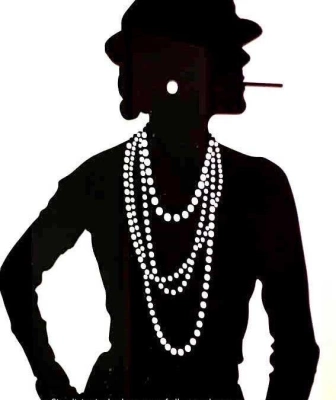
Coco Untold Stories, the early years...
She symbolizes French elegance. Gabrielle Chanel, born in Saumur in 1883, whose real name was Gabrielle Chasnel, was raised in an orphanage. At the age of 12, she was taken in with two of her sisters at Aubazine Abbey in Corrèze.
Her mother died in Brive-la-Gaillarde in 1895. When she was just 12, her father abandoned her a few months later, to the care of the nuns. He never returned. Gabrielle went to Aubazine to learn sewing. She stayed for 6 years. The abbey would remain a powerful source of inspiration for the codes of the House of Chanel...
Coco Chanel's taste for clean lines and her predilection for black, white and beige are perhaps linked to the sobriety of the abbey and its occupants...
Once she left Aubazine, she moved to Moulin. Gabrielle had to earn a living, so she sang in small shows in bars, famous for her rendition of
“Who has seen Coco on the Trocadero? Coco, a nickname that has stuck for posterity...
10 Aug 2023