








Are you sure you want to perform this action?
A pre-owned bag isn’t purchased like an ordinary accessory. In the world of luxury, it involves more than just a matter of personal taste—it’s about a connection to the material, to the house that created it, to its era, and to how it will stand the test of time. This is precisely what makes it unique: a beautiful pre-owned bag can offer more than a new model, provided you know what to look for.
## Why Pre-Owned Bags Are Gaining Ground in Luxury
The appeal of pre-owned items is no longer just a matter of opportunity. In the high-end fashion segment, it reflects a matter of taste. Many of the most desirable models are no longer produced, have changed in size, leather, or finishes, or belong to a particularly significant moment in a house’s history. Buying secondhand therefore often means accessing a more interesting version of a bag that has already become an icon.
There is also a question of perceived quality. Some collectors seek out specific production periods, leathers that are harder to find today, or construction details that have been phased out over time. A vintage Chanel, an older Louis Vuitton Keepall, a Kelly in a less common style, or a Lady Dior from a certain decade convey a different story than a piece fresh from the workshop this season.
Finally, value isn’t solely financial, even if that matters. For certain iconic lines, the secondary market allows you to acquire an item whose desirability remains strong—sometimes more stable than that of a new purchase. But this depends on the model, its rarity, its condition, and its documentation.
## Choosing the Right Secondhand Bag: The Criteria That Really Matter
The first criterion is always the model itself. You must distinguish between a trend-driven bag and a timeless classic. The former is quick to captivate and can grow tiresome just as quickly. The latter embodies enduring design principles: balanced proportions, a strong identity, clear functionality, and visible craftsmanship. It is often in this second category that the most satisfying purchases over time are found.
The material comes next, and it changes everything. Box calf, grained calfskin, caviar leather, monogrammed canvas, or exotic leather do not age in the same way or at the same pace. Some leathers develop a beautiful patina. Others show more wear, which isn’t necessarily a flaw if you accept that the item is a living thing. You must therefore examine the condition with care: a slight suppleness in the leather can be charming, while a sagging structure on an architectural model can diminish its appeal.
Metal finishes deserve the same attention. Gilding, palladium, brass, clasps, chains, bag feet, zippers, and screws must be examined carefully. Even wear may be consistent with the bag’s age. On the other hand, replacements, inconsistencies in engraving, or unusual variations should prompt caution.
Size is another factor that is often underestimated. A highly sought-after bag isn’t necessarily the right bag for you. Between a mini evening bag, a structured tote, a soft shoulder bag, or a travel bag, actual use matters just as much as the market value. A great secondhand purchase is one you actually wear, not just a name on an invoice.
### Condition: Acceptable Flaw or Real Issue
In the world of second-hand luxury, condition is never a black-and-white issue. Some signs are consistent with good preservation, while others significantly affect the item’s desirability. Even wear on a handle, a few internal marks, slightly softened leather, or subtly scuffed corners can be acceptable on an older bag, especially if the price reflects this reality.
On the other hand, certain alterations must be assessed more rigorously: cracking, lingering odors, severe deformation, poorly executed repairs, damaged linings, open seams, or loss of structure on a model that is supposed to be pristine. In this area, it all comes down to the balance between the item’s age, rarity, brand, and the future owner’s standards.
## The authenticity of a secondhand bag is no small matter
This is where the difference between a market of trust and a market of risk comes into play. In the world of luxury bags, authenticity relies neither on intuition nor on a few flattering photos. It requires an expert examination of the piece: construction, materials, markings, typography, hardware, stitching, dating, and overall consistency. The higher the apparent quality of counterfeits becomes, the more decisive this expertise becomes.
One must therefore be wary of an overly simplistic approach. The presence of an old receipt, a box, or a dust bag is not enough to guarantee authenticity. These elements are valuable, but they never replace a thorough examination. Conversely, a perfectly authentic piece may have lost some of its accessories over time without losing its legitimacy.
For a discerning buyer, the right question is not merely “does the bag look genuine?” but “on what authority is this claim based?” It is this point that transforms the buying experience. When authentication is documented and endorsed by a recognized expert, the value of the transaction changes immediately. At Les Malletiers, this standard is upheld by a certificate of authenticity issued by Jérôme Lalande, an expert appointed by the Paris Court of Appeal, which elevates the verification process to a level rarely seen in the market.
## The Houses and Models That Best Stand the Test of Time
Not all houses perform the same way on the secondary market, nor do all bags from the same house. Certain lines have achieved a permanence that transcends shifting trends. At Hermès, the most architecturally designed models and the most classic styles retain a unique power. At Chanel, the strength of the quilted lines, interlaced chains, and historic silhouettes continues to attract both connoisseurs and new customers.
Louis Vuitton occupies a special place. Its canvas, travel pieces, and several iconic bags transcend eras with remarkable ease. However, one must distinguish heritage pieces from more mainstream productions. Dior, Prada, Gucci, Goyard, or Moynat require a more nuanced approach: some styles are deeply established, while others are more a matter of personal taste or a standout season.
The right approach is less about following a rigid hierarchy and more about understanding what makes a piece desirable: the purity of the design, the history of the line, the rarity of the material-color combination, the coherence of the proportions, and the quality of craftsmanship. A rarely seen but perfectly executed bag can prove more interesting than a highly publicized model.
### Buying to Wear, Collect, or Pass On
Different motivations entail different criteria. If you’re looking for a bag to wear regularly, the durability of the material, comfort, weight, and ease of care become central. If you’re buying to collect, the original condition, the presence of associated elements, the rarity of the model, and the integrity of the piece take precedence.
As for the idea of passing it down, it demands a different approach. One is more likely to choose an iconic line, a subtle color, impeccable craftsmanship, and a condition well-preserved enough for the item to change hands without losing its aura. Not all luxury bags become heirlooms. Some remain beautiful accessories. Others take on, over time, an almost heritage-like significance.
## What a Discerning Eye Notices Before Buying
An experienced buyer doesn’t just look at the front of a bag. They examine the corners, the edges, the evenness of the stitching, the condition of the handles, the clarity of the stamps, the interior, the pockets, the fasteners, and the alignment of the metal hardware. They also look for consistency between the bag’s supposed age and its actual condition.
They pay attention to what has been restored. Restoration isn’t necessarily a problem. When done well, it can extend a piece’s life without betraying its spirit. But it must be identified, understood, and factored into the evaluation. In the luxury sector, invisible interventions don’t really exist to the trained eye.
Finally, they examine the selection offered by the seller. A reputable house doesn’t present items as mere stock. It selects them, documents them, and contextualizes them. This curation is a signal in itself. In a market saturated with offerings, true luxury often lies in discernment.
Choosing a secondhand bag ultimately means choosing a piece whose presence has already stood the test of time. When it is authentic, well-preserved, and carefully selected, it offers something rare: not novelty, but authenticity.
Related articles

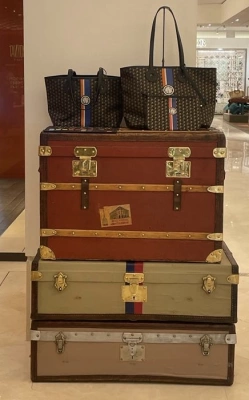
The history of luggage dates back to ancient times, when people used cloth bags or woven baskets to carry their belongings. However, these bags were often bulky and impractical to carry over long distances.
Over the centuries, luggage evolved to become more functional and adapted to travellers' needs. In the Middle Ages, nobles used wooden chests to carry their belongings when travelling. These chests were often heavy and required several people to carry them.
With the advent of rail and sea travel in the 19th century, luggage underwent a new evolution. Wooden trunks became popular, offering better protection for fragile objects. These trunks were often adorned with leather or canvas and were used by wealthy travellers.
In the 20th century, the arrival of commercial aviation led to a further transformation of luggage. Rigid metal or plastic suitcases became common, offering greater shock resistance and storage capacity. Wheels were also added to make transport easier.
Today, luggage is available in a wide variety of shapes, sizes and materials. Many models are available from Les Malletiers....
27 Jul 2023
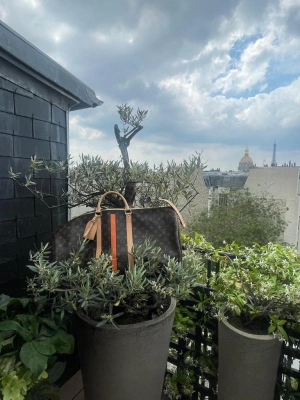
Louis Vuitton's Keepall travel bag, the 1930s... Cruises were fashionable, as were holidays in Deauville and Biarritz.
At that time, Louis Vuitton, renowned for its trunks, had to adapt to these new lifestyles. The result was the Keepall, a bag that "keeps everything". The Keepall is a flexible, zipped bag made from the famous monogrammed coated canvas. Its generous shape allows you to slip in a sports outfit and a few simple clothes for a weekend in the countryside.
An immediate success, the Keepall has never left the Louis Vuitton catalogue. It has been used in the trunk-maker's other collections, and given a new look by artists invited by Marc Jacobs, including Takashi Murakami and others.
Four sizes were chosen (45, 50, 55 and 60 cm), with the first three being the most popular because they could be carried in the cabin.
Seen over and over again on all the people for generations, the Keepall is now a timeless piece, which we keep, cherish and watch lovingly polish... Les Malletiers loves it too!
27 Jul 2023
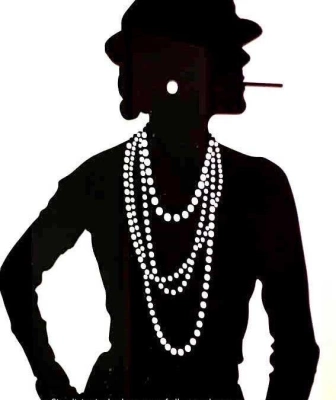
Coco Untold Stories, the early years...
She symbolizes French elegance. Gabrielle Chanel, born in Saumur in 1883, whose real name was Gabrielle Chasnel, was raised in an orphanage. At the age of 12, she was taken in with two of her sisters at Aubazine Abbey in Corrèze.
Her mother died in Brive-la-Gaillarde in 1895. When she was just 12, her father abandoned her a few months later, to the care of the nuns. He never returned. Gabrielle went to Aubazine to learn sewing. She stayed for 6 years. The abbey would remain a powerful source of inspiration for the codes of the House of Chanel...
Coco Chanel's taste for clean lines and her predilection for black, white and beige are perhaps linked to the sobriety of the abbey and its occupants...
Once she left Aubazine, she moved to Moulin. Gabrielle had to earn a living, so she sang in small shows in bars, famous for her rendition of
“Who has seen Coco on the Trocadero? Coco, a nickname that has stuck for posterity...
10 Aug 2023