








Are you sure you want to perform this action?
For Les Malletiers, the secondhand luxury leather goods marketplace: A secondhand Chanel bag isn’t bought like a seasonal accessory. It’s chosen like a piece of furniture, with an eye for the design, the material, the era, and, above all, the certainty of its authenticity. In today’s market, Chanel’s desirability remains undiminished, but it comes with a growing demand: the ability to distinguish the iconic from the merely visible, the beautiful specimen from the over-restored piece, and the good opportunity from the hasty purchase.
## Why Secondhand Chanel Bags Are So Appealing
Chanel occupies a unique place in the world of luxury. Certain bags span decades without losing their aesthetic authority. The 2.55, the Timeless Classic Flap, the Boy, and even some more niche variations retain this rare ability to complement very different wardrobes while asserting a distinct identity.
Buying a pre-owned model therefore fulfills several desires at once. There is, of course, the search for a price that is sometimes more reasonable than in the primary market, but that is not the heart of the matter for a discerning enthusiast. The real appeal often lies in access to finishes, sizes, or leathers that are harder to find today—or even to discontinued models. The second-hand market also allows you to rediscover vintage proportions, chains with a distinctive drape, leather with just the right patina, and that certain presence that only certain pieces with a history can offer.
We must also acknowledge a market reality: Chanel remains one of the brands most closely watched by buyers, collectors, and specialized resellers. This demand sustains the value of many models, though it doesn’t guarantee that every bag seen online is a good buy. The signature alone is never enough.
## Which second-hand Chanel bag models to prioritize
It all depends on your relationship with the item. Are you looking for a collector’s bag, an everyday companion, or a piece with strong resale value? The answer completely changes the criteria.
### The icons that define the market
The Classic Flap remains the most instantly recognizable model. Its quilting, CC clasp, and leather-wrapped chain make it a piece that is both iconic and surprisingly versatile. When buying secondhand, however, pay close attention to the condition of the corners, the structure of the flap, and the evenness of the quilting. A piece that looks appealing in photos may, upon closer inspection, reveal a loss of shape or visible repairs.
The 2.55 Reissue often appeals to a more discerning eye. More understated in its signature style, with its Mademoiselle clasp, it appeals to those who appreciate the history of the design as much as its purity. It can be a particularly relevant choice for those seeking a less ostentatious Chanel, yet one that remains deeply faithful to the house’s spirit.
The Boy Chanel belongs to a more graphic style. Its more assertive, almost architectural construction appeals to a clientele that loves contemporary pieces without sacrificing the house’s prestige. On the secondary market, its value depends heavily on size, color, and material. Some novelty versions age less well than classic leathers.
### Models to Consider with Greater Nuance
Not all Chanel bags are created equal on the secondary market. Some seasonal lines can be very appealing but more susceptible to fashion trends. Others are magnificent but more delicate to wear or resell. A rare model isn’t necessarily a good choice if it’s rare because it wasn’t in high demand. Conversely, a discreet, well-regarded model produced over a short period can offer real collector’s value.
The key is to avoid making a purchase driven solely by social media visibility or a sense of urgency. When it comes to Chanel, patience is often a form of discernment.
## Authenticity: The Non-Negotiable Factor
The secondhand Chanel handbag market is one of the most vulnerable to counterfeiting, including highly sophisticated reproductions. This is why authenticity must never be treated as a mere commercial formality, but as the foundation of the transaction.
Rigorous authentication relies on a range of indicators: leather quality, accuracy of proportions, typography of markings, interior construction, hardware, plaque, stitching, serial number (depending on the era), and overall consistency between the model and its year of production. No single photo can replace an expert examination of the entire piece.
One must be wary of overly simplistic claims. The presence of a card, a dust bag, or a box does not in itself establish authenticity. Similarly, a consistent serial number is not sufficient proof if the item exhibits manufacturing anomalies. In this field, what provides reassurance is not an original accessory, but the expertise of the person who takes responsibility for the piece.
For this reason, the most discerning buyers favor dealers capable of rigorously documenting authenticity. At Les Malletiers, each piece comes with a certificate of authenticity written by Jérôme Lalande, an expert appointed by the Paris Court of Appeal. In a market where uncertainty comes at a high cost, this standard profoundly changes the quality of the purchase.
## Condition, restoration, patina: what you really need to look for
A beautiful secondhand Chanel is not necessarily a perfect bag. It may bear the marks of time, provided they remain elegant and compatible with its structure. Patina is acceptable when it reflects use without compromising the integrity of the object. On the other hand, certain alterations can permanently weaken the piece.
Worn corners, persistent dents in the leather, oxidized chains, peeling linings, or musty odors are warning signs to take seriously. With lambskin, the material’s sensuality is unmatched, but it also makes it more susceptible to friction and marks. Caviar leather, with its coarser grain, often withstands regular use better, though relative durability should not be confused with invulnerability.
Restoration also warrants a nuanced assessment. A light, skillfully executed intervention can restore clarity and elegance to an older bag. But overly heavy recoloring, overly uniform leather repair, or a clumsy replacement of certain finishes can diminish the object’s value. In the high-end second-hand market, the goal is not to erase history, but to preserve the piece’s dignity.
## The Fair Price of a Secondhand Chanel Bag
There is no single price, but rather a hierarchy of values. The model, size, leather, color, era, condition, presence of original elements, and market liquidity all play a role. Two bags that look similar may have significant price differences for perfectly legitimate reasons.
Classic black bags, in leather with gold or silver hardware, remain the most sought-after, particularly in easy-to-carry sizes. Highly seasonal colors, certain fabrics, or atypical shapes may be more affordable, though by no means uninteresting. It all depends on the buyer’s intent. Someone looking for a wardrobe staple will make different decisions than a collector.
You must also accept that a low price is sometimes a red flag. With Chanel more than with many other brands, an excessive discount raises questions. The discrepancy may be due to the condition, a lack of provenance, extensive restoration, or, more seriously, doubts about authenticity. The right purchase isn’t the cheapest one. It’s the one whose value aligns with the item’s actual quality.
## Where to buy without compromising your standards
The secondary market is vast, but not all listings are created equal. Generalist platforms offer choice—sometimes plenty of it—but they often leave too much room for the buyer to interpret. Yet, when it comes to Chanel, approximation is a luxury that comes at a high price.
It’s better to turn to a curated selection, presented with precision, where each piece is examined with both a curatorial and technical eye. A good secondhand dealer doesn’t just list a bag. They contextualize it, honestly describe its condition, vouch for its authenticity, and understand what, in that specific piece, deserves a connoisseur’s attention.
This quality of curation is particularly valuable when searching for a rare model, a specific combination of leather and size, or a vintage Chanel whose appeal lies in details that only true expertise can appreciate.
## Buy to wear, buy to pass on
The best secondhand Chanel bag is often the one that fits a real life. A classic black bag may seem like the obvious choice, but it isn’t always the most thoughtful one. A deep burgundy shade, a subtly weathered beige, a highly structured mini format, or a 2.55 with a more intellectual character may better suit a silhouette, a lifestyle, or an existing collection.
True luxury, here, is not about accumulation. It is the perfect harmony between an object, its purpose, and one’s perspective. A well-chosen Chanel quickly becomes more than just a purchase. It joins a lineage of objects that we keep, that we wear consistently, and that we sometimes pass on.
If any doubt remains, it’s better to wait for the right piece than to give in to a fleeting opportunity. In the world of exceptional second-hand items, time often works in the favor of the attentive buyer.
Related articles

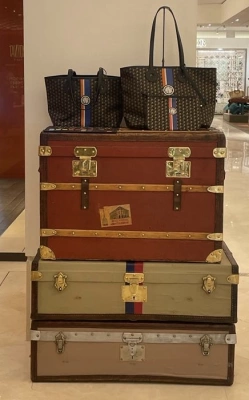
The history of luggage dates back to ancient times, when people used cloth bags or woven baskets to carry their belongings. However, these bags were often bulky and impractical to carry over long distances.
Over the centuries, luggage evolved to become more functional and adapted to travellers' needs. In the Middle Ages, nobles used wooden chests to carry their belongings when travelling. These chests were often heavy and required several people to carry them.
With the advent of rail and sea travel in the 19th century, luggage underwent a new evolution. Wooden trunks became popular, offering better protection for fragile objects. These trunks were often adorned with leather or canvas and were used by wealthy travellers.
In the 20th century, the arrival of commercial aviation led to a further transformation of luggage. Rigid metal or plastic suitcases became common, offering greater shock resistance and storage capacity. Wheels were also added to make transport easier.
Today, luggage is available in a wide variety of shapes, sizes and materials. Many models are available from Les Malletiers....
27 Jul 2023
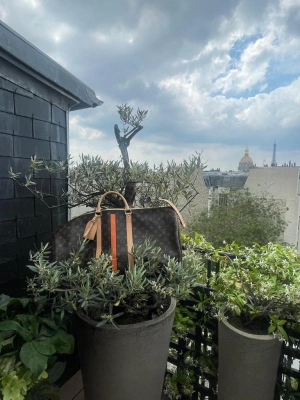
Louis Vuitton's Keepall travel bag, the 1930s... Cruises were fashionable, as were holidays in Deauville and Biarritz.
At that time, Louis Vuitton, renowned for its trunks, had to adapt to these new lifestyles. The result was the Keepall, a bag that "keeps everything". The Keepall is a flexible, zipped bag made from the famous monogrammed coated canvas. Its generous shape allows you to slip in a sports outfit and a few simple clothes for a weekend in the countryside.
An immediate success, the Keepall has never left the Louis Vuitton catalogue. It has been used in the trunk-maker's other collections, and given a new look by artists invited by Marc Jacobs, including Takashi Murakami and others.
Four sizes were chosen (45, 50, 55 and 60 cm), with the first three being the most popular because they could be carried in the cabin.
Seen over and over again on all the people for generations, the Keepall is now a timeless piece, which we keep, cherish and watch lovingly polish... Les Malletiers loves it too!
27 Jul 2023
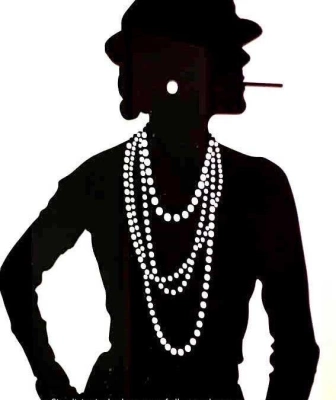
Coco Untold Stories, the early years...
She symbolizes French elegance. Gabrielle Chanel, born in Saumur in 1883, whose real name was Gabrielle Chasnel, was raised in an orphanage. At the age of 12, she was taken in with two of her sisters at Aubazine Abbey in Corrèze.
Her mother died in Brive-la-Gaillarde in 1895. When she was just 12, her father abandoned her a few months later, to the care of the nuns. He never returned. Gabrielle went to Aubazine to learn sewing. She stayed for 6 years. The abbey would remain a powerful source of inspiration for the codes of the House of Chanel...
Coco Chanel's taste for clean lines and her predilection for black, white and beige are perhaps linked to the sobriety of the abbey and its occupants...
Once she left Aubazine, she moved to Moulin. Gabrielle had to earn a living, so she sang in small shows in bars, famous for her rendition of
“Who has seen Coco on the Trocadero? Coco, a nickname that has stuck for posterity...
10 Aug 2023