








Are you sure you want to perform this action?
Looking for the best luxury resale site isn’t just about finding the platform with the largest selection. In this world, abundance rarely inspires confidence. What really matters is the care taken in examining each piece, the rigor of the authentication process, the accuracy of the description, and the ability to distinguish a beautiful item from one that’s merely in demand.
When it comes to a Chanel bag, a Hermès scarf, a Louis Vuitton trunk, or a designer piece of jewelry, the purchase is not just about style. It involves a significant sum, of course, but also trust. Yet the luxury second-hand market has expanded considerably. This growth has allowed more buyers to access rare pieces, sometimes impossible to find in stores. It has also created persistent confusion between marketplaces, consignment shops, specialized curators, and expert authenticators. Not all are created equal.
## What Really Defines the Best Luxury Secondhand Site
The best luxury secondhand site isn’t necessarily the most visible one. It’s the one that minimizes uncertainty at every step. Even before the question of price, a savvy buyer wants to know who examined the item, according to what criteria, with what expertise, and how the item is presented.
A reputable site doesn’t just sell a brand. It documents an item. It knows how to explain the material, the period, the finishes, the actual wear, any restorations, and, when necessary, the particular significance of a specific model. This precision isn’t just editorial fluff. It’s a testament to expertise.
The difference is decisive for the most sought-after brands. At Hermès, a few details regarding stitching, branding, or structure make all the difference. At Chanel, the focus must be as much on the overall look as on the manufacturing details. For Louis Vuitton, knowledge of trunks, canvas, travel pieces, or vintage collections requires a much deeper understanding of the house’s heritage than a simple visual inspection.
### Authenticity: A Non-Negotiable Criterion
In the world of pre-owned luxury, authenticity is not a marketing pitch. It is the foundation. Without it, the rest is worthless. Yet not all websites place the same emphasis on this requirement. Some settle for vague wording, others pile on clauses that shift liability, and still others present internal procedures that are impossible to evaluate from the outside.
A discerning buyer must seek out clear, tangible, and verifiable guarantees. Who authenticates the item? What are the expert’s qualifications? Does a certificate accompany the piece? Does the website clearly assume responsibility? The more precise these answers are, the more the purchase is based on a sound foundation.
This is precisely where a specialist stands out from a generalist platform. A platform connects people. A specialist puts their name on the line.
### Selection matters as much as inventory
A large volume can be impressive, but it is not always synonymous with quality. In the world of luxury, selection is a language. It conveys a vision, an understanding of the houses, and a hierarchy of taste. Seeing a rare heritage piece, a timeless classic, and a more niche yet remarkable item side by side reveals an editorial vision. Seeing a simple pile of items reveals, above all, a focus on turnover.
For the discerning connoisseur, the real question is therefore not just “is there a lot of choice?”, but “has this selection been thought through?”.
A site that knows how to curate inspires more confidence than a site that merely accumulates.
## How to recognize a reliable site before buying
The first indicator is often the quality of the product listings. Clear, numerous, and consistent photographs showing essential angles, corners, the interior, markings, and signs of use say a lot about the company’s professionalism. A description that is too brief, on the other hand, leaves unnecessary gaps.
The second indicator relates to vocabulary. A competent site does not use terms like “vintage,” “collector’s item,” “exceptional,” or “rare” indiscriminately. It reserves them for pieces that truly deserve them. This restraint is valuable. In the luxury sector, exaggeration undermines credibility.
The third criterion concerns service. The ability to ask specific questions, obtain additional information, or even receive assistance in searching for a particular model transforms the experience. For a collector, this aspect is far from secondary. It allows one to move beyond a standardized purchase and enter into a relationship built on expertise.
### Marketplace or Specialized Dealer: A Fundamental Difference
Confusion is common. Many buyers compare models that do not fulfill the same promise. A marketplace aggregates sellers and offers a vast catalog. This may suit those seeking, above all, the speed of comparison. On the other hand, the level of control varies depending on the items, the channels, and the contacts.
A specialty retailer, on the other hand, offers a narrower but generally more discerning selection. It provides a curated perspective, consistency, editorial responsibility, and often more deeply rooted expertise. For high-value items, this approach has a clear advantage. It prioritizes trust over volume.
This is not to say that one model is always superior to the other. It all depends on the item being sought and the buyer’s level of discernment. For a common item, some will accept a broader, less personalized framework. For a rare, iconic, or highly counterfeited item, the criteria change immediately.
## Price isn’t everything
Many believe that identifying the best luxury second-hand site comes down to finding the lowest price. This is a classic mistake. In the luxury heritage market, a slightly higher price may reflect genuine expertise, a more rigorous selection process, better traceability, or a more accurately described condition.
Conversely, a very attractive price should prompt caution, especially for the most coveted models. An item that is poorly authenticated, over-restored, incomplete, or inaccurately described can end up costing far more in the long run than a purchase that seems more demanding at first.
The right price stems from a balance between desirability, rarity, condition, market season, and the quality of the warranty offered. A reputable site knows how to maintain this balance without exaggeration or false promises.
## Categories Where Expertise Makes All the Difference
Not all luxury items present the same level of complexity. Iconic bags naturally attract the most attention, but they are not the only ones requiring an expert eye. Small leather goods, designer jewelry, travel items, trunks, and certain vintage accessories demand specific expertise.
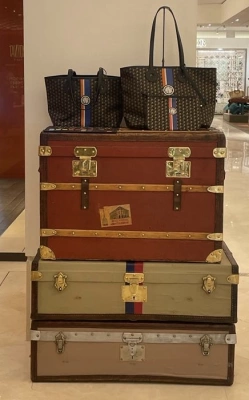
Travel items, in particular, often defy standardized approaches. Their value depends not only on the brand, but on the era, construction, hardware, restorations, and sometimes very subtle details regarding provenance or typology. In this field, a company like [Les Malletiers](https://www.lesmalletiers.com/fr/) offers a valuable distinction: an eye trained in the history of the great houses and in interpreting objects beyond their mere commercial appeal.
### The best luxury second-hand site for you also depends on your profile
A first-time buyer does not judge a site the same way a seasoned collector does. The former will seek above all a clear framework, transparent guarantees, and a reassuring experience. The latter will expect more: a curated selection, less common pieces, more detailed descriptions, and sometimes even the ability to source items on request.
Similarly, the buyer of a contemporary “it” bag doesn’t always have the same expectations as the enthusiast of a vintage piece or a travel item. One might prioritize inventory turnover and availability. The other will seek a cultural connection to the object, a sense of heritage, and a more nuanced relationship with rarity.
That’s why the right question isn’t just “which is the best site?”, but “which site handles what I’m looking for with the level of care I expect?” This nuance changes everything.
## What a connoisseur should always check
Before finalizing a purchase, a few checks remain essential. You must examine the claimed authentication, carefully read the condition description, assess the consistency of the photos, understand the return policy, and evaluate the quality of customer service based on the responses provided. None of this is trivial.
You must also accept that, in the secondhand market, absolute perfection is rare. A slight patina can be part of a piece’s charm, especially when it preserves its integrity. What matters is transparency. A great site isn’t one that embellishes the item. It’s one that presents it with intelligence and accuracy.
Ultimately, the best luxury second-hand website is one that understands that a designer item is never just a used item. It is a piece of craftsmanship, sometimes of memory, sometimes of a collection. When a website knows how to honor this dimension with rigor, the purchase ceases to be a cautious transaction and becomes what it should always be: a chosen encounter with an object of enduring desire.
Related articles

The history of luggage dates back to ancient times, when people used cloth bags or woven baskets to carry their belongings. However, these bags were often bulky and impractical to carry over long distances.
Over the centuries, luggage evolved to become more functional and adapted to travellers' needs. In the Middle Ages, nobles used wooden chests to carry their belongings when travelling. These chests were often heavy and required several people to carry them.
With the advent of rail and sea travel in the 19th century, luggage underwent a new evolution. Wooden trunks became popular, offering better protection for fragile objects. These trunks were often adorned with leather or canvas and were used by wealthy travellers.
In the 20th century, the arrival of commercial aviation led to a further transformation of luggage. Rigid metal or plastic suitcases became common, offering greater shock resistance and storage capacity. Wheels were also added to make transport easier.
Today, luggage is available in a wide variety of shapes, sizes and materials. Many models are available from Les Malletiers....
27 Jul 2023

Louis Vuitton's Keepall travel bag, the 1930s... Cruises were fashionable, as were holidays in Deauville and Biarritz.
At that time, Louis Vuitton, renowned for its trunks, had to adapt to these new lifestyles. The result was the Keepall, a bag that "keeps everything". The Keepall is a flexible, zipped bag made from the famous monogrammed coated canvas. Its generous shape allows you to slip in a sports outfit and a few simple clothes for a weekend in the countryside.
An immediate success, the Keepall has never left the Louis Vuitton catalogue. It has been used in the trunk-maker's other collections, and given a new look by artists invited by Marc Jacobs, including Takashi Murakami and others.
Four sizes were chosen (45, 50, 55 and 60 cm), with the first three being the most popular because they could be carried in the cabin.
Seen over and over again on all the people for generations, the Keepall is now a timeless piece, which we keep, cherish and watch lovingly polish... Les Malletiers loves it too!
27 Jul 2023

Coco Untold Stories, the early years...
She symbolizes French elegance. Gabrielle Chanel, born in Saumur in 1883, whose real name was Gabrielle Chasnel, was raised in an orphanage. At the age of 12, she was taken in with two of her sisters at Aubazine Abbey in Corrèze.
Her mother died in Brive-la-Gaillarde in 1895. When she was just 12, her father abandoned her a few months later, to the care of the nuns. He never returned. Gabrielle went to Aubazine to learn sewing. She stayed for 6 years. The abbey would remain a powerful source of inspiration for the codes of the House of Chanel...
Coco Chanel's taste for clean lines and her predilection for black, white and beige are perhaps linked to the sobriety of the abbey and its occupants...
Once she left Aubazine, she moved to Moulin. Gabrielle had to earn a living, so she sang in small shows in bars, famous for her rendition of
“Who has seen Coco on the Trocadero? Coco, a nickname that has stuck for posterity...
10 Aug 2023