








Are you sure you want to perform this action?
With Les malletiers, choosing which luxury brand to buy secondhand or vintage isn’t simply a matter of a taste for the vintage. It’s a decision shaped by perspective, culture, and sometimes strategy. Between Hermès’s heritage, Chanel’s enduring appeal, Louis Vuitton’s history of travel, and Dior’s sophistication, each brand embodies a distinct relationship with style, rarity, and legacy.
The real question, then, isn’t just which brand to buy, but why you’re buying it. To wear every day, to collect, to invest in a piece that retains its value on the secondary market, or to find a discontinued line that no store carries anymore. In vintage fashion, the right brand is the one whose DNA aligns with both your lifestyle and your sensibilities.
## Which luxury brand to buy vintage based on your goal
The first distinction to make is simple. If you’re looking for a collector’s item, you won’t choose the same brand as if you want a bag for everyday use, a piece of jewelry with character, or a trunk that instantly adds presence to an interior.
Hermès appeals to lovers of artisanal excellence and impeccable craftsmanship. Chanel attracts those seeking an instantly recognizable silhouette, with an iconic presence rarely matched. Louis Vuitton remains the obvious choice for the world of travel, monogrammed canvas, and pieces with a strong stylistic legacy. Dior stands out when you prefer a more structured elegance, often with a more couture-inspired look. Goyard and Moynat appeal to a more discerning circle, sensitive to discretion, the tradition of luggage-making, and a less ostentatious form of distinction.
In other words, there is no universal answer to the question of which luxury brand to buy vintage. There are brands that are more or less the right fit depending on your eye, your lifestyle, and your budget.
## Hermès, Chanel, Louis Vuitton, Dior: the essential benchmarks
### Hermès - for craftsmanship, materials, and longevity
In the vintage market, Hermès holds a unique status. The house embodies a standard of craftsmanship that has remained remarkably consistent across the decades. While the Kelly and Birkin bags command the most attention, reducing Hermès to these two models alone would overlook a much broader heritage: the Constance, Evelyne, and Trim lines, travel bags, small leather goods, jewelry, scarves, and, of course, the entire equestrian collection.
Buying vintage Hermès makes sense for several reasons. First, the quality of the leather and the precision of the craftsmanship often allow an older piece to age gracefully. Second, certain colors, sizes, and styles that are less common today become particularly desirable when they reappear in good condition. On the other hand, prices remain high, even on the secondary market. Here, selection must be extremely rigorous.
### Chanel - for the icon and the stylistic tension
Vintage Chanel possesses a rare strength: that of being immediately recognizable while varying greatly across different eras. An older Timeless, a Diana, a Camera Bag, or certain pieces in jersey, tweed, or quilted leather carry an allure that contemporary pieces do not always replicate.
Chanel’s great appeal lies in this intersection of iconic status and personality. A well-chosen vintage piece can seem more unique than a new purchase. However, you must closely inspect the condition of the leather, chains, corners, linings, and interior markings. Chanel is one of the most coveted houses and also one of the most vulnerable to counterfeits and excessive restoration.
### Louis Vuitton - for its luggage heritage and enduring desirability
Louis Vuitton is often one of the best entry points into luxury vintage, provided you target the right categories. The house excels in luggage, trunks, vanity cases, Keepalls, travel accessories, and some soft leather goods. The vintage monogram, the historic Damier canvas, certain editions, and sizes no longer in production have a presence that new items cannot replace.
The appeal of Louis Vuitton lies in its heritage. You’re not just buying a bag, but a tradition of travel. For collectors, trunks and vintage travel pieces represent a particularly rich territory. For everyday use, certain vintage lines offer a very elegant patina, provided the natural leather, handles, and trim have aged well.
### Dior - for the couture spirit
Vintage Dior appeals to those who seek a balance between sophistication and modernity. Over the decades, the house has produced highly structured bags, statement costume jewelry, and pieces marked by a distinctive couture aesthetic. Certain Galliano-designed models, as well as some older accessories, are experiencing a clear resurgence in interest.
Dior, however, requires a more nuanced understanding of the market. Not all lines hold their desirability equally well. It is often best to prioritize bold shapes, clearly identifiable signatures, and periods with a distinct stylistic signature.
## The more understated houses, often the most interesting
If your taste leans toward a less conventional elegance, Goyard and Moynat deserve special attention. These houses speak more softly, but their influence endures. Their appeal in the vintage market lies in their rarity, a deep artisanal tradition, and more limited distribution.
Goyard appeals to lovers of understated distinction. Its canvas, supple shapes, travel-inspired aesthetic, and relative scarcity on the market make it a highly sought-after brand among connoisseurs. Moynat, for its part, appeals to a public drawn to the Parisian history of the trunk, the purity of its lines, and the idea of a luxury rooted in culture rather than ostentation.
Prada and Gucci occupy a different category. Their vintage appeal rests more on fashion, the era, the cyclical return of certain designs, and stylistic expressiveness. One can sometimes find exceptional pieces, but the purchase is more a matter of choosing a silhouette than a purely heritage-based decision.
## What to Look for Before Buying
The brand name alone is never enough. In vintage fashion, condition, provenance, and authenticity determine the soundness of the purchase. A piece from a major house, but weakened by clumsy restorations, a distorted structure, or replaced components, loses some of its appeal. Conversely, a less famous model in remarkable condition can prove to be a much finer choice.
One must also accept a simple truth: not all signs of age are flaws. A consistent patina, subtle signs of regular use, and leather that has softened elegantly can enhance a piece’s charm. On the other hand, deep cracks, a strong odor, recent gluing, re-sewn seams that disregard the original construction, or mismatched hardware should prompt caution.
Authentication is non-negotiable. In a market where counterfeiting has become increasingly sophisticated, trust does not rest on intuition but on expertise. This is precisely what distinguishes a confident purchase from a risky one.
## Should you buy to wear or to preserve value?
Both approaches are valid, but they lead to different choices. If you’re buying to wear, prioritize practicality. A suitable size, a comfortable weight, a practical closure, and a material that withstands daily wear matter more than a highly sought-after piece that’s impractical to use.
If you’re buying with a focus on value, look at rarity, consistent demand, the model’s significance in the brand’s history, and the condition of the piece. Certain high-profile items remain sought-after, but the most interesting pieces are often those that combine desirability with limited availability: rare colors, small runs, discontinued lines, vintage luggage, and jewelry from specific eras.
The best purchase often lies somewhere in between. A piece strong enough to retain its appeal, yet understated enough to be worn without reservation.
## So, which luxury brand should you buy vintage?
For heritage and artisanal value, Hermès remains a major benchmark. For an iconic piece with a strong presence, Chanel remains a natural choice. For history, travel, and certain categories of collectibles, Louis Vuitton stands out. For couture elegance, Dior deserves careful consideration. For connoisseurs who value discretion and rarity, Goyard and Moynat often offer the most lasting emotional resonance.
The best answer is almost always personal. It arises from the moment when an antique object feels not like a relic of the past, but just right. Just right in its proportions, in its materials, in its memory. At Les Malletiers, this sense of rightness also stems from a rigorous selection process and authentication that allows you to choose freely, without succumbing to uncertainty.
Before buying, ask yourself one demanding question: do you want to own a brand, or to form a connection with a house? The difference is immediately apparent, and it lasts a long time.
Related articles

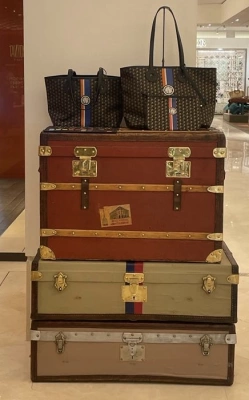
The history of luggage dates back to ancient times, when people used cloth bags or woven baskets to carry their belongings. However, these bags were often bulky and impractical to carry over long distances.
Over the centuries, luggage evolved to become more functional and adapted to travellers' needs. In the Middle Ages, nobles used wooden chests to carry their belongings when travelling. These chests were often heavy and required several people to carry them.
With the advent of rail and sea travel in the 19th century, luggage underwent a new evolution. Wooden trunks became popular, offering better protection for fragile objects. These trunks were often adorned with leather or canvas and were used by wealthy travellers.
In the 20th century, the arrival of commercial aviation led to a further transformation of luggage. Rigid metal or plastic suitcases became common, offering greater shock resistance and storage capacity. Wheels were also added to make transport easier.
Today, luggage is available in a wide variety of shapes, sizes and materials. Many models are available from Les Malletiers....
27 Jul 2023
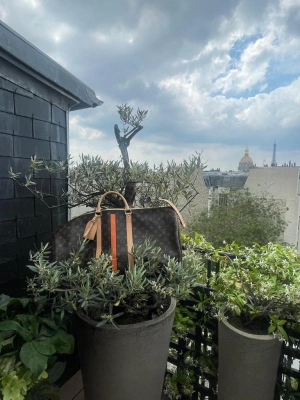
Louis Vuitton's Keepall travel bag, the 1930s... Cruises were fashionable, as were holidays in Deauville and Biarritz.
At that time, Louis Vuitton, renowned for its trunks, had to adapt to these new lifestyles. The result was the Keepall, a bag that "keeps everything". The Keepall is a flexible, zipped bag made from the famous monogrammed coated canvas. Its generous shape allows you to slip in a sports outfit and a few simple clothes for a weekend in the countryside.
An immediate success, the Keepall has never left the Louis Vuitton catalogue. It has been used in the trunk-maker's other collections, and given a new look by artists invited by Marc Jacobs, including Takashi Murakami and others.
Four sizes were chosen (45, 50, 55 and 60 cm), with the first three being the most popular because they could be carried in the cabin.
Seen over and over again on all the people for generations, the Keepall is now a timeless piece, which we keep, cherish and watch lovingly polish... Les Malletiers loves it too!
27 Jul 2023
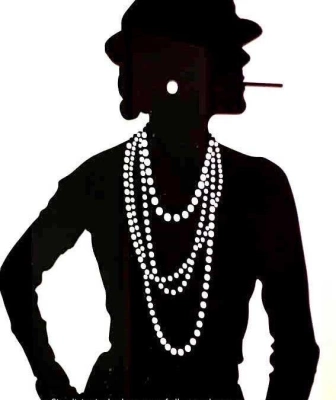
Coco Untold Stories, the early years...
She symbolizes French elegance. Gabrielle Chanel, born in Saumur in 1883, whose real name was Gabrielle Chasnel, was raised in an orphanage. At the age of 12, she was taken in with two of her sisters at Aubazine Abbey in Corrèze.
Her mother died in Brive-la-Gaillarde in 1895. When she was just 12, her father abandoned her a few months later, to the care of the nuns. He never returned. Gabrielle went to Aubazine to learn sewing. She stayed for 6 years. The abbey would remain a powerful source of inspiration for the codes of the House of Chanel...
Coco Chanel's taste for clean lines and her predilection for black, white and beige are perhaps linked to the sobriety of the abbey and its occupants...
Once she left Aubazine, she moved to Moulin. Gabrielle had to earn a living, so she sang in small shows in bars, famous for her rendition of
“Who has seen Coco on the Trocadero? Coco, a nickname that has stuck for posterity...
10 Aug 2023