








Are you sure you want to perform this action?
Buying a pre-owned luxury bag is far from an impulse purchase. It is often a more nuanced, more meaningful experience than a purchase made in a store. You aren’t just choosing a brand or a line—you’re choosing a condition, an era, a patina, and sometimes even a rarity that no longer exists in the catalog. This is precisely what makes this market so distinguished, but also so demanding.
A well-chosen secondhand bag can offer more than just access to luxury. It allows you to experience a brand through its most enduring qualities—the quality of the leather, the precision of the craftsmanship, the timelessness of the design. But you still need to know where to look and what criteria to base your decision on.
## Why buying a secondhand luxury bag is so appealing
The high-end secondhand market has undergone a profound shift in status. It is no longer seen as a secondary alternative, but as a legitimate gateway to iconic pieces—sometimes impossible to find, often more interesting than current productions.
For a discerning enthusiast, the appeal is threefold. First is the heritage aspect. Certain Chanel, Hermès, Louis Vuitton, Dior, or Goyard designs have stood the test of time without losing their visual impact. Buying these models secondhand sometimes means rediscovering proportions, finishes, or leathers that have evolved in recent collections.
Then there is the question of selection. In the primary market, supply depends on timing, availability, waiting lists, and distribution policies. In the secondary market, one can look toward vintage pieces, limited editions, discontinued colors, or sizes that have become rare. The choice becomes more unique.
Finally, there is value. This does not necessarily mean getting a good deal in the simplest sense of the term. A remarkable secondhand luxury bag, in excellent condition and fully authenticated, comes at a price. But that price may be more in line with the item’s true value, its market appeal, and its potential to hold its value over time.
## How to Buy a Secondhand Luxury Bag Without Making a Mistake
The first criterion is neither price nor even the brand. It is authenticity. In a market saturated with increasingly sophisticated counterfeits, trust cannot be based on general impressions or a few flattering photographs. A piece must be examined methodically, focusing on construction details, materials, markings, manufacturing consistency, and provenance.
This is where many buyers go wrong. They believe they can recognize a genuine bag by its overall appearance, the logo, or the presence of a certificate of authenticity. Yet these elements, on their own, are not enough. A certificate of authenticity may be missing for an older piece that is perfectly authentic. Conversely, documents may accompany an item that is not genuine. In the world of pre-owned luxury, serious expertise always takes precedence over commercial trappings.
The condition also warrants a more nuanced assessment than a simple “very good condition.” Smooth leather does not age the same way as supple lambskin. Coated canvas is not evaluated the same way as box calf or exotic leather. The edges, handles, corners, hardware, lining, stitching, and closures reveal how the bag has been worn. You must distinguish between natural patina, which can be elegant, and structural wear, which affects usability or value.
The right purchase also depends on your intention. Are you looking for an everyday bag, a classic collector’s item, an emotional investment piece, or a rare model meant to be worn sparingly? The answer changes everything.
A supple tote in good condition may be more practical for daily use than a highly sought-after but fragile model. Conversely, a more delicate bag, in excellent condition and with a reliable provenance, may appeal to a collector despite its limitations in terms of use.
## Points to consider before deciding
Before buying, you must learn to read a bag as an object of craftsmanship. The material comes first. Beautiful leather retains its depth, structure, and texture. Canvas from a prestigious house exhibits a consistency and sharpness that are no accident. The interior finishes matter just as much as the exterior, because reputable houses never neglect what isn’t immediately visible.
The hardware is often revealing. The weight, the metal’s hue, the precision of an engraving, and the shape of a clasp or zipper can sometimes help you quickly rule out a questionable piece. Logos, stamps, serial numbers, and internal codes must be consistent with the supposed year, the model, and the brand in question. Here again, there is no single rule that applies to all brands or all periods.
Repairs are also worth noting. They do not necessarily disqualify a purchase. A well-executed restoration can extend a bag’s lifespan and preserve its functionality. But it must be known, understood, and factored into the price assessment. The difference between a light touch-up and major structural work is considerable.
## Where to Buy a Secondhand Luxury Bag
Where you buy matters almost as much as the bag itself. Generalist platforms offer volume, but rarely the level of editorial rigor and expertise expected by a connoisseur of fine pieces. They are suitable for certain simple purchases, but less so for rare, expensive, or heavily counterfeited models.
A specialized retailer inspires greater confidence when it takes genuine responsibility for the selection. This means rigorous curation, precise descriptions, an honest assessment of condition, and above all, authentication conducted by a recognized authority. For the buyer, this rigor transforms the experience. You’re no longer sifting through a sea of listings; you’re entering a curated world.
In this spirit, the quality of the dealer’s eye makes all the difference. A good selection does not simply juxtapose famous bags. It creates a coherent collection of desirable pieces—sometimes iconic, sometimes more niche—but always championed for their own merits: design, provenance, rarity, condition, and brand of origin.
## The right price is not the lowest price
The obsession with the “right price” often leads to the most disappointing purchases. In the world of secondhand luxury, an abnormally low price should raise a question before sparking enthusiasm. Why is this piece discounted? Is it its condition, its lack of traceability, extensive restoration, or a deeper concern?
Conversely, a high price is not automatically excessive. Certain items command sustained high prices because demand remains strong, supply is scarce, and examples in good condition are becoming hard to find. This is particularly true for certain house classics, discontinued series, or specific leather goods.
The fair price therefore results from a balance between four factors: authenticity, condition, the model’s desirability, and its actual rarity. When these four criteria are met, the value makes sense. It is not determined solely by a raw comparison, but by the objective quality of the item in question.
## What Sets a Whim Purchase Apart from a Lasting Purchase
A successful purchase is one that you continue to appreciate after the initial excitement has faded. This implies a certain harmony between the bag and your lifestyle. The most beautiful model isn’t always the best choice if its weight, size, fragility, or closure system prevent you from actually using it.
Conversely, certain bags stand out clearly because they combine style, comfort, and longevity. These are often the ones we carry for a long time, then pass on or resell without regret. The secondhand luxury market offers precisely this sense of timelessness. An item has already lived a life, but its story isn’t over yet.
Collectors know this well: sometimes you have to wait for the right piece rather than settle for a close approximation. A more common color, average condition, or a less desirable manufacturing detail may seem acceptable at the time, but can leave a sense of incompleteness. In this case, discernment is better than haste.
For those seeking a specific piece, specialized guidance can save precious time. When an expert eye knows the brands, the variations in models, and the criteria that determine a bag’s value, the search becomes more precise, more serene, and often more demanding as well.
At Les Malletiers, this commitment is rooted in a simple conviction: in the world of pre-owned luxury, trust is never just for show; it is the very foundation of desire. Buying a beautiful bag is, of course, about choosing a silhouette. Above all, it is about recognizing a brand’s craftsmanship, the authenticity of an object, and the opportunity to give it a new place in a story that deserves to endure.
Related articles

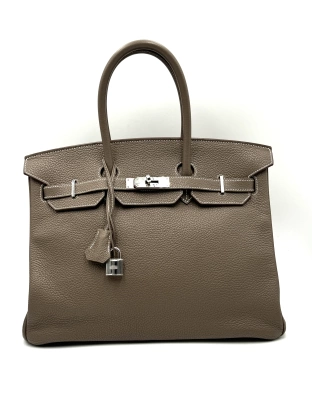
S.A.C.
Sac : le mot est simple, élémentaire.
Pour autant (est-ce assez ?), ces trois lettres presque insignifiantes contiennent en réalité, comme par magie, une quantité infinie d’objets de toutes sortes, surprises, trésors, mystères, promesses, souvenirs ou secrets.
Néo~aristo, il fait sa révolution à contrepied de l’Histoire, de France notamment, et se voit attribuer une particule qui lui confère ses lettres de noblesse : longue vie au sac à main !
Acclamé. Adoubé. Adulé. Il devient un objet de culte.
Mystique, religieux, divin ?
Dans l’écho de son nom, proféré tel un mantra, se trouve peut-être l’énigme de son âme phonétique : [amɛ̃]
À la question « Quel est votre sac du moment ? »,
les invités du podcast Sans Contrefaçon ont répondu par exemple :
Un Diorcamp, sac besace à bandoulière Dior, un Manhattan large de Yves Saint Laurent,
un Evelyne Hermès, un Muse Two Yves Saint Laurent, un Cross-body Rimowa,
un Kelly Hermès, un City Bag Balenciaga vintage, un cabas APC,
un small bag bordeaux Bottega Veneta, ou encore un vieux sac de chasse…
Source d’inspiration, chaque sac a son histoire.
Les mots sont comme les sacs.
Ils prennent la forme de ce qu’on met dedans.
Alfred CAPUS
Voici quelques ouvrages de références à consulter sans modération
* Le Sac à Main Megan Hess (L’imprévu)
* SACS Sophie Gachet (EPA)
* Pièces Iconiques Federico Rocca (Larousse)
* For the love of Bags Julia Werner (TeNeues)
* Sacs à Main Anna Johnson (HF Ullmann)
* Vintage handbags Marnie Fogg (Welbeck)
* Le Sac à main Marie Desplechin (Points) Roman
* La Malle Auteurs divers (Gallimard) Recueil de nouvelles
Je me retrouvai, après une suite de visions étranges,
le nez dans l’herbe, mon sac à la main : chose curieuse, car je l’oublie généralement partout.
Françoise SAGAN (Le garde du cœur)
25 Apr 2025
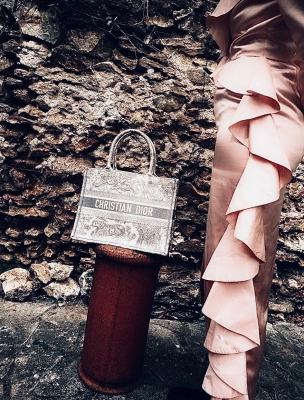
Connectés sur la toile.
Tant qu’il y aura des saisons il y aura des collections.
Chaque passage à l’heure d’été sonne le retour du soleil et des tenues légères aux matières décontractées.
En accord avec ce rituel renouvellement de garde-robe, le sac à main suit le mouvement et se décline en version toile, dans une large gamme d’inspirations, de couleurs et de tailles différentes.
Au commencement était le Tote Bag.
Utilisé à son origine par les postiers et les livreurs de journaux, il constitue de ce fait l’élément idéal pour illustrer cette newsletter.
Shopping bag réutilisable, éco-responsable, ce sac cabas aux qualités multiples est devenu un incontournable de la mode repris et personnalisé par toutes les marques, qu’on retrouve en objet promotionnel ou sur les podiums.
Au catalogue des grandes maisons, quelques modèles en toile sont devenus des classiques disponibles en seconde main.
Chez Dior, par exemple, on retient le Book Tote, disponible en toile de Jouy ou toile tissée, ou encore le Dior Camp, à porter en bandoulière, en toile Diorama et son motif Dior oblique, tandis que chez Hermès le sac cabas maison s’appelle tout simplement Toto.
Un outsider : le Prada Canapa en toile denim bleu.
À retrouver sur le site lesmalletiers.com
13 Mai 2025

Les Malletiers ask you: Faced with a truly discerning selection of pre-owned items, the question is far from trivial: Hermès or Chanel? Behind this choice lies more than just a preference for a logo or silhouette. It involves weighing two visions of luxury, two relationships with time, and two ways of thoughtfully building a collection.
Certain Chanel pieces captivate immediately with their presence. Certain Hermès pieces reveal their appeal more gradually, through their materials, their structure, and the evident craftsmanship. For a discerning connoisseur, the question is therefore not which house is generally more desirable, but which one aligns with the intended use, aesthetic vision, and heritage perspective one seeks.
## Vintage or Secondhand Hermès or Chanel: Two Signatures, Two Languages
Choosing between vintage Hermès and Chanel means first recognizing that the two houses do not speak the same aesthetic language. Chanel has built a vocabulary that is immediately identifiable: quilting, the interlaced leather chain, the logoed clasp, the fluidity of a look that transitions from day to evening with remarkable ease. Vintage Chanel often carries a sense of iconic familiarity. It stands out immediately, and that’s often what appeals.
Hermès takes a different approach. The house is rooted in a culture of saddlery, leather, and restraint. The strength of a Kelly, a Birkin, a Trim, or a Constance lies not solely in visual recognition, but in the precision of its proportions, the nobility of the leather, and the rigor of its construction. A vintage Hermès bag doesn’t always seek an immediate impact. It stands out through its perfection.
This contrast is essential. Chanel readily appeals to those who love a more expressive, sometimes more fashion-forward elegance. Hermès often attracts collectors who prioritize longevity, craftsmanship visible in the details, and a more understated form of luxury.
## The question of personal style
The right choice depends less on general popularity than on how you wear luxury. A vintage Chanel flap bag, particularly in its 1980s to 1990s versions, perfectly complements a structured yet flexible wardrobe: a blazer, raw denim, a little black dress, fine knitwear, pumps, or ballet flats. It has that rare ability to add depth to a silhouette without weighing it down.
Vintage Hermès sometimes calls for a more deliberate interplay with your wardrobe. A Kelly Sellier dictates a certain line. A Bolide beautifully complements a discreet and precise look. A Trim brings a very different fluidity, almost intellectual. Where Chanel can play the card of urban ease, Hermès often evokes a culture of detail and poise.
So you must ask yourself a simple question: do you want a bag that defines the silhouette at first glance, or an object that reveals its value the more you look at it? Both approaches are valid. They simply don’t tell the same story.
## Hermès or Chanel Vintage for a First Purchase
For a first foray into luxury vintage, Chanel often seems more accessible. The models are well-known, the appeal is immediate, and daily use is generally very intuitive. A vintage Classic Flap or a Timeless in lambskin or caviar leather can be a very satisfying purchase if you’re looking for an iconic, wearable, and instantly recognizable piece.
Hermès, for a first purchase, sometimes requires a bit more precision. The market features significant variations in value depending on the model, leather, size, color, and era. But this complexity also has a virtue: it allows connoisseurs to find pieces that are less expected yet extremely relevant. An older Herbag, an early Garden Party, a well-chosen vintage Evelyne, or a Bolide in a beautiful shade can offer a very fitting introduction to the house’s universe.
In other words, Chanel often makes the first purchase a safe bet. Hermès rewards the discerning eye that is willing to compare, wait, and choose methodically.
## Rarity, Desirability, Value
In the secondary market, the two houses occupy a unique position, but not for the same reasons. Chanel benefits from very broad demand, supported by the power of its signature codes and the steady rise in prices for new items. This dynamic fuels interest in beautiful vintage pieces, especially when they retain their original silhouette, hardware, tag, or certain traceability elements depending on the era.
Hermès, on the other hand, operates within a more segmented and often more heritage-driven framework. Rarity depends not only on the model’s name, but on a specific combination: leather, color, size, production era, condition, and market demand at a given moment. A vintage Hermès bag can appreciate very differently from another, even within the same model family.
Here, one must avoid oversimplifications. Not all vintage Chanel bags appreciate in value in the same way, and not all vintage Hermès bags are automatically sound investments. Value always depends on the soundness of the initial purchase. A piece that has been over-restored, poorly preserved, is incomplete, or lacks sufficient documentation does not tell the same story as a coherent, sound, and properly attributed example.
## Condition and authenticity make all the difference
In the world of vintage, the brand name is never enough. Between two bags that appear identical, the actual difference can be considerable. Chanel leathers can exhibit varying degrees of fragility depending on the year and finish. The corners, chain, quilting, lining, overall alignment, interior markings, and serial elements must be examined with precision.
At Hermès, the analysis focuses in particular on the quality of the leather, the sharpness of the topstitching, the structure, the hardware, the stamps, the date letters specific to each period, as well as the overall consistency of the piece. A Hermès piece that has been overly repaired or subjected to major alterations loses some of its appeal, even if it remains attractive at first glance.
This is where the choice of seller becomes decisive. In a market where sophisticated counterfeits, inconsistent assemblies, and opaque restorations still circulate, expertise must come before desire. At Les Malletiers, every piece is presented as authentic and accompanied by a certificate of authenticity drafted by Jérôme Lalande, Expert at the Paris Court of Appeal. For a collector, this rigor is not a mere administrative detail. It is the prerequisite for a worry-free purchase.
## How to use it in everyday life?
The best vintage pieces aren’t always the most spectacular. They are often the ones you actually wear. In this regard, Chanel and Hermès meet different expectations.
Vintage Chanel excels in versatility. A bag worn over the shoulder or as a crossbody, depending on how the chain is attached, easily accompanies an active day, a dinner, or a short trip. It adds an instantly polished touch, even to a simple outfit. For someone who wants to integrate their purchase into a busy urban lifestyle, Chanel is often the obvious choice.
Vintage Hermès offers, depending on the model, a more structured experience. Some bags are beautifully crafted but less spontaneous in use. Others, on the contrary, surprise with their functionality. An Evelyne, a Trim, or a Garden Party can become remarkably practical everyday companions. A more structured Kelly will be more of a choice based on silhouette and occasion, even if it can be worn every day by those who embrace its codes.
The real question, then, is not merely aesthetic. It depends on your lifestyle. If you want an instinctive companion, Chanel often wins out. If you’re looking for an object with a more understated presence but of rare depth, Hermès takes the lead.
## Hermès or Vintage Chanel for Collecting
A collector doesn’t just look at the individual piece. They look at the coherence of the collection as a whole. From this perspective, Chanel allows you to build a highly cohesive collection centered on variations in flaps, leathers, hardware, seasons, and eras. It’s a collection that engages deeply with the history of fashion.
Hermès opens up another realm, broader in materials, uses, and craftsmanship. One can collect bags, of course, but also travel items, small leather goods, jewelry, or objects where the artisanal dimension takes precedence over the trend factor. For many enthusiasts, Hermès places the collection more firmly within a heritage framework.
There is no universal hierarchy between the two. Chanel offers an incomparable stylistic intensity. Hermès offers a slower, often deeper, relationship with the object. The best choice depends on what you wish to convey about your taste.
If you’re still hesitating between vintage Hermès or Chanel, don’t look for the answer in general market preferences. Instead, look at the specific piece, its condition, its balance, its era, and the way it fits into your life. The true luxury of secondhand shopping isn’t about following a buying impulse. It’s about calmly recognizing the item that was already waiting for you.
28 Mar 2026